Integrated rate Laws
- gives [] of reactants and products at any time after the start of the reaction
- By integrating general rate equations we can obtain integrated rate laws. These laws allow us to predict the concentration of a species over the entire course of a reaction.
- The general form of the 0th, 1st, and 2nd order integrated rate laws are on your formula sheet and are also shown below. These equations are applied to a system which depends on the concentration of one species [A].
- Note your formula sheet has assumed that a = 1. Be very careful that if a does not equal 1 you remember to include it.
[A] is the concentration of a species at time, t.
[A0] is the initial concentration.
t is time in seconds!
- In order to determine if a reaction is 0th 1st or 2nd order in a substrate, scientists can plot [A] vs t
- in 0 order: [A] decreases in a linear fashion as t increases, slope=-ak (show how!)
- in 1st order: [A] decays exponentially with t, larger k will result in ________(slower/faster) decay, and ________(shorter/longer) half life (see half life equation for 1st order to help: 1st order: t1/2=ln2/ak )
- but if you plot ln[A] vs t you will get a linear decline in [A] as t increases (this is how you can confirm it is 1st order!)
- this linear plot also has slope=-ak
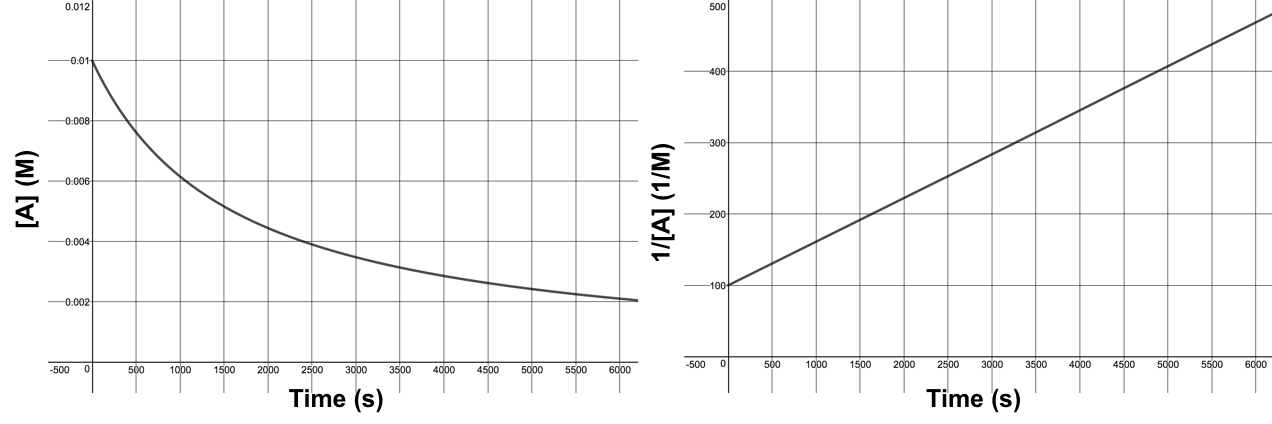
- for 2nd order: if we plot 1/[A] vs t we get a straight line with slope=ak
For each of the above integrated rate laws determine what will need to be plotted in order to obtain a straight line graph. What is the significance of the slope and y intercept? Remember that a straight line has the formula y = mx + b
0th order:
1st order:
2nd order:


First Order Reactions
- For first-order reactions, the differential rate law is:
- The integrated rate law for a first-order reaction is:
- The integrated rate law can be rearranged to a standard linear equation format:
- A plot of ln[A] versus t for a first-order reaction is a straight line with a slope of −k and an intercept of ln[A]0.

Second Order Reactions
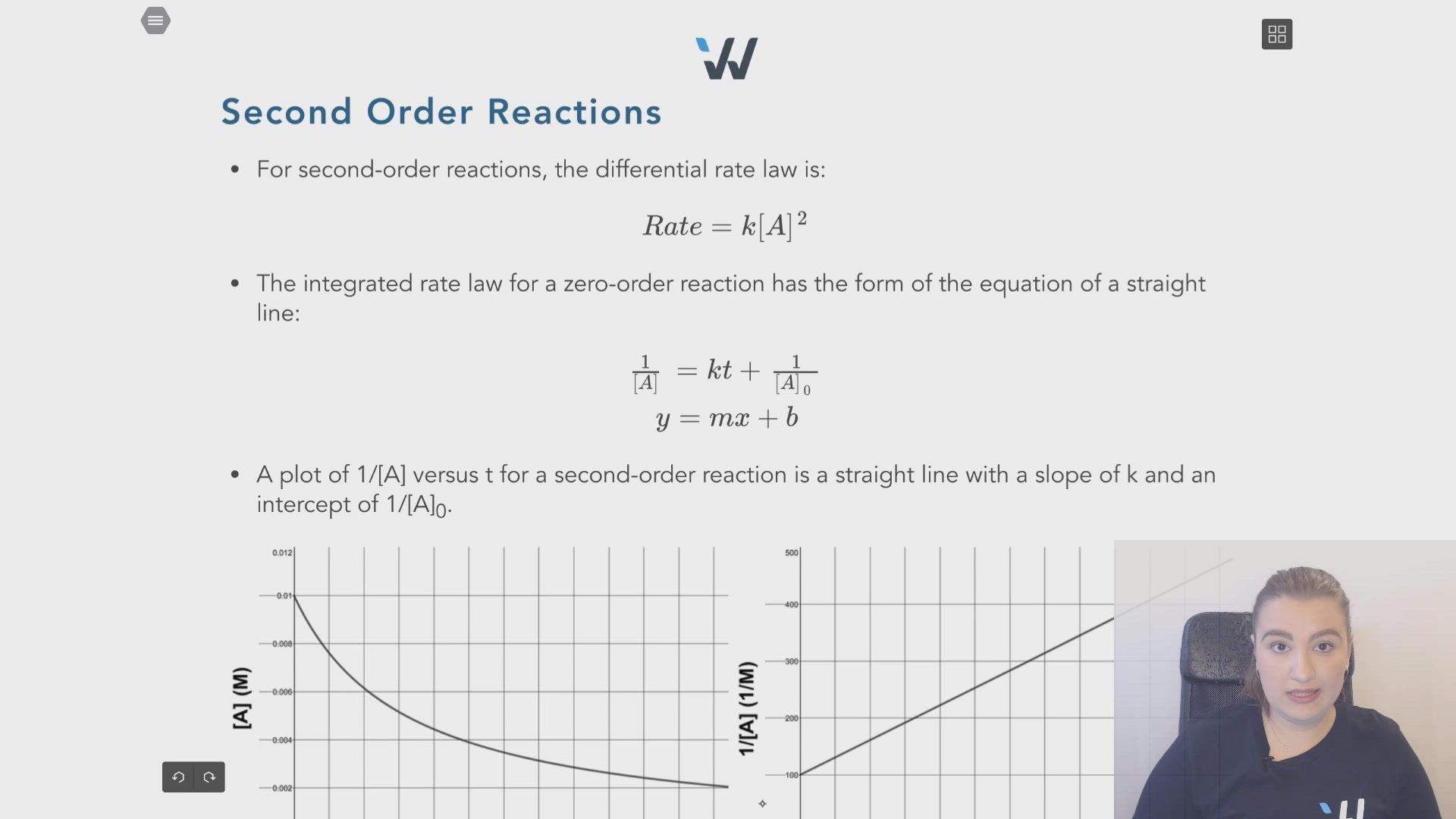
- For second-order reactions, the differential rate law is:
- The integrated rate law for a second-order reaction has the form of the equation of a straight line:
- A plot of 1/[A] versus t for a second-order reaction is a straight line with a slope of k and an intercept of 1/[A]0.