Wize University Chemistry Textbook > Kinetics
The Rate Law
Popular Courses
MCAT
General Course
Grade 12 Chemistry
Ontario High School
Grade 12 Chemistry
Canada High School
CHEM 1302A/B
Western University
General Chemistry
University Study Guides
AP Chemistry Exam Prep Course
AP Exam Prep
CHEM 112
Queen's University
CHEM 203
University of Calgary
High School Chemistry
US High School
DAT
General Course
CHM 1311
University of Ottawa
Chemistry
General Course
CHEM 1AA3
McMaster University
General Chemistry
University Study Guides
ENGG 204
University of Calgary
Chemistry 12
British Columbia High School
CHM135H1
University of Toronto
CHEM 154
University of British Columbia
CHEM 102
University of Alberta
CHEM 123
University of British Columbia

0:00 / 0:00
Rate Laws
- We can use inital reaction rates (using initial concentrations of reactants) to get an expression of the reaction rate called the rate law.
Wize Concept
It's important to be able to recognize the rate law!
- The rate law only includes reactants/products:reactants
- k is the rate constant
Watch Out!
We use x and y here because x and y are NOT the coefficients in the balanced equation!
The reaction order can't be determined from the overall balanced equation
a) We could determine the reaction order from experimental data
OR
b) We could determine the reaction order from a reaction mechanism (that shows elementary steps)
- We will take a look at both of these ways to figure out the order of the reaction next!

0:00 / 0:00
Determine the order of each reactant and the overall order for the following rate laws.
- 1st order in , 2nd order in , 3rd order overall
- 1st order in , 1st order overall
- half order in , 1st order in , 1.5 order overall
- 0 order reaction

0:00 / 0:00
Determining the Rate Law from Experimental Data
The reaction order can't be determined from the overall balanced equation
a) We could determine the reaction order from experimental data
OR
b) We could determine the reaction order from a reaction mechanism (that shows elementary steps)
Wize Tip
This method of finding the rate law is found on tests quite often!
Part 1: Use the rate data provided to determine an experimental rate law for the following reaction:

1) We'll write the general rate law expression:
2) Let's figure out what x would be (exponent for [BrO3-]):
(it doesn't matter which exponent we choose to solve for first!)
It makes sense to look at trials 1 and 2 because in these trials we have the concentration of this reactant doubling while the other reactants' concentrations stay the same. This means that whatever happens to the rate is because of [BrO3-]
[BrO3-] gets multiplied by 2 from trials 1 to 2.
The rate gets multiplied by 2 as well.
rate = k[BrO3-}x
2 = k[2]x
Therefore x = 1
rate = k[BrO3-][Br-]y[H+]z
3) Let's figure out what y would be (exponent for [Br-]):
It makes sense to look at trials 2 and 3 here because the concentrations of the other reactants aren't changing. As a result we know that any change in the concentration of Br- is solely responsible for any change in the rate of the reaction.
From trial 2 to 3 [Br-] gets multiplied by 2.
From trial 2 to 3, the rate gets multiplied by 2.
This means that y = 1
rate = k[BrO3-][Br-][H+]z
4) Let's figure out what z would be (exponent for [H+]):
Here, the easiest way to solve this problem would be to consider trials 1 and 4. This is because in trials 1 and 4 the concentration of the other reactants don't change, but the concentration of H+ doubles so any change we see in the rate is due to the change in concentration of H+!
From trial 1 to 4 we see that the rate gets multiplied by 4!
rate = k[H+]z
4 = k[H+]z
This means z = 2
5) Finally, we can write out the completed rate law:
Part 2: What is the overall reaction order?
To figure out the overall reaction order all we need to do is add up the exponents in the rate law:
1 + 1 + 2 = 4
Therefore the overall reaction order is 4.
Part 3: What is the rate constant?
To find k we can just substitute data in directly from the table with the experimental data.
We need the completed rate law and we can choose any trial to take #s from; choose the trial with the lowest numbers for easier calculations.
Here we'll use trial 1:
According trial 1, rate = 8.0 × 10⁻¹⁴, [BrO3–] = 0.1 M, [Br–] = 0.1 M, [H+] = 0.1 M
Now rearrange to solve for k (the rate constant):
k = 8
What about the units for k?
Recall rate has units:
M/s
And concentration has units:
M
Therefore, k has units M-3 s-1
Part 4: If we were asked to solve for the rate but were given k and the reactant concentrations for a trial, how would we do that?
rate = 8[BrO3-][Br-][H+]2
Plug in the k value and the concentration values for a trial into the rate law to solve for the rate!

0:00 / 0:00
Shortcut to Find Units of k Quicker
For 0th order: k has units M s-1
For 1st order: k has units s-1
For 2nd order: k has units M-1 s-1
Recognize a pattern?
What would the units for k be for a 3rd order reaction?
For 3rd order: k has units M-2 s-1
In summary, units of k will be: M1-n s-1
Low yield:
What if the answer options don't have M but instead have moles and L?
What would the units be for a 2nd order reaction for example?
Well M = mol/L
So for a 2nd order reaction, we know the units would be M-1 s-1
This is the same as writing:
Now let's substitute M for mol/L:
Which could be written as: Lmol-1s-1
Use the rate data provided to determine an experimental rate law for the following reaction. Solve for the rate constant, k, as well.

The following data was gathered for the reaction:
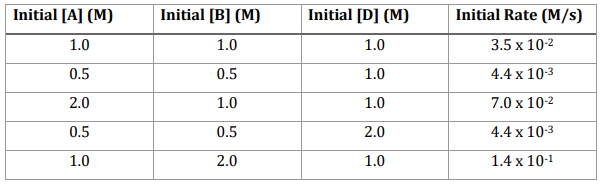
Find the rate law exponents and the rate constant for this reaction. Report your exponents as integers and your rate constant as a decimal to two significant figures without units in the answer field.
The reaction A + 2B → products was found to follow the rate law: rate = k[A]2[B]. Predict by what factor the rate of reaction will increase when the concentration of A is doubled, the concentration of B is tripled, and the temperature remains constant.
Suppose a gas-phase reaction has the rate law, rate = k[A][B]2 Which of the following could be the units for the rate constant, k?