Wize University Chemistry Textbook > Kinetics
Rate of Reaction
Popular Courses
MCAT
General Course
Grade 12 Chemistry
Ontario High School
Grade 12 Chemistry
Canada High School
CHEM 1302A/B
Western University
General Chemistry
University Study Guides
AP Chemistry Exam Prep Course
AP Exam Prep
CHEM 112
Queen's University
CHEM 203
University of Calgary
High School Chemistry
US High School
Chemistry 30
Alberta High School
DAT
General Course
CHM 1311
University of Ottawa
Chemistry
General Course
CHEM 1AA3
McMaster University
General Chemistry
University Study Guides
ENGG 204
University of Calgary
Chemistry 12
British Columbia High School
CHM135H1
University of Toronto
CHEM 154
University of British Columbia
CHEM 102
University of Alberta
0:00 / 0:00
Reaction Rates
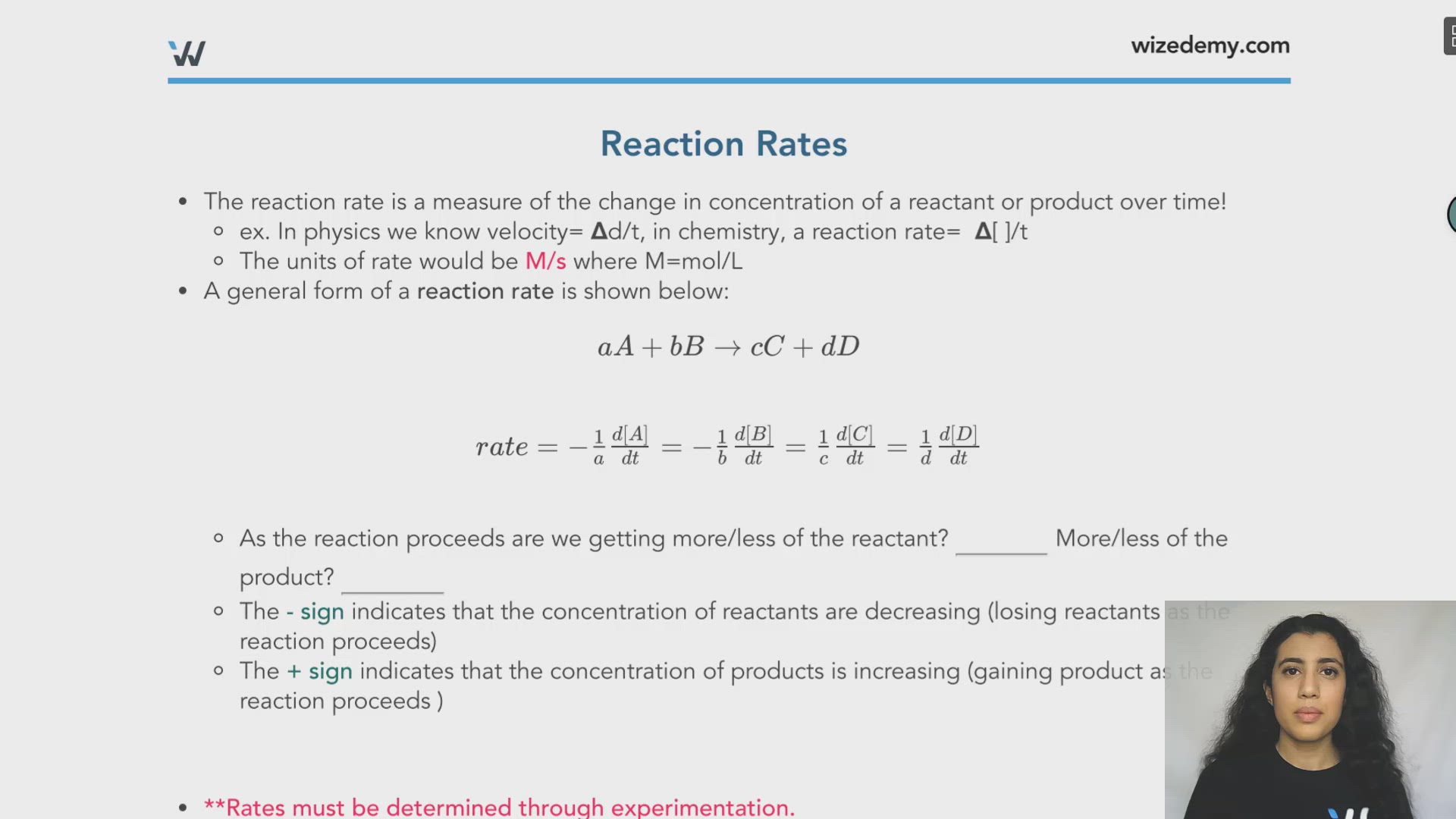
- The reaction rate is a measure of the change in concentration of a reactant or product over time!
- eg, in physics we know velocity = Δd/t, in chemistry, a reaction rate = Δ[ ]/t
- The units of rate would be M/s where M = mol/L
- A general form of a reaction rate is shown below:
- As the reaction proceeds are we getting more/less of the reactant?LessMore/less of the product?More
- The - sign indicates that the concentration of reactants are decreasing (losing reactants as the reaction proceeds)
- The + sign indicates that the concentration of products is increasing (gaining product as the reaction proceeds )
- **Rates must be determined through experimentation.
0:00 / 0:00
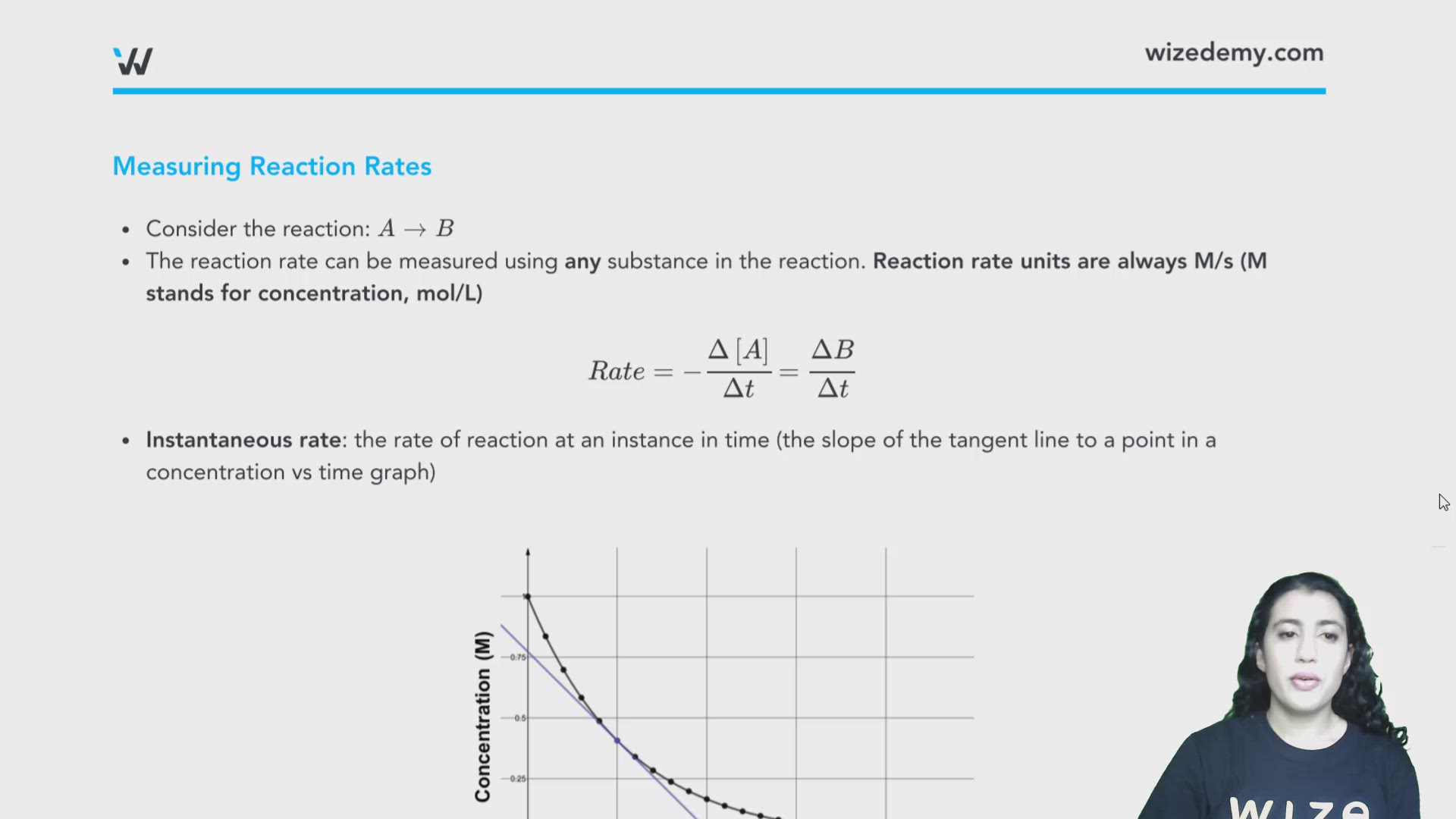
Measuring Reaction Rates
- Consider the reaction:
- The reaction rate can be measured using any substance in the reaction. Reaction rate units are always M/s (M stands for concentration, mol/L)
- Instantaneous rate: the rate of reaction at an instance in time (the slope of the tangent line to a point in a concentration vs time graph)
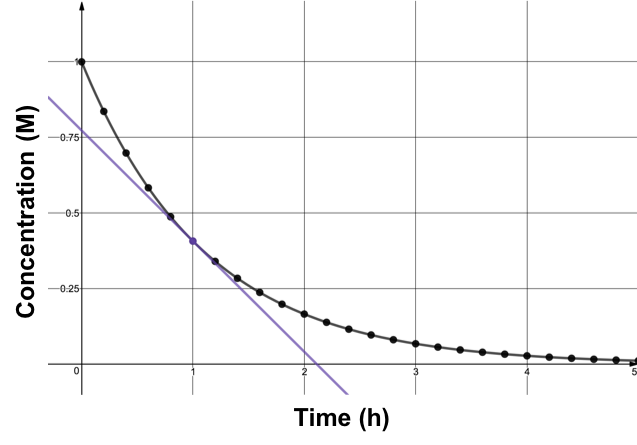
- Initial rate – instantaneous rate of a chemical reaction at t = 0, immediately after the reaction has begun

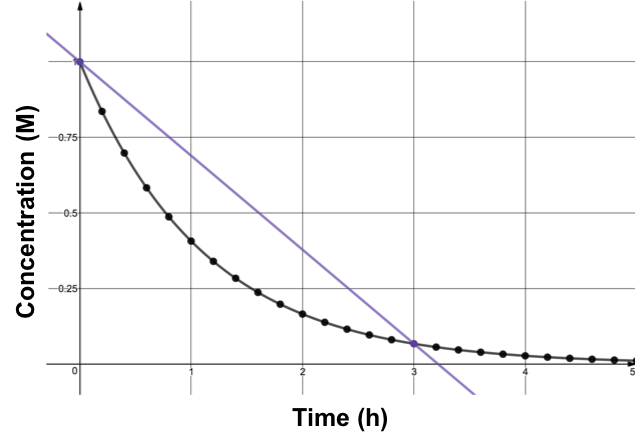
- Average rate: the rate of reaction over a period of time (the slope of the line connecting 2 points in a concentration vs time graph)
Practice: Rates of Reaction
If N2 is consumed at 2 M/s, what is the rate of production of NH3 and rate of consumption of H2 in the reaction?
In the following reaction the average rate of formation of NO(g) is 1.12 mol/Ls. If 2 minutes passes, what is the concentration of O2(g) that is consumed?
4 NH3(g) + 5O2(g) → 4 NO(g) + 6 H2O(g)