Wize University Chemistry Textbook > Kinetics
Integrated rate Laws
Popular Courses
CHEM 1302A/B
Western University
General Chemistry
University Study Guides
AP Chemistry Exam Prep Course
AP Exam Prep
CHEM 112
Queen's University
CHEM 203
University of Calgary
DAT
General Course
Chemistry
General Course
CHEM 1AA3
McMaster University
General Chemistry
University Study Guides
ENGG 204
University of Calgary
CHM135H1
University of Toronto
CHEM 154
University of British Columbia
CHEM 102
University of Alberta
CHEM 123
University of British Columbia
CHY 102
Toronto Metropolitan University
CHEM 120
McGill University
SC/CHEM 1001 3.00
York University
APSC 132
Queen's University
CHEM 112B
Queen's University
CHEM 102
University of Victoria

0:00 / 0:00
Integrated rate Laws
- gives [] of reactants and products at any time after the start of the reaction
- By integrating general rate equations we can obtain integrated rate laws. These laws allow us to predict the concentration of a species over the entire course of a reaction.
- The general form of the 0th, 1st, and 2nd order integrated rate laws are on your formula sheet and are also shown below. These equations are applied to a system which depends on the concentration of one species [A].
- Note your formula sheet has assumed that a = 1. Be very careful that if a does not equal 1 you remember to include it.
[A] is the concentration of a species at time, t.
[A0] is the initial concentration.
t is time in seconds!
- In order to determine if a reaction is 0th 1st or 2nd order in a substrate, scientists can plot [A] vs t
- in 0 order: [A] decreases in a linear fashion as t increases, slope=-ak (show how!)
- in 1st order: [A] decays exponentially with t, larger k will result infaster(slower/faster) decay, andshorter(shorter/longer) half life (see half life equation for 1st order to help: 1st order: t1/2=ln2/ak )
- but if you plot ln[A] vs t you will get a linear decline in [A] as t increases (this is how you can confirm it is 1st order!)
- this linear plot also has slope=-ak
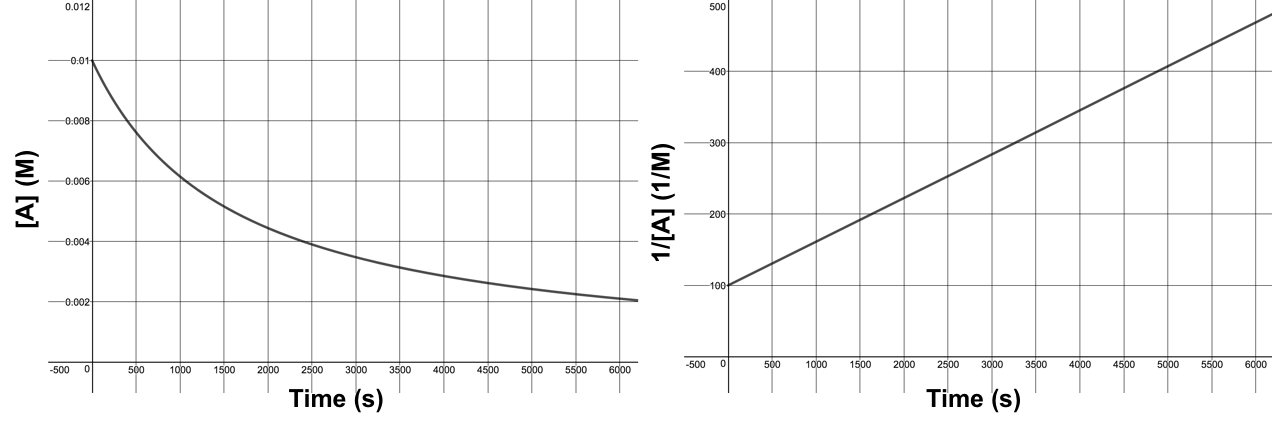
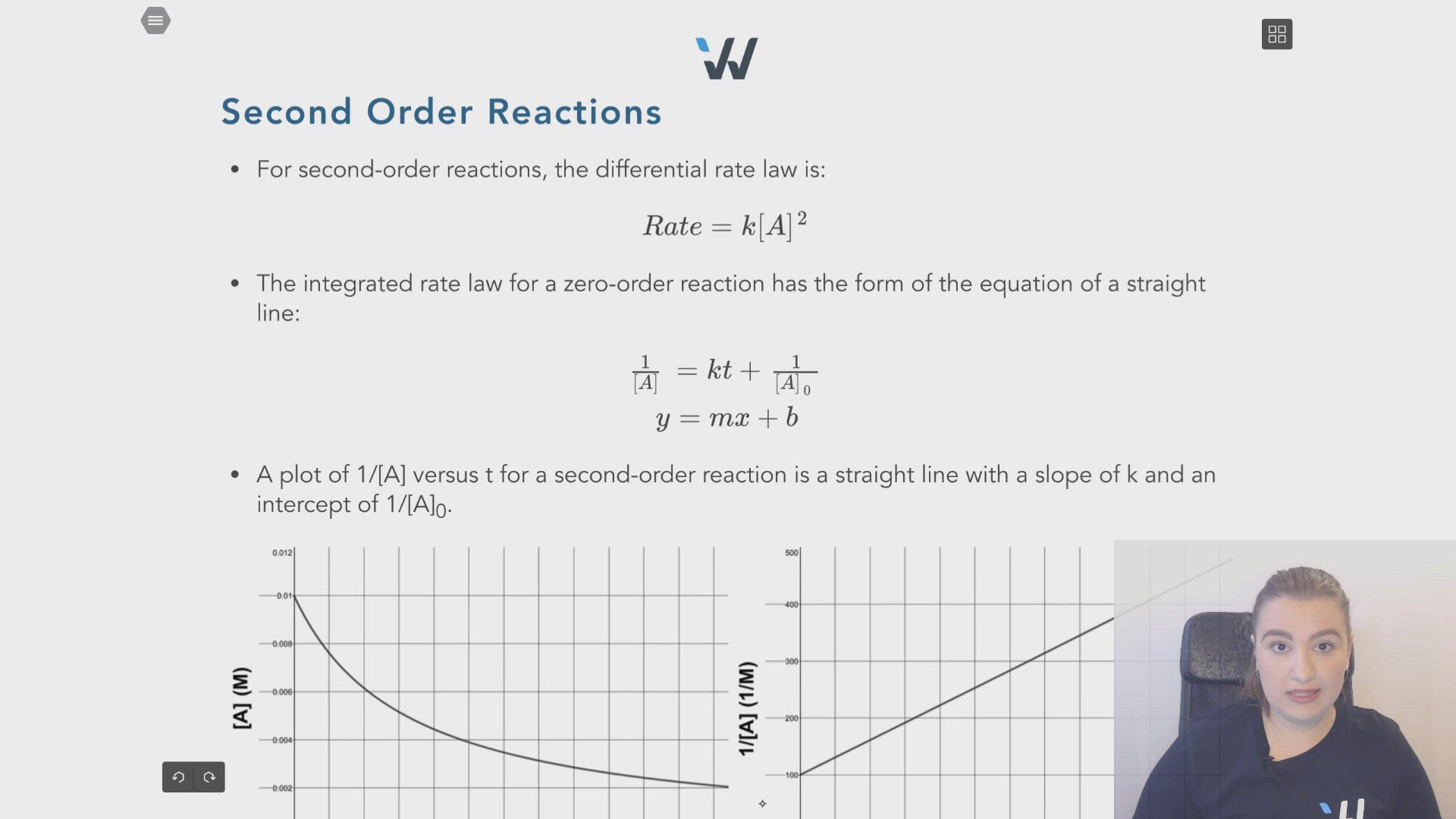
- for 2nd order: if we plot 1/[A] vs t we get a straight line with slope=ak
For each of the above integrated rate laws determine what will need to be plotted in order to obtain a straight line graph. What is the significance of the slope and y intercept? Remember that a straight line has the formula y = mx + b
0th order:
1st order:
2nd order:
N2O4 decomposes to NO2 in a first order process with a rate constant of 0.0007 s-1 . How long will it take for 75% of a sample of N2O4 to decompose?


0:00 / 0:00
First Order Reactions
- For first-order reactions, the differential rate law is:
- The integrated rate law for a first-order reaction is:
- The integrated rate law can be rearranged to a standard linear equation format:
- A plot of ln[A] versus t for a first-order reaction is a straight line with a slope of −k and an intercept of ln[A]0.

0:00 / 0:00
Second Order Reactions
- For second-order reactions, the differential rate law is:
- The integrated rate law for a second-order reaction has the form of the equation of a straight line:
- A plot of 1/[A] versus t for a second-order reaction is a straight line with a slope of k and an intercept of 1/[A]0.