Create a free account to get started

Unlock full course notes by signing up

  • Video lessons taught by top educators
  • Practice questions with guided solutions
  • Written review notes for reference
  • Expert answers anytime from course tutors

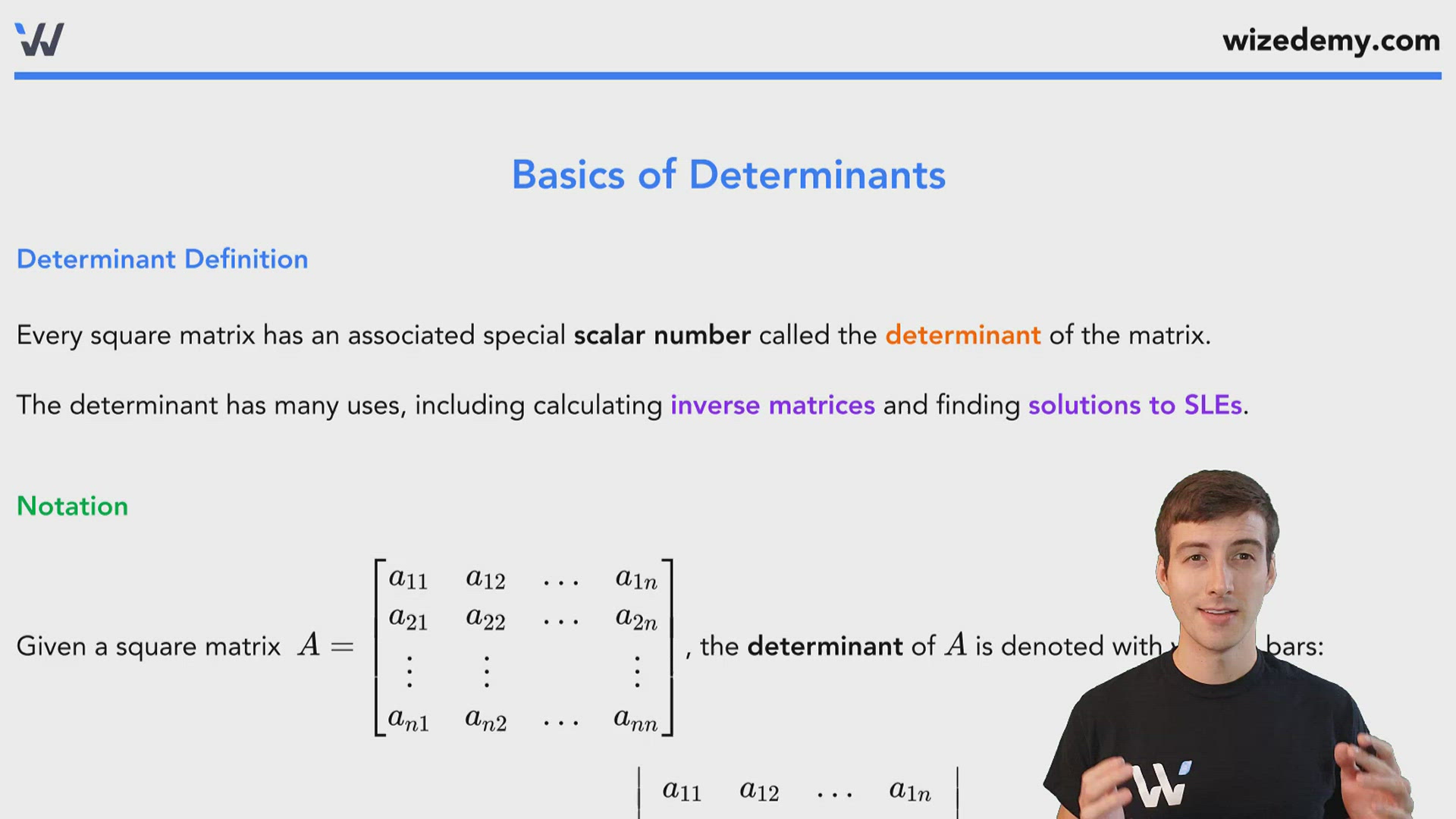
Basics of Determinants

Determinant Definition

Every square matrix has an associated special scalar number called the determinant of the matrix.

The determinant has many uses, including calculating inverse matrices and finding solutions to SLEs.

Notation

Given a square matrix A=[a11a12…a1na21a22…a2n⋮⋮⋮an1an2…ann]A = \begin{bmatrix} a_{11} & a_{12} & \dots & a_{1n}\\ a_{21} & a_{22} & \dots & a_{2n}\\ \vdots & \vdots & & \vdots\\ a_{n1} & a_{n2} & \dots & a_{nn}\\ \end{bmatrix} , the determinant of AA is denoted with vertical bars:

det(A)=∣a11a12…a1na21a22…a2n⋮⋮⋮an1an2…ann∣\detp{A} = \left \vert \begin{array}{cccc} a_{11} & a_{12} & \dots & a_{1n}\\ a_{21} & a_{22} & \dots & a_{2n}\\ \vdots & \vdots & & \vdots\\ a_{n1} & a_{n2} & \dots & a_{nn}\\ \end{array} \right\vert

Calculating Determinants of Small Matrices

  • 1×11\times1 matrix: det([ a ])=a\detp{[\ a\ ]}=a
  • 2×22\times2 matrix: det[abcd] = ∣abcd∣ = ad−bc{\rm det} \begin{bmatrix} a&b\\ c&d \end{bmatrix} \ =\ \left \vert \begin{array}{rr} a&b\\ c&d \end{array} \right \vert \ =\ ad-bc

Determinant Properties

Let An×nA_{n \times n} and  Bn×n\ B_{n \times n} be square matrices.

  • If AA has a zero row or zero column, then det(A)=0\detp{A}=0
  • If two rows or two columns are scalar multiples of one another, then det(A)=0\detp{A}=0
  • det(A)=det(AT)\detp{A}=\detp{A^T}
  • det(A−1)=1det(A)\detp{A^{-1}}=\dfrac{1}{\detp{A}}
  • det(cA)=cn det(A)\detp{cA}=c^n\ \detp{A}
  • det(AB)=det(A)⋅det(B)\detp{AB} = \detp{A} \cdot \detp{B}

Note: In general, det(A+B)≠det(A)+det(B)\detp{A+B} \colorTwo{\neq} \detp{A} + \detp{B}.

Triangular Matrices

  • Upper triangular matrix: all entries under the main diagonal are 0s. Example:[abc0de00f]\begin{bmatrix} \colorTwo a & \colorTwo b & \colorTwo c\\ 0 & \colorTwo d & \colorTwo e\\ 0 & 0 & \colorTwo f\\ \end{bmatrix}
  • Lower triangular matrix: all entries above the main diagonal are 0s. Example: [a00bc0def]\begin{bmatrix} \colorTwo a & 0& 0 \\ \colorTwo b & \colorTwo c &0\\ \colorTwo d & \colorTwo e & \colorTwo f\\ \end{bmatrix}
  • Diagonal matrix: both upper and lower triangular. All entries that are not on the main diagonal are 0s. Example: [a000b000c]\begin{bmatrix} \colorTwo a & 0 & 0\\ 0 & \colorTwo b &0\\ 0 & 0 & \colorTwo c\\ \end{bmatrix}

Create a free account to get started

Unlock full course notes by signing up

  • Video lessons taught by top educators
  • Practice questions with guided solutions
  • Written review notes for reference
  • Expert answers anytime from course tutors

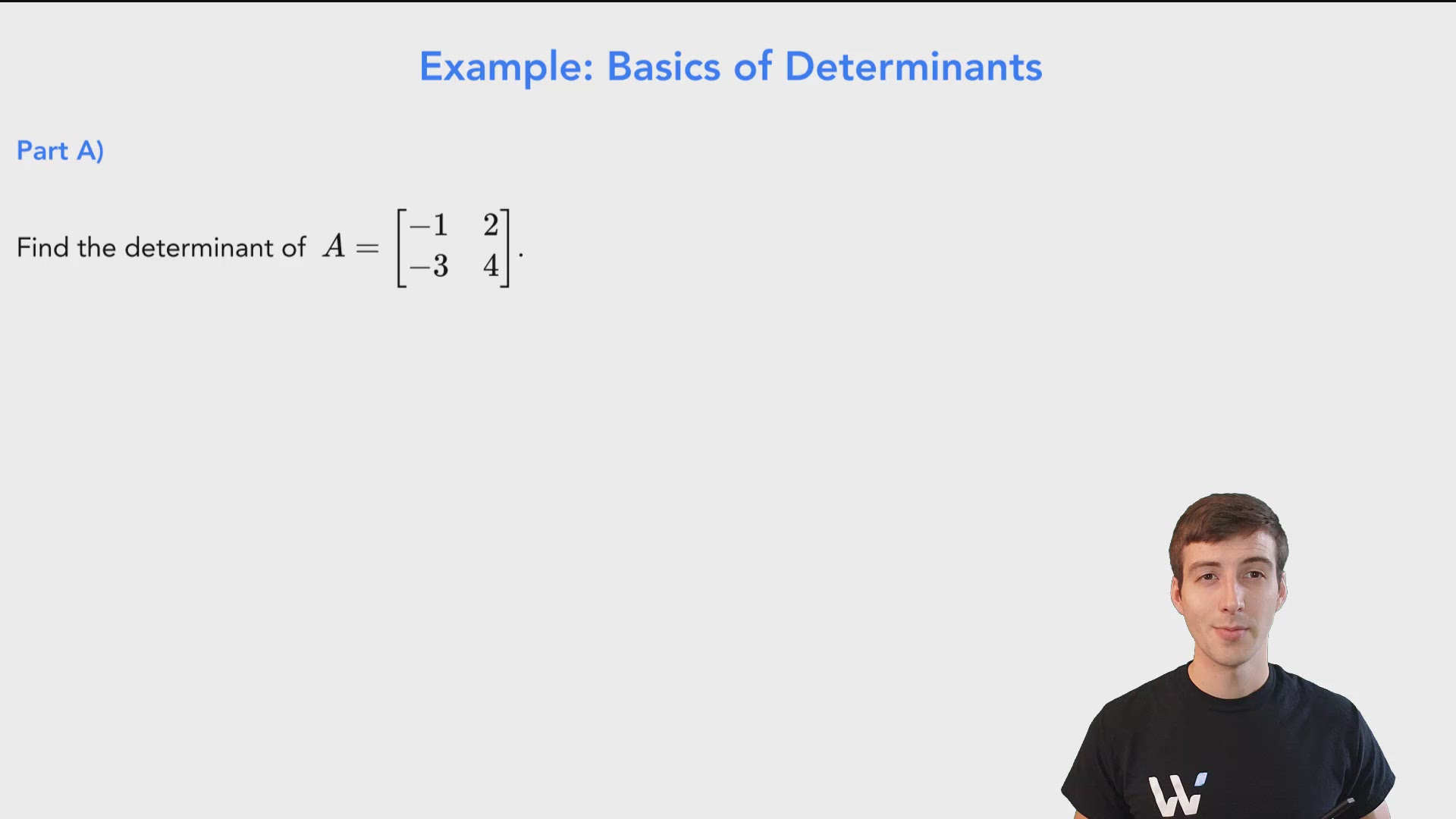
Example: Basics of Determinants

Part A)

Find the determinant of A=[−12−34]A=\begin{bmatrix} -1&2\\ -3&4 \end{bmatrix}.

det(A) = ad−bc = (−1)(4)−(2)(−3) = −4−(−6) = 2{\rm det}(A) \ =\ ad - bc \ =\ \left(−1\right)\left(4\right)−\left(2\right)\left(-3\right) \ =\ −4−\left(−6\right) \ =\ 2


Part B)

Find the determinant of B=[3007−5062−1]B= \left[\begin{array}{rrr} 3&0&0\\ 7&-5&0\\ 6&2&-1 \end{array}\right].

Notice that BB is lower triangular (0s above the main diagonal).

Then its determinant is the product of the diagonal entries.

det(B) = (3)(−5)(−1) = 15\detp{B} \ =\ (3)(-5)(-1) \ =\ 15


Part C)

Given C=[23−11]C= \left[ \begin{array}{rr} 2&3\\ -1&1 \end{array} \right] and D=[−331−1]D= \left[ \begin{array}{rr} -3&3\\ 1&-1 \end{array} \right], find det(3CD)\detp{3CD} without using matrix multiplication.


Using determinant properties:

  • det(3CD)=32⋅det(CD)\detp{3CD} = 3^2 \cdot\detp{CD}
  • Since the product CDCD is a 2×22 \times 2 matrix, we must raise the scalar to the power of 22.
  • det(CD)=det(C) det(D)\detp{CD} = \detp{C} \ \detp{D}

So we can compute:

det(3CD)=32⋅det(C)⋅det(D)=9⋅∣23−11∣⋅∣−331−1∣=9⋅[(2)(1)−(3)(−1)]⋅[(−3)(−1)−(3)(1)]=9⋅5⋅0=0\begin{aligned} \detp{3CD} &= 3^2\cdot \detp{C}\cdot\detp{D}\\[0.5em] &=9 \cdot \left\vert \begin{array}{rr} 2&3\\ -1&1 \end{array} \right\vert \cdot \left\vert \begin{array}{rr} -3&3\\ 1&-1 \end{array} \right\vert \\[1em] &=9 \cdot \big[(2)(1)-(3)(-1)\big]\cdot \big[(-3)(-1)-(3)(1)\big] \\[0.5em] &=9 \cdot 5 \cdot 0 \\[0.5em] &= 0 \end{aligned}

Note: det(D)=0\detp{D}=0 since it contains rows (and columns) that are scalar multiples of one another.


Let CC be an invertible matrix with det⁡C=3\det C = 3, and let B=[−2−1001000−5]B= \left[ \begin{array}{rrr} -2 & -1 & 0\\ 0 & 1 & 0\\ 0 & 0 & -5\\ \end{array} \right].

If A=C−1BCA = C^{-1}BC, calculate det⁡A\det A.


Choose an answer

Create a free account to get started

Unlock full course notes by signing up

  • Video lessons taught by top educators
  • Practice questions with guided solutions
  • Written review notes for reference
  • Expert answers anytime from course tutors

Answer the following true/false questions.


True or False?

Given A4×4A_{4 \times 4} and det⁡A=−3\det A = -3, then det(AT)=1det(A−1)\detp{A^T}=\dfrac{1}{\detp{A^{-1}}}.

Create a free account to get started

Unlock full course notes by signing up

  • Video lessons taught by top educators
  • Practice questions with guided solutions
  • Written review notes for reference
  • Expert answers anytime from course tutors

Extra Practice