Linear Momentum and Impulse
Linear Momentum
Linear Momentum (or simply Momentum) is defined as the product of mass and velocity of an object.
Momentum is a vector and measured in kg . m/s.
If a force is applied to an object, the Second law of Newton could be written in terms of change in momentum as follows:
Impulse
Impulse is defined as the change in the momentum of the object if a constant external force of F is applied to the object:
Momentum Conservation in 2D Collisions

Momentum is a vector. This means we always have to work with its and components separately, We'll have to write two equations, one for each direction.
Steps for solving a 2D momentum question:
- Draw a diagram of the velocities / momenta, and choose a system of coordinates.
- Split up all the velocities / momenta into and components.
- Write the equations of momentum conservation OR impulse (depending on the question) for each of the and directions.
- Algebraically combine your equations to solve for the unknown.
Example: Fireworks
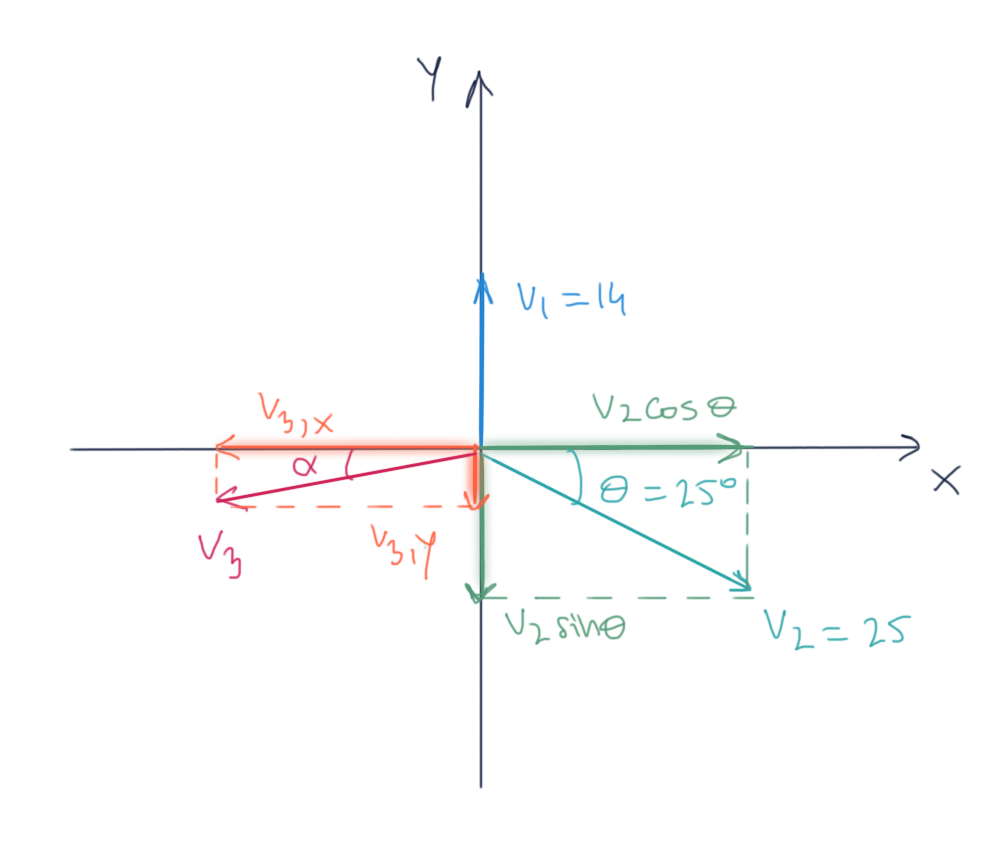
A firework explodes and forms three fragments of equal mass. One fragment travels directly upward at m/s and the second fragment moves at m/s at below the horizontal to the right. Determine the velocity of the third fragment immediately after the explosion.
- Assume the firework was at rest before the explosion, so the initial momentum is zero.
- The firework explodes into 3 fragments of equal mass, let's call them .
Velocities:

Conservation of momentum:
Horizontal direction:
Therefore, we have the velocity of the 3rd piece in the direction:
(m/s)
(that is, to the left)
Vertical direction:
Therefore, we have the velocity of the 3rd piece in the direction:
(m/s)
(that is, downwards)
Find the resultant velocity:
(m/s)
Find the direction:
* it should be: tan^-1 (3.43/22.66)
(below the horizontal, to the left)