Electrochemistry: Reduction potential application

Reduction Potentials Application

  • Below we see a diagram showing mitochondrial cellular respiration.
  • If we just consider the electron carrier NADH, NADH molecules gives up their electrons to the first complex, then the electron goes to the 2nd complex, then the 3rd, then the 4th and finally oxygen (O2) is the final electron acceptor.
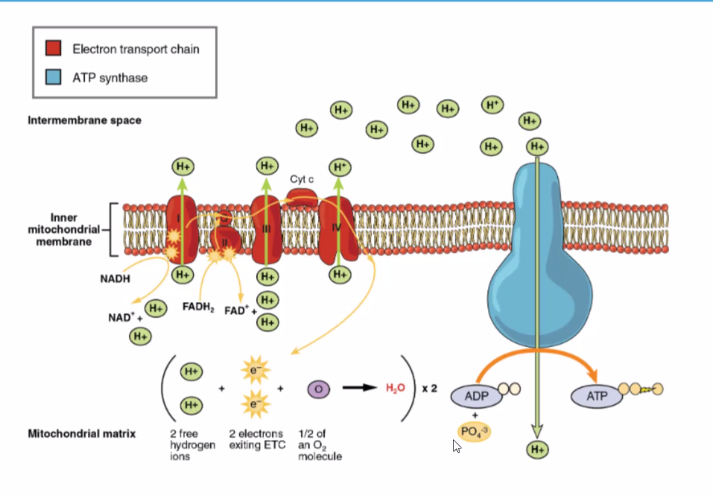

  • Order NADH, complex 1, complex 2, complex 3, complex 4, and O2 in order of increasing reduction potential:
  • First think: does increasing reduction potential means that it wants electrons more or less?
  • Order:

  • Which one is the strongest reducing agent?
  • Which one is the strongest oxidizing agent?
  • Which one would have the highest reduction potential?
  • Which one would have the highest oxidation potential?
More Redox Reactions Questions:
More Reduction Potentials Questions:
(Duplicated)
Use the standard reduction potentials below to answer the following question: which species listed is the strongest oxidizing agent?
Reduction halfβˆ’reactionEΒ°(V)πΆπ‘Ž2+(π‘Žπ‘ž)+2π‘’βˆ’β‡ŒπΆπ‘Ž(𝑠)βˆ’2.87π‘π‘Ž+(π‘Žπ‘ž)+π‘’βˆ’β‡Œπ‘π‘Ž(𝑠)βˆ’2.71𝐴𝑙3+(π‘Žπ‘ž)+3π‘’βˆ’β‡Œπ΄π‘™(𝑠)βˆ’1.66𝑀𝑛2+(π‘Žπ‘ž)+2π‘’βˆ’β‡Œπ‘€π‘›(𝑠)βˆ’1.18𝐢𝑒2+(π‘Žπ‘ž)+2π‘’βˆ’β‡ŒπΆπ‘’(𝑠)+0.15𝐴𝑔+(π‘Žπ‘ž)+π‘’βˆ’β‡Œπ΄π‘”(𝑠)+0.80\begin{array}{c:c}\rm Reduction\ half-reaction& EΒ° (V)\\ \hline πΆπ‘Ž^{2+} (π‘Žπ‘ž)+2 𝑒^βˆ’β‡ŒπΆπ‘Ž (𝑠)& -2.87\\ \hline π‘π‘Ž^+ (π‘Žπ‘ž)+𝑒^βˆ’β‡Œπ‘π‘Ž (𝑠)&-2.71\\ \hline 𝐴𝑙^{3+} (π‘Žπ‘ž)+3 𝑒^βˆ’β‡Œπ΄π‘™(𝑠) &-1.66\\ \hline 𝑀𝑛^{2+} (π‘Žπ‘ž)+2 𝑒^βˆ’β‡Œπ‘€π‘› (𝑠)&-1.18\\ \hline 𝐢𝑒^{2+} (π‘Žπ‘ž)+2 𝑒^βˆ’ β‡ŒπΆπ‘’ (𝑠) &+0.15\\ \hline 𝐴𝑔^+ (π‘Žπ‘ž)+𝑒^βˆ’ β‡Œπ΄π‘” (𝑠)&+0.80\end{array}
Electrochemistry: Reduction potentials in a Galvanic Cell
Use the standard reduction potentials below to answer the following question: which metal could be used to create a sacrificial anode for an aluminum pipe?
Reduction halfβˆ’reactionEΒ°(V)πΆπ‘Ž2+(π‘Žπ‘ž)+2π‘’βˆ’β‡ŒπΆπ‘Ž(𝑠)βˆ’2.87π‘π‘Ž+(π‘Žπ‘ž)+π‘’βˆ’β‡Œπ‘π‘Ž(𝑠)βˆ’2.71𝐴𝑙3+(π‘Žπ‘ž)+3π‘’βˆ’β‡Œπ΄π‘™(𝑠)βˆ’1.66𝑀𝑛2+(π‘Žπ‘ž)+2π‘’βˆ’β‡Œπ‘€π‘›(𝑠)βˆ’1.18𝐢𝑒2+(π‘Žπ‘ž)+2π‘’βˆ’β‡ŒπΆπ‘’(𝑠)+0.15𝐴𝑔+(π‘Žπ‘ž)+π‘’βˆ’β‡Œπ΄π‘”(𝑠)+0.80\begin{array}{c:c}\rm Reduction\ half-reaction& EΒ° (V)\\ \hline πΆπ‘Ž^{2+} (π‘Žπ‘ž)+2 𝑒^βˆ’β‡ŒπΆπ‘Ž (𝑠)& -2.87\\ \hline π‘π‘Ž^+ (π‘Žπ‘ž)+𝑒^βˆ’β‡Œπ‘π‘Ž (𝑠)&-2.71\\ \hline 𝐴𝑙^{3+} (π‘Žπ‘ž)+3 𝑒^βˆ’β‡Œπ΄π‘™(𝑠) &-1.66\\ \hline 𝑀𝑛^{2+} (π‘Žπ‘ž)+2 𝑒^βˆ’β‡Œπ‘€π‘› (𝑠)&-1.18\\ \hline 𝐢𝑒^{2+} (π‘Žπ‘ž)+2 𝑒^βˆ’ β‡ŒπΆπ‘’ (𝑠) &+0.15\\ \hline 𝐴𝑔^+ (π‘Žπ‘ž)+𝑒^βˆ’ β‡Œπ΄π‘” (𝑠)&+0.80\end{array}
Use the standard reduction potentials below to answer the following question: which metal could be used as an anode for an aluminum pipe?
Reduction halfβˆ’reactionEΒ°(V)πΆπ‘Ž2+(π‘Žπ‘ž)+2π‘’βˆ’β‡ŒπΆπ‘Ž(𝑠)βˆ’2.87π‘π‘Ž+(π‘Žπ‘ž)+π‘’βˆ’β‡Œπ‘π‘Ž(𝑠)βˆ’2.71𝐴𝑙3+(π‘Žπ‘ž)+3π‘’βˆ’β‡Œπ΄π‘™(𝑠)βˆ’1.66𝑀𝑛2+(π‘Žπ‘ž)+2π‘’βˆ’β‡Œπ‘€π‘›(𝑠)βˆ’1.18𝐢𝑒2+(π‘Žπ‘ž)+2π‘’βˆ’β‡ŒπΆπ‘’(𝑠)+0.15𝐴𝑔+(π‘Žπ‘ž)+π‘’βˆ’β‡Œπ΄π‘”(𝑠)+0.80\begin{array}{c:c}\rm Reduction\ half-reaction& EΒ° (V)\\ \hline πΆπ‘Ž^{2+} (π‘Žπ‘ž)+2 𝑒^βˆ’β‡ŒπΆπ‘Ž (𝑠)& -2.87\\ \hline π‘π‘Ž^+ (π‘Žπ‘ž)+𝑒^βˆ’β‡Œπ‘π‘Ž (𝑠)&-2.71\\ \hline 𝐴𝑙^{3+} (π‘Žπ‘ž)+3 𝑒^βˆ’β‡Œπ΄π‘™(𝑠) &-1.66\\ \hline 𝑀𝑛^{2+} (π‘Žπ‘ž)+2 𝑒^βˆ’β‡Œπ‘€π‘› (𝑠)&-1.18\\ \hline 𝐢𝑒^{2+} (π‘Žπ‘ž)+2 𝑒^βˆ’ β‡ŒπΆπ‘’ (𝑠) &+0.15\\ \hline 𝐴𝑔^+ (π‘Žπ‘ž)+𝑒^βˆ’ β‡Œπ΄π‘” (𝑠)&+0.80\end{array}