Wize High School Grade 12 Chemistry Textbook > Electrochemistry
Reduction Potentials

0:00 / 0:00
Reduction Potentials
- Each half reaction has a potential.
- For example, the first half reaction below has a reduction potential of -3.05V!
- We got these potentials from measuring the voltage when the other half reaction was the reference electrode (H 0V)
- In the table below, are the reactions showing reductions or oxidations?reductions
- Therefore, these arereductionpotentials!
- If we flip a reaction, the Eo potential changes signs
- let's do this for the first half reaction in the table so it is clear:
Li(s) --> Li+(aq) + e- Eo=3.05
- Is this reaction now describing reduction or oxidation?oxidation!
- So do you think the potential written would now be a reduction or oxidation potential?oxidationpotential
- In general:
- If we see a more positive reduction potential:
- It means something is more likely to be oxidized/reduced:reduced
- and will act as a(n) reducing/oxidizing agent:oxidizingagent
- If we see a more negative reduction potential:
- It means something is more likely to be oxidized/reduced:oxidized
- and will act as a(n) reducing/oxidizing agent:reducingagent

Based on this table, answer the following questions:
1) What is the strongest oxidizing agent?
F2(g)
2) What is the weakest reducing agent?
F-(aq)
3) What is the strongest reducing agent?
Li(s)

0:00 / 0:00
Reduction Potentials Application
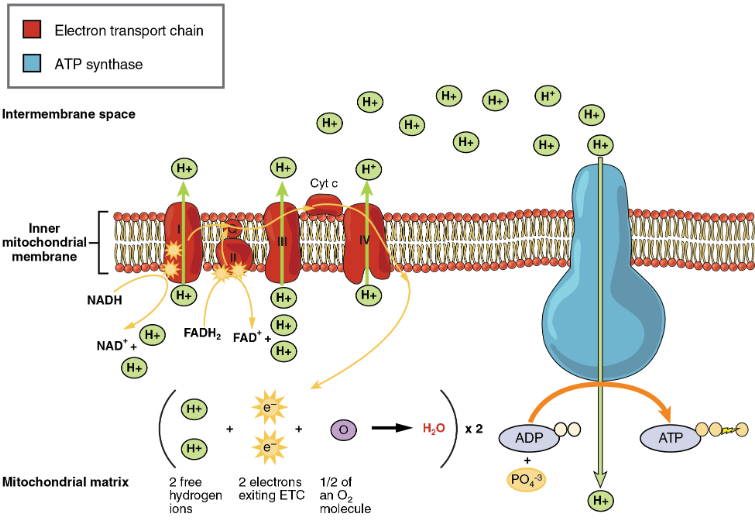
- Below we see a diagram showing mitochondrial cellular respiration.
- If we just consider the electron carrier NADH:
- NADH molecules gives up their electrons to the first complex, then the electron goes to the 2nd complex, then the 3rd, then the 4th and finally oxygen is the final electron acceptor.
- Order NADH, complex 1, complex 2, complex 3, complex 4, and oxygen in order of increasing reduction potential:
- First think: does increasing reduction potential means that it wants electrons more or less?more
- Order:
- Which one is the strongest reducing agent?NADH
- Which one is the strongest oxidizing agent?O2
- Which one would have the highest reduction potential?O2
- Which one would have the highest oxidation potential?NADH
- NADH < complex 1 < complex 2 < complex 3 < complex 4 < O2
0:00 / 0:00
How Potentials Relate to Spontaneity
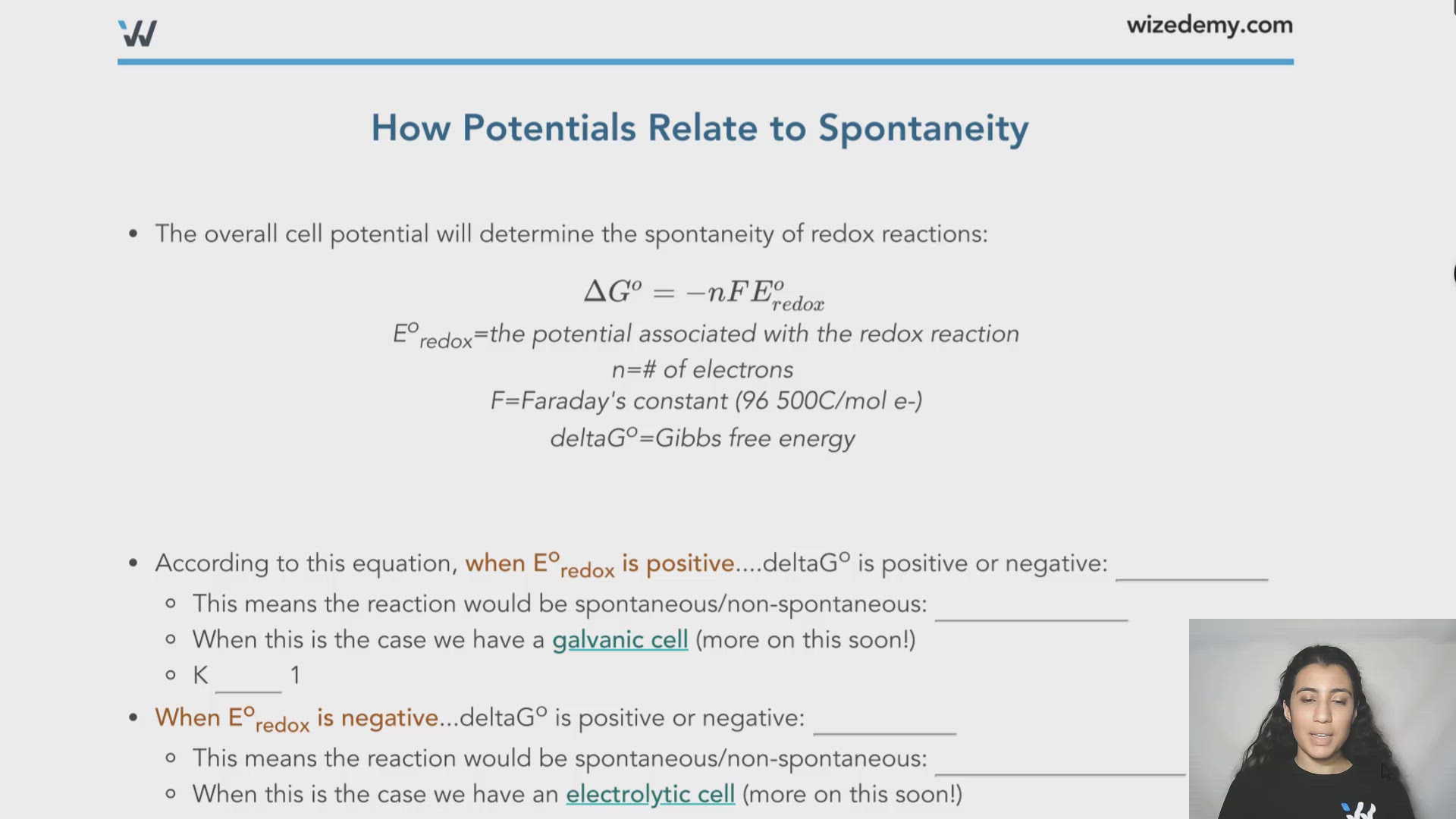
- The overall cell potential will determine the spontaneity of redox reactions:
Eoredox = potential associated with a redox reaction
n = # of electrons
F = Faraday's constant (96 500C/mol e–)
ΔG° = Gibbs free energy
- According to this equation, when E°redox is positive, is ΔG° positive or negative?negative
- This means the reaction would be spontaneous/nonspontaneous:spontaneous
- When this is the case we have a galvanic cell (more on this soon!)
- K>1
- When E°redox is negative, is ΔG° positive or negative?positive
- This means the reaction would be spontaneous/nonspontaneous:non-spontaneous
- When this is the case we have an electrolytic cell (more on this soon!)
- K<1
Apply: If we had the following overall reaction, would it be spontaneous or not?
Zn(s) + Cu2+(aq) → Zn2+(aq) + Cu(s)
1) Let's write out the oxidation and reduction half reactions:
a) Oxidation half reaction:
Zn(s) --> Zn2+(aq) + 2 e-
b) Reduction half reaction:
Cu2+(aq) + 2 e- --> Cu(s)
2) Given the above reactions that are occuring, write out an oxidation potential and a reduction potential using the table values below:
From the table:
Zn2+ (aq) + 2 e– → Zn(s) E° = –0.76 V
Cu2+(aq) + 2 e– → Cu(s) E° = +0.34 V
For us,
Zn(s)
is being oxidized, so E°ox = +0.76
(changes sign)And
Cu2+(aq)
is being reduced, so E°red = +0.34V
(stays the same)3) Solve for E°redox:
E°redox = 0.76 V + 0.34 V
E°redox = 1.10 V
4) Figure out if the reaction is spontaneous using this equation:
- Our E°redox value is positive/negative:positive
- This means our ΔG° value is positive/negative:negative
- Therefore, the reaction is spontaneous/nonspontaneous:spontaneous
0:00 / 0:00
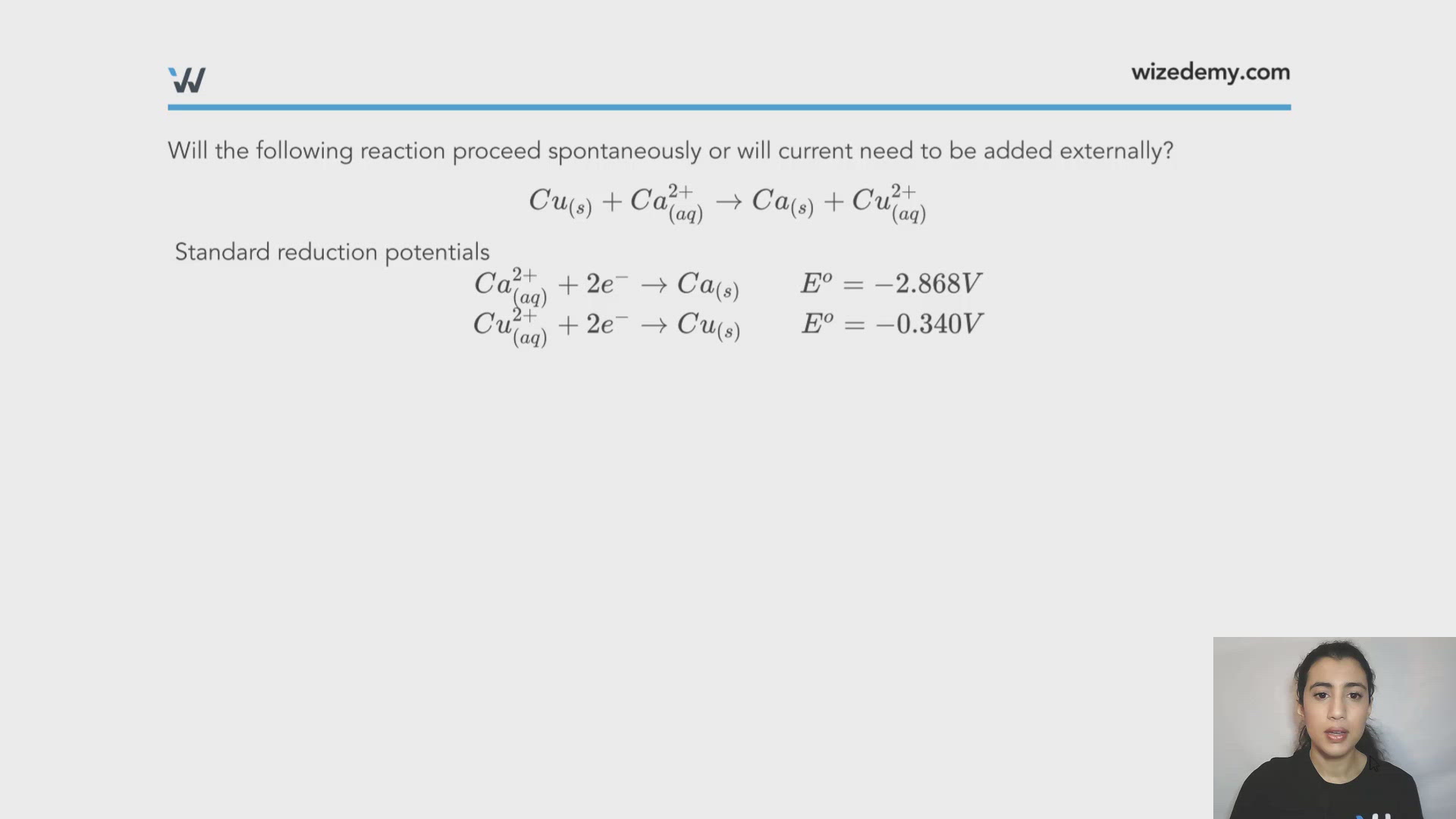
Will the following reaction proceed spontaneously or will current need to be added externally?
Standard reduction potentials
- For reaction 1: -2.868 V stays the same since that equation is not flipped.
- For reaction 2: we get 0.340 V since that equation is flipped according to the overall equation.
- For the Erxn = -2.868 + 0.340 = -2.528 (doing the full calculation isn't necessary since we just need to figure out the sign of E to tell us about the sign of G)
- We know E is negative now, so deltaG would be positive.
- The electromotive force (E) is negative so this reaction would be non-spontaneous. We would have to apply at least 2.528 V to force this reaction to proceed ie, current needs to be added externally.
Based on the following reduction potentials, which of these species is the strongest reducing agent?