
0:00 / 0:00
Galvanic/Voltaic Cells
- A galvanic cell constructed of two half cells is shown below.
- Before we take a deeper look, let's review what we already know about galvanic cells:
- Do galvanic cells have spontaneous or non-spontaneous electron flow?spontaneous
- Is the Go positive or negative?negative
- According to the equation deltaGo=-nFEoredox then is the Eoredox positive or negative?positive
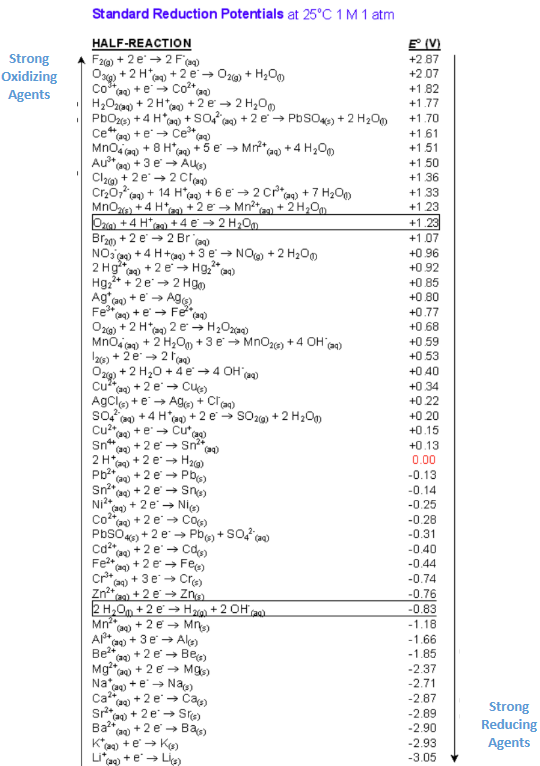
- Let's take a look at our 2 half reactions from the table again:
Zn2+ (aq) + 2e- -> Zn(s) Eo= -0.76V
Cu2+(aq) + 2e- -> Cu(s) Eo= +0.34V
- In order to get an Eoredox that is positive, we needed to flip the Zn(s) equation:
Zn(s) -> Zn2+ (aq) + 2e- Eoox=+0.76
Cu2+(aq) + 2e- -> Cu(s) Eored=+0.34
Eoredox=1.1V (you might see the Eocell be referred to as the electromotive force or emf, they mean the same thing!)
Now let's label the galvanic cell...

1) Which is the reduction half equation and which is the oxidation half reaction?
2) Using the following "Wize Concept,"label the anode and cathode in the above diagram.
Wize Concept
The anode is always where oxidation happens.
The cathode is always where reduction happens.
There are different ways to remember this. One way is to remember that anode and oxidation both start with vowels, while cathode and reduction both start with consonants. The other way to remember this is: An Ox Red Cat! Pick your favourite way :)
3) Show where the ions are moving (into solution/onto electrode)
4) Which electrode is shrinking? Which is growing?
5) Consider the salt bridge. Let's say it's made of KCl. Which half cell would the K+ ions travel to? Which half cell would the Cl- ions travel to?
Wize Concept
Anions of the salt bridge move to the anodic solution
Cations of the salt bridge move to the cathodic solution.
This helps to complete the circuit and prevent charges from building up by keeping the solution neutral.
6) Draw the direction of electron flow.
- Analogy: Running out of your last exam! Everyone is running in the same direction and to where they want to go (outside of the school!)
Wize Tip
Since the anode is always where oxidation happens and the cathode is always where reduction happens, then electrons will always flow from the anode to the cathode!
7) Write in the charges (+ or -) for each electrode.
Wize Concept
Since galvanic cells involve spontaneous electron flow, electrons will travel to where they want to go!
Electrons will always go from the anode to the cathode.
But here, since it's spontaneous flow it means that the cathode will have a positive charge (electrons want to go here) and the anode will have a negative charge (electrons want to get away from here!)
We will see how this is different for electrolytic cells...
8) Write in the spectator ions (in this case it is SO42-, you might also see NO3- in other cases).
- These ions are called "spectator" ions because that's all they are doing...spectating! They don't participate in the actual reaction, but help to balance charges!
In a galvanic cell, oxidation occurs at the:
Which of the following is true about a galvanic cell?

Mark Yourself Question
- Grab a piece of paper and try this problem yourself.
- When you're done, check the "I have answered this question" box below.
- View the solution and report whether you got it right or wrong.
Construct a galvanic cell with the highest voltage given the following half reactions. Determine the voltage produced and express it in standard cell notation.
For a galvanic cell with Na/Na+ and Cu/Cu2+ answer the following questions.
Which element is being oxidized?
0:00 / 0:00
Spontaneity Rule
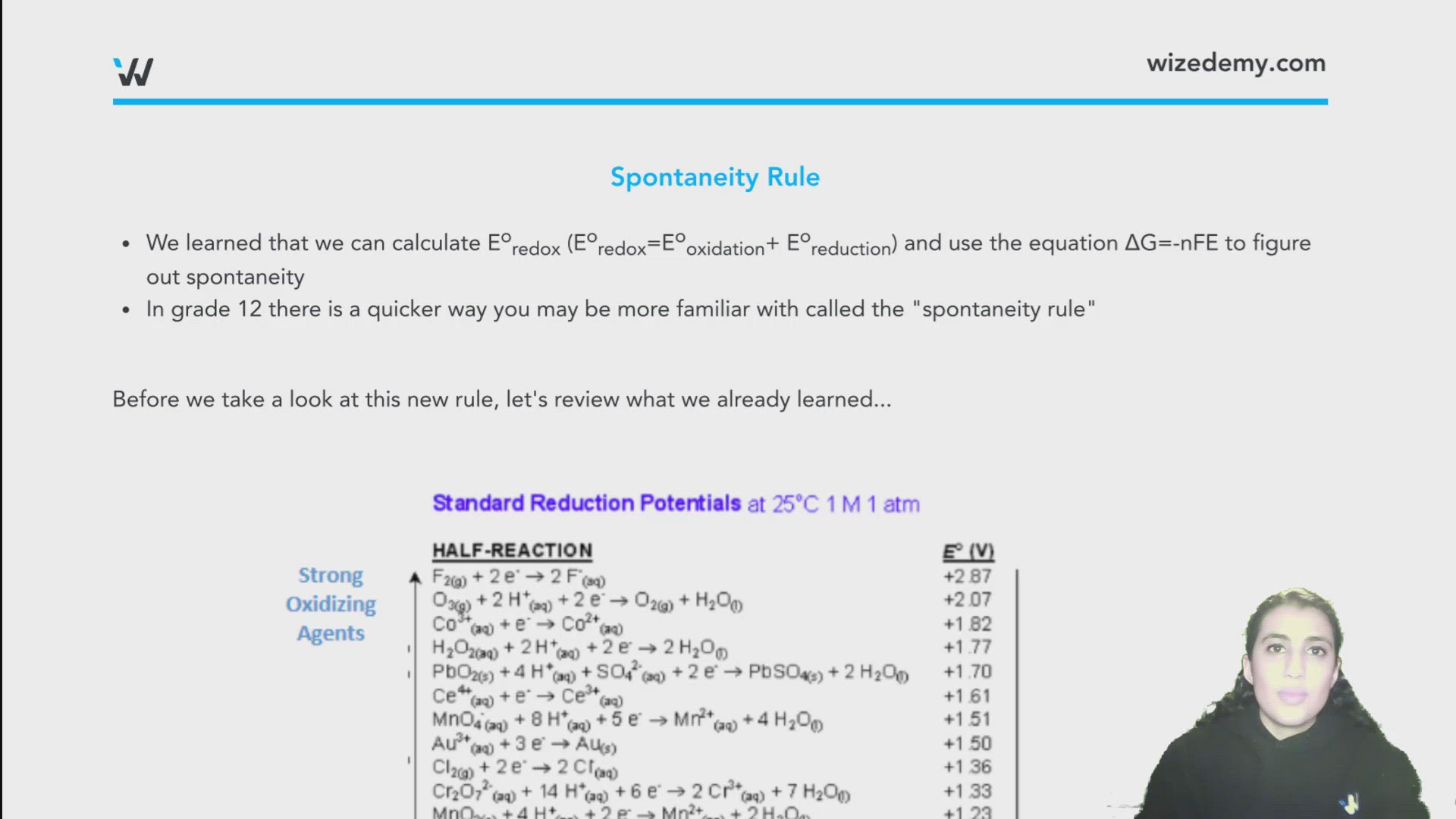
- We learned that we can calculate Eoredox (Eoredox=Eooxidation+ Eoreduction) and use the equation ΔG=-nFE to figure out spontaneity
- In grade 12 there is a quicker way you may be more familiar with called the "spontaneity rule"
Before we take a look at this new rule, let's review what we already learned...

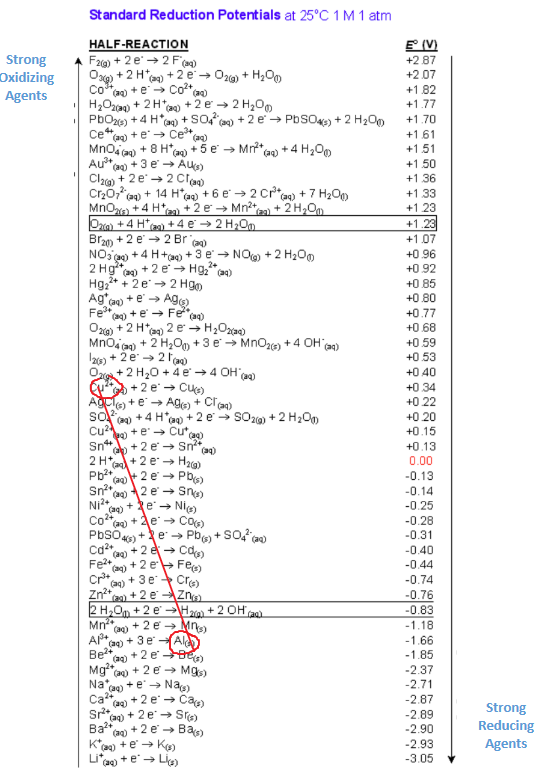
Question: Can solid aluminum and aqueous copper (II) sulphate react?
- Find the Eored values in the table:
- Al3+(aq) + 3e- --> Al(s) Eored=-1.66V
- Cu2+(aq) + 2e- --> Cu(s) Eored=0.34V
Flip the equation with aluminum since Al(s) is supposed to be a reactant:
- Al(s) --> Al3+(aq) + 3e- Eoox=+1.66V
- Cu2+(aq) + 2e- --> Eored=0.34V
Calculate Eoredox=Eoox + Eored
Eoredox=1.66 + 0.34V
Eoredox=2V
Since Eoredox is positive, we know the reaction is spontaneous and so these will react!
Now, let's use the spontaneity rule to arrive at the same answer:
According to the spontaneity rule, any strong reducing agent + strong oxidizing agent will be able to react spontaneously (so a reaction will occur!)
Determine if the following reactions will occur or not.
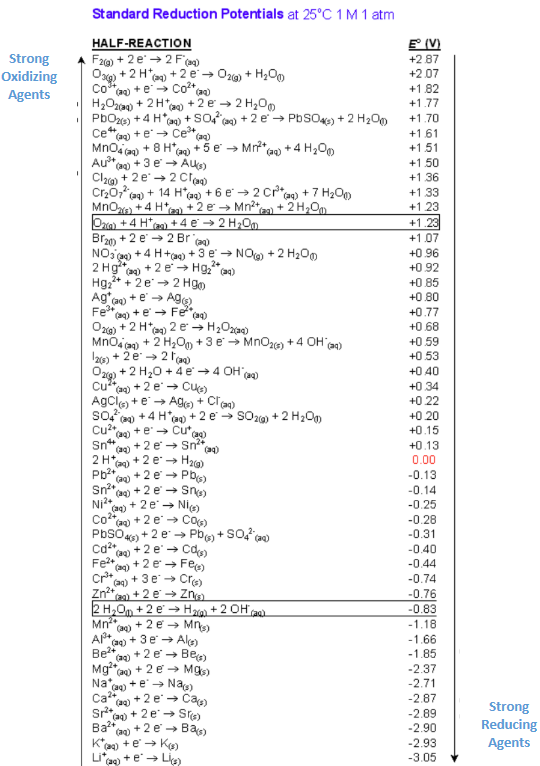
Will the reaction occur between aqueous calcium nitrate and solid nickel?