Wize AP Biology Textbook > The Cell Cycle
Control of Cell Cycle
Popular Courses
Find My Course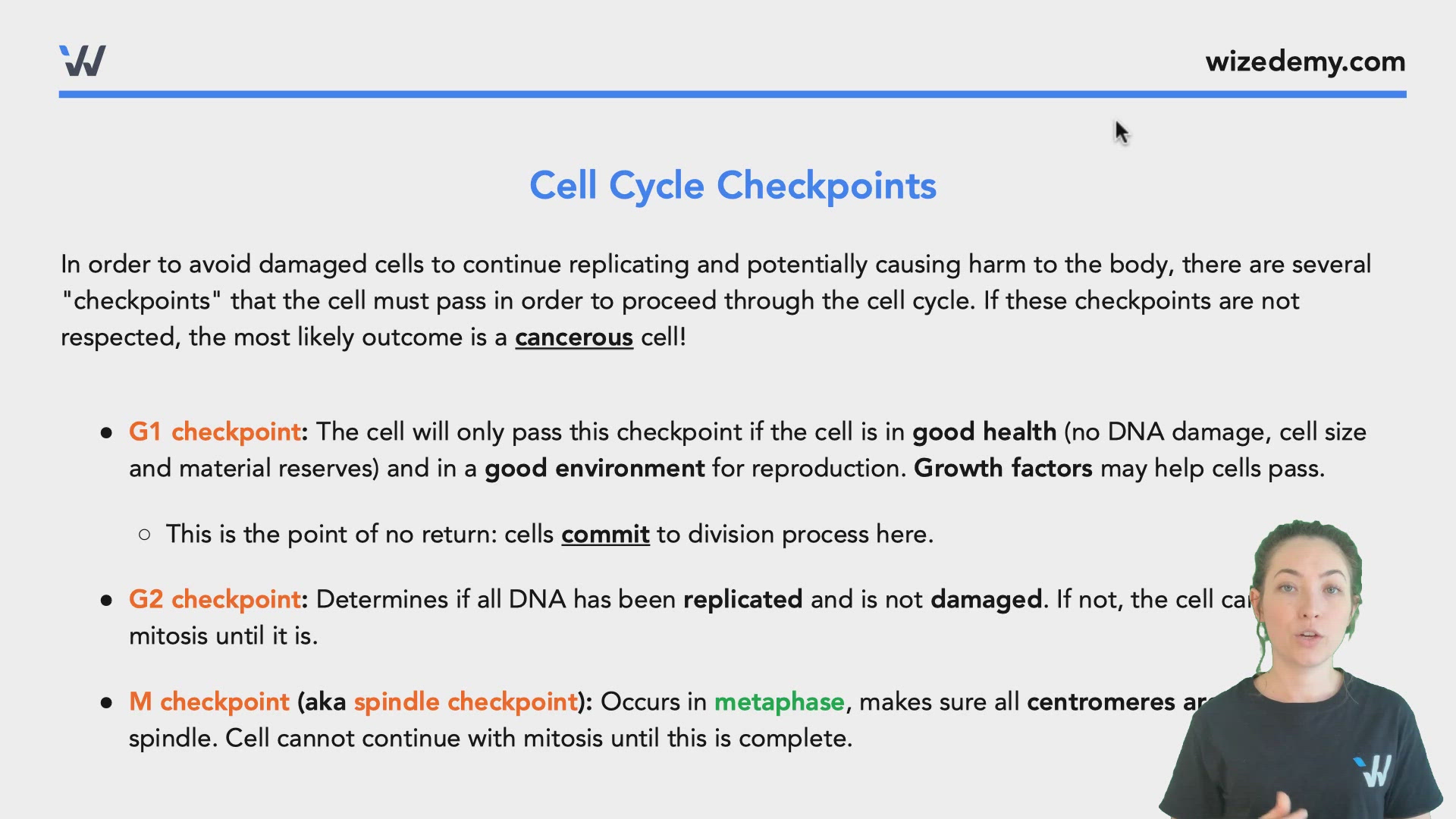
0:00 / 0:00
Cell Cycle Checkpoints
In order to avoid damaged cells to continue replicating and potentially causing harm to the body, there are several "checkpoints" that the cell must pass in order to proceed through the cell cycle. If these checkpoints are not respected, the most likely outcome is a cancerous cell!
- G1 checkpoint: The cell will only pass this checkpoint if the cell is in good health (no DNA damage, cell size and material reserves) and in a good environment for reproduction. Growth factors may help cells pass.
- This is the point of no return: cells commit to division process here.
- G2 checkpoint: Determines if all DNA has been replicated and is not damaged. If not, the cell can't enter mitosis until it is.
- M checkpoint (aka spindle checkpoint): Occurs in metaphase, makes sure all centromeres are “attached” to spindle. Cell cannot continue with mitosis until this is complete.
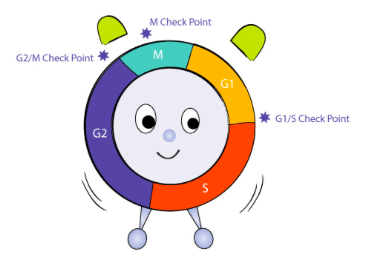
How does the cell "pass" or "fail" a checkpoint?
If necessary conditions are not met (i.e. the checkpoint is failed), the cell will produce a signal to change protein regulation within the cell and inhibit proteins needed to move to the next phase.
Molecules that Regulate the Cell Cycle
Progression through the cell cycle is dependent on two main proteins:
- Cyclins: Proteins that bind to and activate Cdks.
- Concentration of these proteins rise and fall in a cyclical fashion.
- Increase in concentration results from increased transcription.
- Decrease in concentration results from targeted proteolysis.
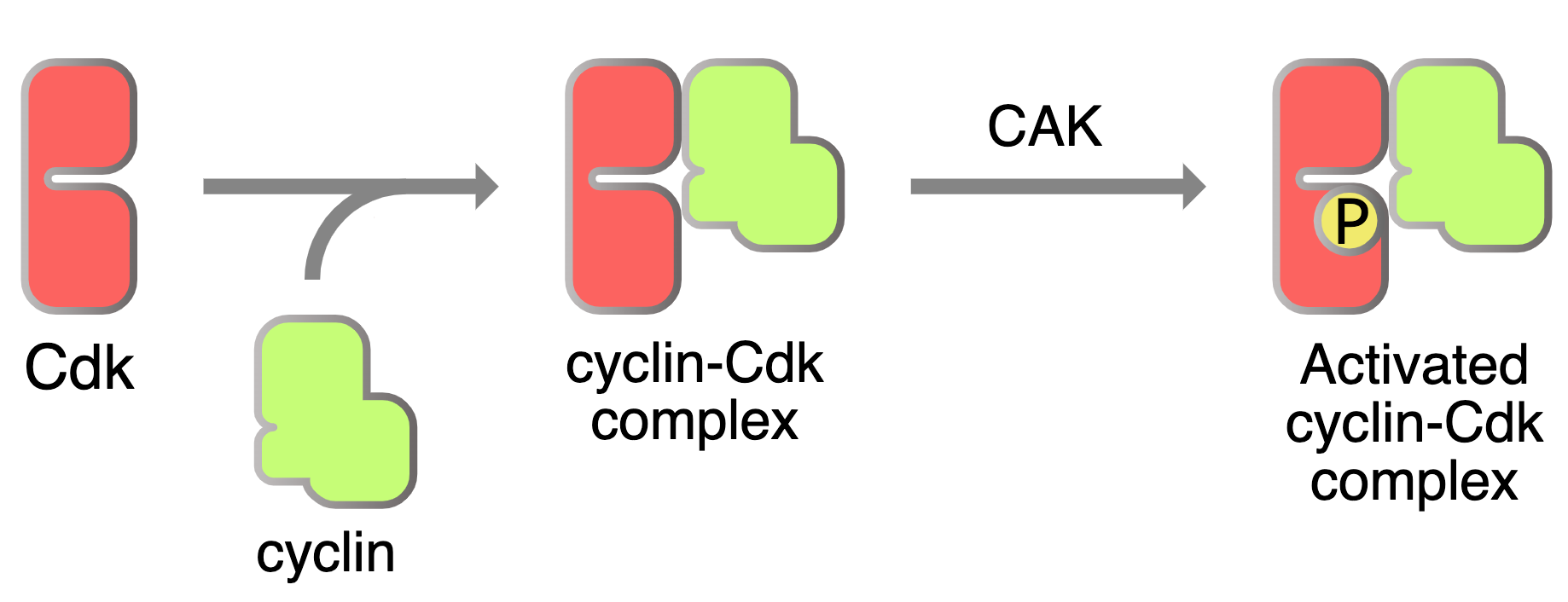
- Cyclin-dependent kinases (Cdks): enzymes that phosphorylate other proteins involved in the cell cycle.
- Phosphorylation status regulates the activity of various proteins.
- There is a unique cyclin-Cdk pair for each phase of the cell cycle.
- When the pair forms, the cyclin-Cdk complex can phosphorylate proteins that help cells advance stages of the cell cycle.
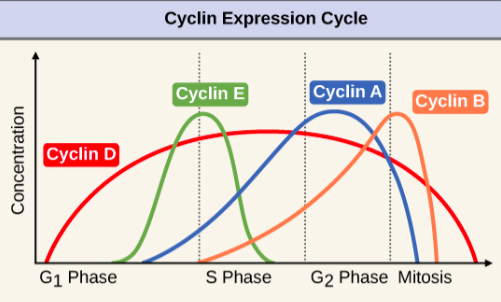
Depending on where the cell cycle is in its cycle, different cyclins will be produced. There are 4 main types of Cdk's that regulate the cell cycle. They are each made by attaching a different cyclin to a Cdk.
- G1-Cdk: Made from Cdk and cyclin D.
- G1/S-Cdk: Made from Cdk and cyclin E.
- S-Cdk: Made from Cdk and cyclin A.
- M-Cdk: Made from Cdk and cyclin B.
Wize Concept
Mitogens are extracellular signals that promote progression from G1 to S phase by stimulating synthesis of G1 cyclins, G1/S cyclins, and other proteins associated with DNA replication. Be careful though, overproduction of these can lead to cancer.
0:00 / 0:00
Putting the Breaks on the Cell Cycle
By adding or removing cyclins from the cell, we can control what stage of the cell cycle the cell remains in. There are 2 main ways to control these cyclins:
- Changing the concentration of the cyclins: if they are removed, they cannot bind to Cdk and it will be inactive.
- Adding or removing cyclin inhibitors: molecules that halt the cell cycle.
- p53 - "guardian of the genome."
- A transcription factor protein that is activated when DNA is damaged. Once active, it binds to DNA altering transcription.
- Halts cells at G1/S.
- Allows for production of Cdk inhibitor proteins so the cell cycle is stopped at a checkpoint (different checkpoints depending on the inhibitor made). Examples: p21, p27, p16.
- Can trigger apoptosis if repairs cannot be made.
- p21
- Rises when p53 also rises to reinforce its breaks on cell cycle progression.
- Directly inhibits Cdk/cyclin complexes.
- Retinoblastoma (Rb)
- Monitors cell size.
- Inhibits transcription factors (E2F) that enable production of proteins for G1/S phase progression.
- Phosphorylation of Rb causes it to dissociate from E2F, allowing for progression of the cell cycle.

Wize Concept
All three of these molecules are called tumor suppressor genes. They are key to prevent cells from forming tumors due to uncontrolled division leading to cancer.
0:00 / 0:00
Example: Cell Cycle
When cell extract from Xenopus (frog) eggs in S-phase is injected into a cell in G1, the G1 cell enters S-phase. Explain why this happens.
Solution:
The extract from the S-phase cell contains active S-cyclin/Cdk complexes. These remain activated even when they are injected into the G1 cell. Once in the G1 cell, S-cyclin/Cdk activates DNA helicase and other proteins required for DNA replication.
Practice: Only Certain Cdks Present
What would happen if S-Cdk was present during mitosis initiation but M-Cdk was not?
Practice: Checkpoint Function
Which of the following is not correctly matched with its function?