Wize AP Biology Textbook > The Cell Cycle
Mitotic Phase of Cell Cycle
Popular Courses
Find My Course
0:00 / 0:00
Mitotic Phase
Mitosis (M Phase) is the part of the cell cycle in which a cell divides into two identical daughter cells, which are genetically identical to each other as well as the "mother" cell.
- Recall that the M Phase of the cell cycle can be subdivided into mitosis and cytokinesis.
- The first portion is also called karyokinesis, which literally just means division of the nuclear contents.
- The second portion, cytokinesis, means separation of the cytoplasmic components into two daughter cells.
- Most of the cell division in our bodies occurs through mitosis.
- Mitosis is for growth, and to replace old and dying cells.
Wize Tip
Remember that "-kinesis" just means motion.
Phases of Mitosis
- Prophase
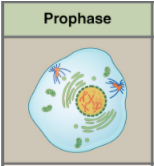
- Chromosomes start to condense.
- Centrosome begins to form the mitotic spindle structure composed of microtubules which organize chromosomes and move them to the appropriate locations during mitosis.
- The spindle gets longer as the centrosomes move to opposite poles of the cell.
- The nucleolus disappears and nuclear envelope breaks down.
- Prometaphase
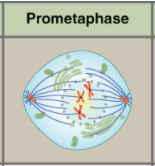
- Chromosomes continue to further condense.
- The mitotic spindle grows and begin to attach to the kinetochore of the chromosomes' centromere.
- The kinetochore is a protein located at the centromere of the sister chromatids.
- Metaphase
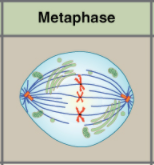
- Chromosomes align at the metaphase plate (also sometimes called the equatorial plane).
- The two kinetochores of each chromosome (one for each sister chromatid) are attached to microtubules – each attached to an opposite centrosome.
- Maximal condensation of chromosomes, but chromatids are still attached to one another.
Wize Tip
Chromatids align like the stars in order for the cell to divide... that's so meta!
- Anaphase
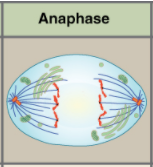
- Sister chromatids separate and are pulled towards opposite ends of the cell towards the two centrosomes.
- Now they are each one chromosome!
- The microtubules that are not attached to chromosomes push apart, causing the cell to elongate and the poles to move away from each other.
- Telophase
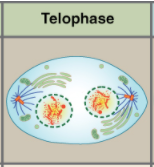
- The mitotic spindle is broken down into tubulin monomers that will form the cytoskeleton of daughter cells.
- Chromosomes start to decondense.
- Nuclear envelope begins to form.
Wize Tip
Cells are telling each other good bye!

0:00 / 0:00
Cytokinesis
This is sometimes seen as the second stage of M phase. Is very different for animals and plants.
- Physical separation of cytoplasmic components occurs in this phase.
- Usually starts to occur in late anaphase or telophase.
In animal cells
- The cell "pinches in" at the metaphase plate due to a band of filaments that act like a drawstring. These filaments are composed of a protein called actin.
- The pinching forms a crease called the cleavage furrow.
- Two daughter cells are formed when cytokinesis is complete.
In plant cells
- Remember that plants have cell walls, composed of cellulose, so a new one must form between the daughter cells.
- Vesicles formed from the Golgi apparatus that contain the components necessary for this process (e.g. glucose) go to the metaphase plate.
- A cell plate forms down the middle, splitting the cell into two and forming a cell wall between them.

Practice 1: Number of Chromosomes and Chromatids
Complete the following table based on a cell that is 2n = 12.
| # Chromosomes | # Chromatids | # DNA strands | |
| G1 Phase | |||
| G2 Phase | |||
| Metaphase | |||
| Anaphase | |||
| After cytokinesis (per cell) |
Practice: Lack of Actin
A human cell has received a mutation and is unable to produce actin. What would be the result after mitosis?
Practice: Chromosomes and Chromatid Number
If a cell contained 4 chromosomes during prophase, how many chromosomes and chromatids would it have during prometaphase?
Practice: Chromosomes During Metaphase and Anaphase
Dogs are . A somatic dog cell undergoes mitosis. How many chromosomes are there during metaphase and anaphase, respectively?