Wize AP Biology Textbook > DNA Replication & Repair
Repair of DNA Mutations
0:00 / 0:00
Repair of Mutations During Replication
When the cellular machinery is working to replicate a DNA strand, errors can occur. When this occurs, it is called a mutation. Types of mutations include:
- Point mutations (base-pair substitutions);
- Insertion and deletion mutations (addition or removal of base pairs).
DNA Polymerase Exonuclease Activity
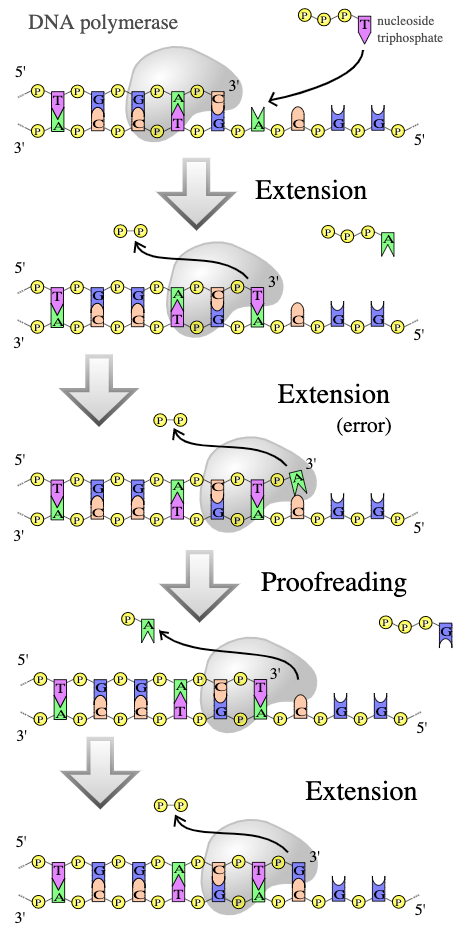
In addition to catalyzing the polymerization of a new strand of DNA, DNA polymerase III can proofread the newly synthesized strand and correct mistakes. This is used to prevent mutations from staying in the DNA and being passed on to daughter cells.
- It can do so due to its exonuclease activity. This means that it can break phosphodiester bonds to correct mistakes.
- Synthesizes 5' -> 3'
- Corrects 3' -> 5'
- It can recognize improper placements of bases by detecting changes in geometry of improper base pairing as it polymerizes the complementary strand.
Wize Concept
Exonucleases are enzymes that cut nucleotide chains at either the 5' or 3' end.
Endonucleases are enzymes that cut bonds of nucleotides within a chain.
DNA Mismatch Repair
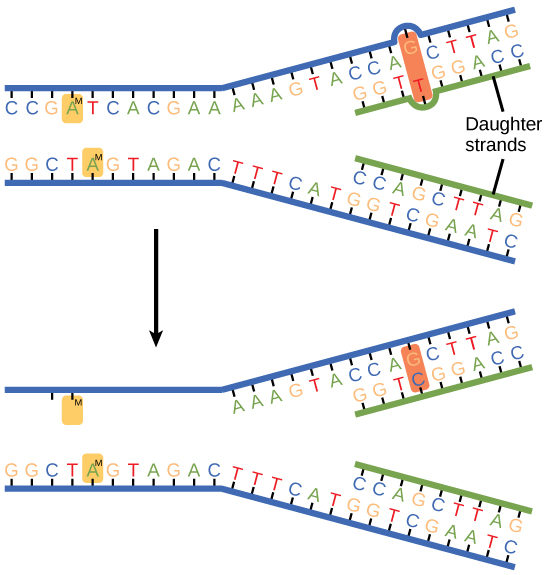
If DNA Polymerase does not correct mismatched bases during DNA polymerization, other mechanisms are in place to prevent those mutations from prevailing.
- Specific DNA repair enzymes (endonucleases) recognize the incorrect geometry and repair the DNA by excising the incorrect nucleotide.
- The gap is filled in later by DNA polymerase.
- The nick is sealed by DNA ligase.
- There are mechanisms in place to enable these enzymes to know which strand is the parental versus daughter strands.
- In bacteria, the parent strand usually has methylated adenines.

0:00 / 0:00
Repair of Mutations by Mutagens
Nucleotide Excision Repair
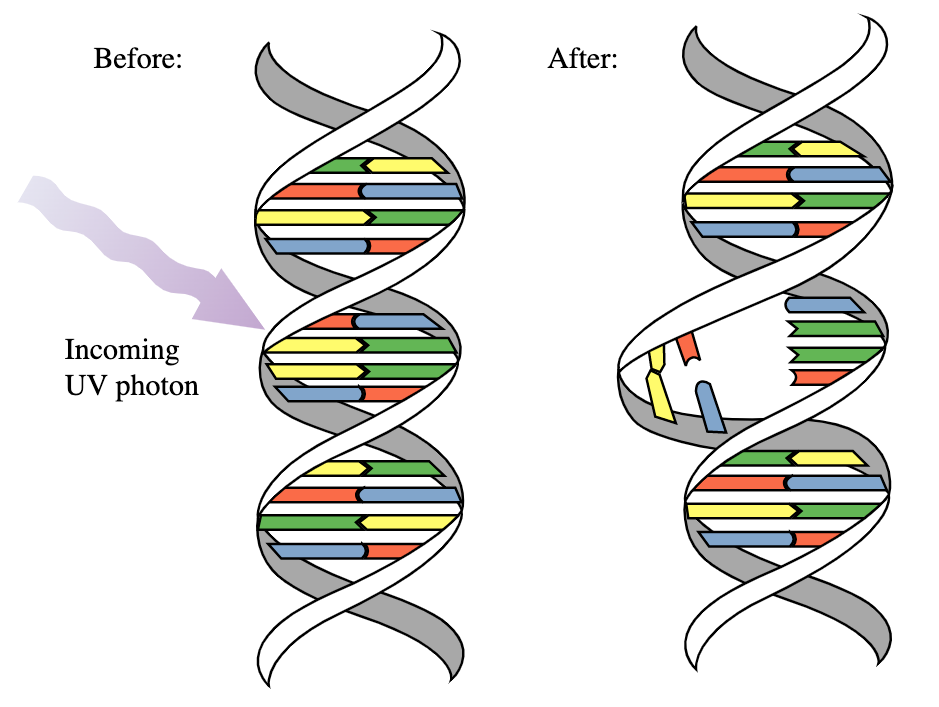
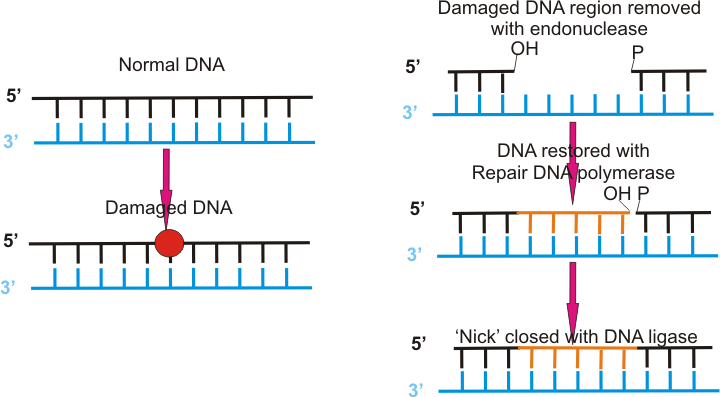
This repair mechanism repairs damaged DNA rather than incorrectly paired ones. This mechanism is readily at play whenever cells are exposed to environmental mutagens, such as ultraviolet (UV) radiation, which causes covalent bonding of two adjacent pyrimidines within DNA (e.g. thymine dimers).
- Enzymes (endonucleases) detect the improper geometry of the DNA and remove the damaged nucleotides.
- New nucleotides are added via DNA polymerase and the old and new nucleotides are bonded by DNA ligase.
Practice: DNA Repair During Replication
What is the primary method by which DNA polymerase fixes errors while it is actively replicating the DNA?