Wize AP Biology Textbook > DNA Replication & Repair
Repair of Double Stranded DNA Breaks
Popular Courses
Find My Course
0:00 / 0:00
Repair of DNA Strand Breaks
Double-stranded breaks in DNA are particularly damaging because incorrect joining of the strands cause mass reorganization of the genes and the affect the structure of chromosomes. There are two main systems for repairing double stranded DNA breaks: non-homologous end joining and homologous recombination.
Non-homologous End Joining (NHEJ)
Joins two non-homologous ends of DNA together. Usually, after a double stranded break, the two ends of DNA are still close enough together that they will be ligated back together.
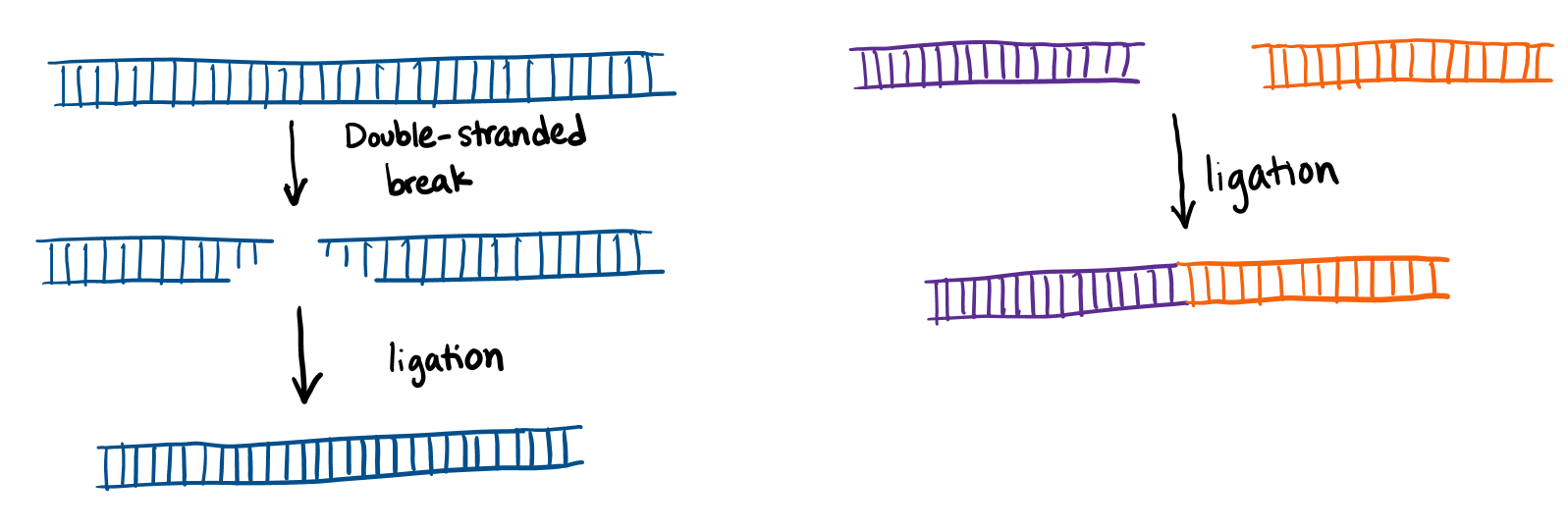
Problems with Non-homologous End Joining:
- Causes minor deletions as base pairs from either ends of the DNA fragments are lost (usually this is not harmful as the majority of DNA is non-coding or intronic DNA).
- Genes can end up joined together resulting in a chimeric genes. This can in turn result in changes to cell function or even cancer.
Homologous Recombination
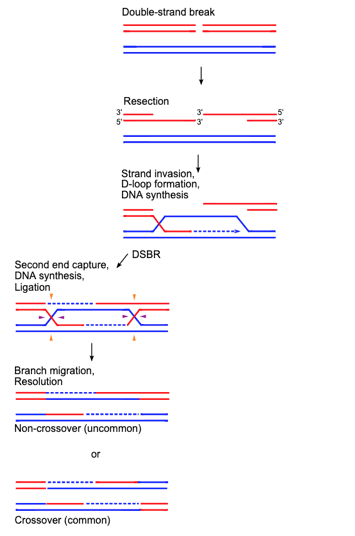
The damaged DNA sequence is copied from an undamaged or highly similar (homologous) copy of the DNA. The break is repaired by an exchange of two different DNA strands, referred to as recombination.
- Homologous recombination can be used to repair nicks in replication forks as well as double stranded breaks in DNA and is error free!
- The Holliday structure can be resolved in two different ways, yielding two different products. Therefore, double-stranded breaks repaired through homologous recombination has potentially FOUR different outcomes.
- Homologous recombination also provides a mechanism for creating genetic diversity in the offspring of two parents.
Practice: Double Stranded Break Repairs
Which of the following statements is true regarding Non-homologous End Joining and Homologous Recombination?