Wize AP Biology Textbook > Transcription and Translation
RNA Maturation in Eukaryotes
Popular Courses
Find My Course
0:00 / 0:00
RNA Maturation in Eukaryotes
After transcription of eukaryotic pre-mRNA, three modifications occur before translation:
- 5’ capping
- Polyadenylation
- Splicing
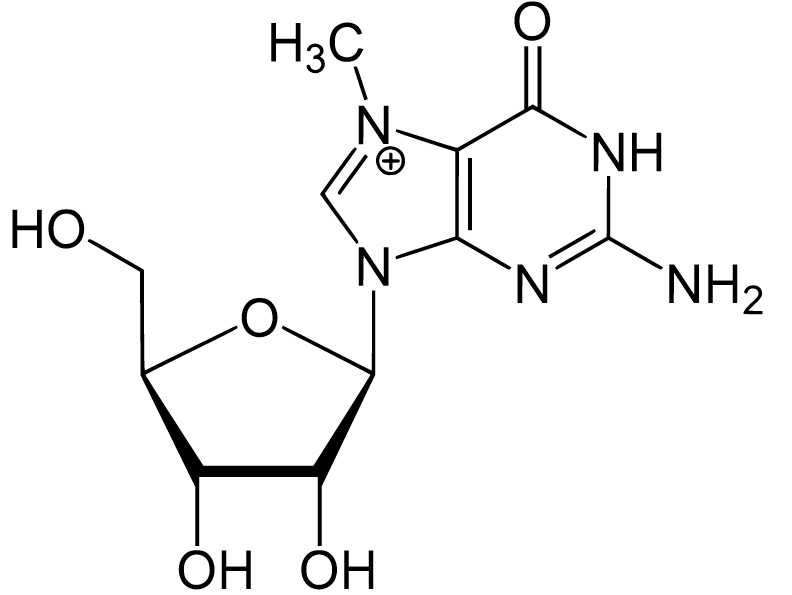
5’ capping
A modification to the 5’ end of the pre-mRNA, which consists of a methylated guanosine (7- methylguanosine). This cap allows for efficient translation and prolongs the stability of the mRNA.
Polyadenylation
A modification to the 3’ end of the pre-mRNA, which consists of several hundred “A” nucleotides to give a poly-A tail. Like the 5’ cap, the poly-A tail helps prevent RNA degradation and helps export pre-mRNA to cytoplasm.
Splicing
Eukaryotic genes contain introns and exons. The resulting mRNA is spliced to join together exons and remove introns. (Hint: think “exons are expressed; introns are in between.”)

Wize Concept
After these modifications, the pre-mRNA is now fully matured and can be called mRNA.
Splicing occurs in the nucleus and is conducted by proteins called spliceosomes. This has to be a very precise process since leaving nucleotides in can cause frameshift mutations that generate nonfunctional proteins.

0:00 / 0:00
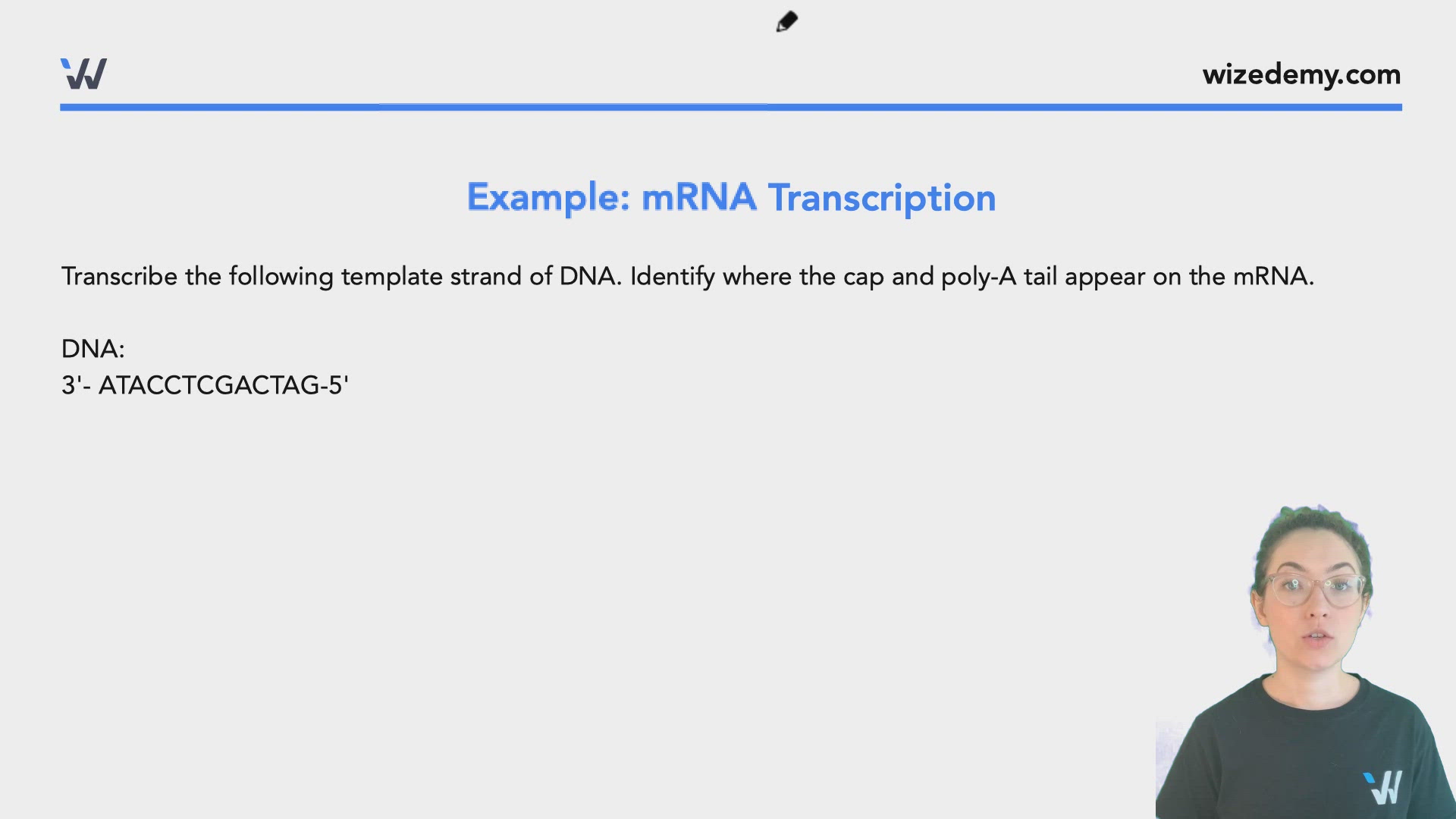
Example: mRNA Transcription
Transcribe the following template strand of DNA. Identify where the cap and poly-A tail appear on the mRNA.
DNA:
3'- ATACCTCGACTAG-5'
The resulting mRNA would be:
5'-UAUGGAGCUGAUC- 3'
The cap would be linked to the 5' end of the sequence and the poly-A tail would added to the 3' end of the sequence.
Practice: Gene Splicing
The diagram represents regions around a gene encoding a mRNA. The translation initiation codon (AUG) is present in exon 1 of the mRNA. The stop codon (UGA) is present in exon 4.

What region of the primary transcript is removed from the mature mRNA?
Practice: Transcription In Eukaryotes

The diagram represents an mRNA with exons (shaded regions) and introns (white regions).
a) In order to create a protein with the regions I, II, IV, what splicing pattern is required?