Wize University Biology Textbook > Phylogenetic Trees
Phylogenetic Trees
Popular Courses
AP Biology Exam Prep Course
AP Exam Prep
Biology
General Course
General Biology
University Study Guides
BIOL 211
University of Calgary
Grade 12 Biology
Canada High School
DAT
General Course
High School Biology
US High School
BIOL 103
Queen's University
BIOL 121
University of British Columbia
BIOLOGY 1M03
McMaster University
BIO120H1
University of Toronto
General Biology
University Study Guides
BIOL 108
University of Alberta
BIOL 111
McGill University
BIOL 184
University of Victoria
BIOL*1070
University of Guelph
BIOL 1010
Dalhousie University
SC/BIOL 1001 3.00
York University
BIOL 1201
Western University
BIOL 1P91
Brock University

0:00 / 0:00
Phylogenetic Trees
Phylogenetic trees are the best way to present how all life forms on earth are related to each other.
Phylogenetic Trees: branching diagrams that show the evolutionary history of organisms
- Phylogeny: evolutionary history of a species or group
- vs. Taxonomy: groups organisms based on similarities
- Show evolutionary relationships between taxa
- Represent hypotheses about evolutionary history
- Build trees using:
- Morphology
- Behavior
- DNA
- Biochemistry
Watch Out!
More recently evolved does not mean more advanced!
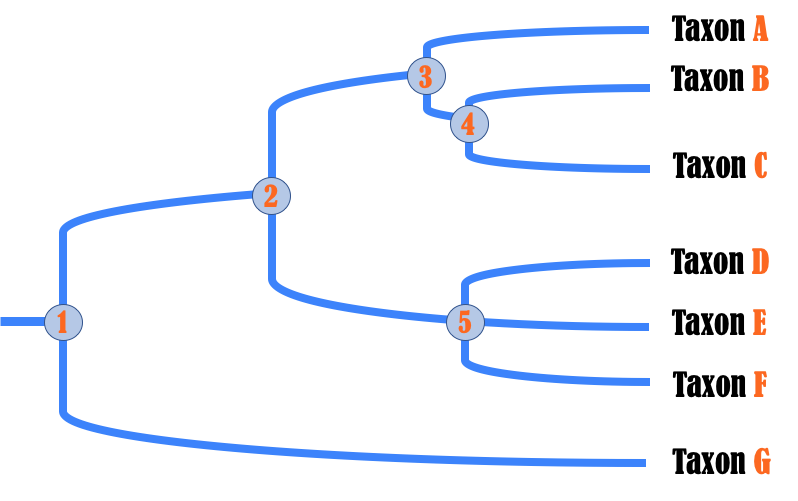
- Taxon (Taxa): the taxonomic unit at any level Example Animalia is the Kingdom taxon
- Sister taxa: Two or more taxa next to each other on the tree (i.e. closely related) Example: Taxon B and Taxon C are sister taxa
- Clade: A group of taxa that share a common ancestor Example: Taxon A, B, C form a clade
- In group: a group of interest usually the focus of a study
- Out group: one or more taxa that is distantly related to the In group
- Character: a specific characteristic Example: a wing or a tail
- State: a particular property of a character Example: the shape of the wing, or the color of the tail
Wize Tip
You can rotate any part of the tree and it doesn't change any relationships
0:00 / 0:00
Phylogenetic Trees and Parsimony
We use the concept of parsimony in every branch of science!
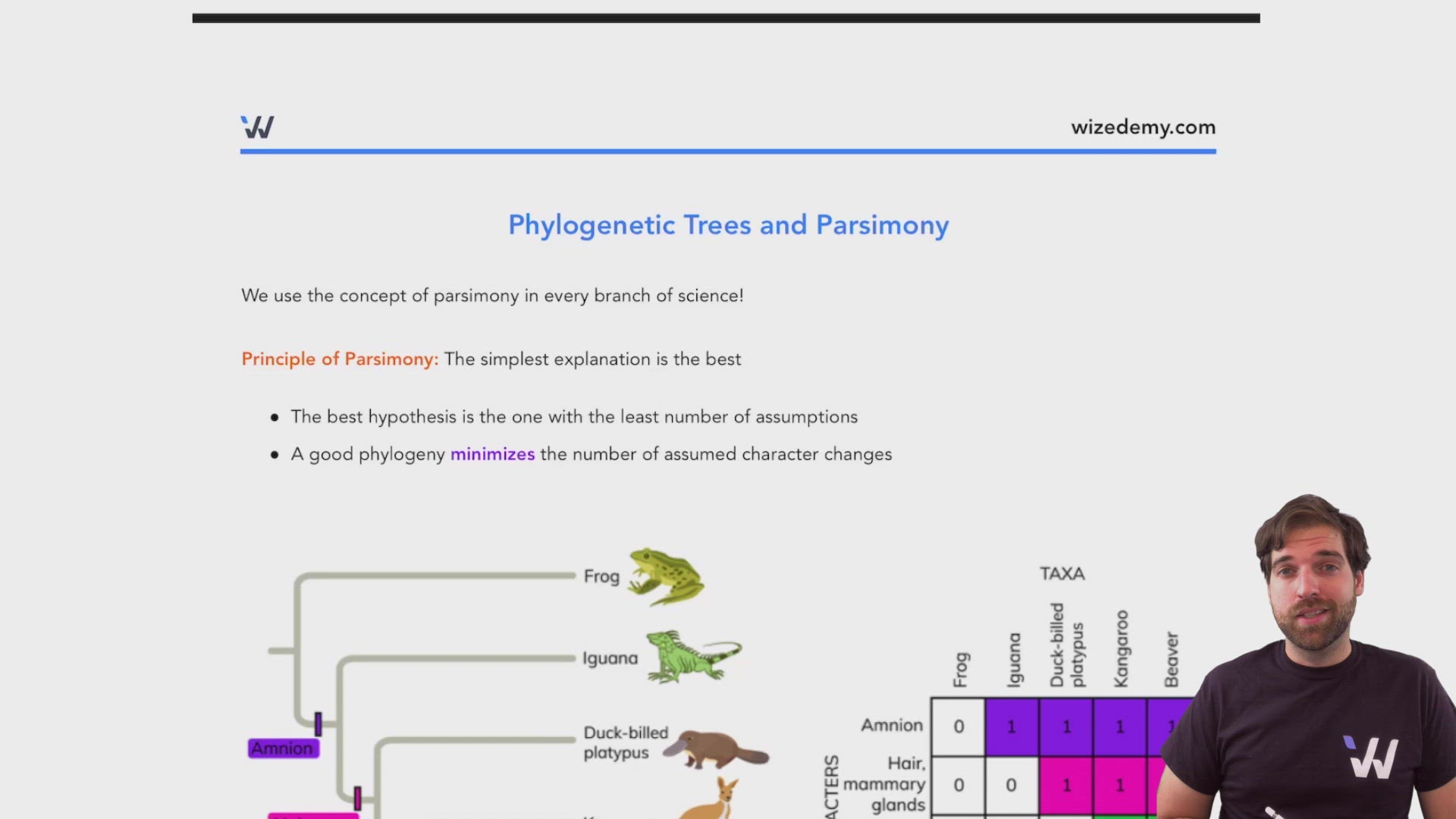
Principle of Parsimony: The simplest explanation is the best
- The best hypothesis is the one with the least number of assumptions
- A good phylogeny minimizes the number of assumed character changes

- Synapomorphy: a shared, derived trait that unites a clade Example: Having four legs is a synapomorphy that unites Frogs, Turtles and Leopards
- Symplesiomorphy: a shared, ancestral trait Example: Within the clade of Frogs, Turtles and Leopards, having four legs is a symplesiomorphy

- Monophyletic groups (clade): group of organisms containing a common ancestor, all of its descendants and nothing else.
- Paraphyletic groups: do not include all descendants of the common ancestor (i.e. missing some taxa)
- Polyphyletic groups: have members whose ancestor is outside of the group (i.e. too many taxa)
Wize Concept
Biologists want to create monophyletic groups. Paraphyletic and polyphyletic groups represent errors in our understanding of evolutionary history.
Similar Traits
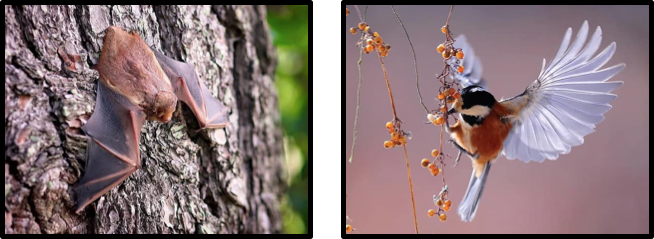
- Analogous traits: appear similar but actually evolved independently
- Convergent evolution: natural selection produces a similar trait from different starting points Example: bat and bird wings
- Homologous traits: similar due to true shared ancestry
- Descended from the same trait in a common ancestor Example: dolphin and whale flippers
Practice: Nomenclature
Phylogenetic trees fall under which category of biology?
Practice: Phylogenetic Trees
Which of the following could NOT be used to create a phylogenetic tree?
Practice: Phylogenetic Trees
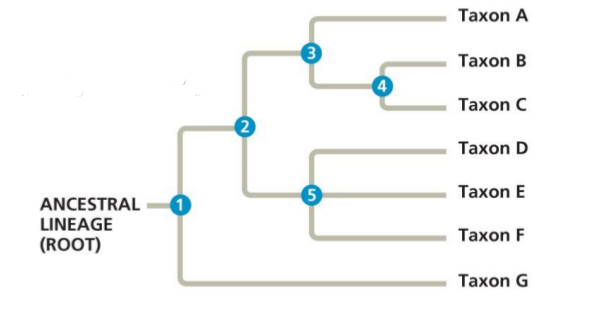
Using the tree below, which of the following would be considered sister taxa?