Wize University Biology Textbook > Evolution
Hardy-Weinberg Equation
Popular Courses
AP Biology Exam Prep Course
AP Exam Prep
BIOLOGY 1001A
Western University
Biology
General Course
General Biology
University Study Guides
Grade 12 Biology
Canada High School
DAT
General Course
High School Biology
US High School
BIOL 103
Queen's University
BIO 1131
University of Ottawa
BIOL 121
University of British Columbia
BIOLOGY 1M03
McMaster University
BIO120H1
University of Toronto
General Biology
University Study Guides
BIOL 108
University of Alberta
BIOL 111
McGill University
BIOL 184
University of Victoria
BIOL*1070
University of Guelph
HMB265H1
University of Toronto
BIOL 1010
Dalhousie University
SC/BIOL 1001 3.00
York University

0:00 / 0:00
Hardy-Weinberg Principle
This can be used to test whether wild populations are actually evolving!

Allele Frequencies
- Population: a group of individuals of the same species that breed together
- Gene pool: all copies of every allele in the population
- All genetic diversity of the entire population
- Homozygous: having two of the same alleles at a locus
- Fixed allele: all individuals in the population are homozygous at this locus
- Heterozygous: having two different alleles at a locus
- Polymorphism: Individuals in the population can be either Homozygous or Heterozygous at this locus
- Allele Frequency: the relative number of a specific allele at a locus
- Expressed as a proportion or a percentage Example: Imagine a population of flowers that have a polymorphism at a specific locus. If there are 200 "r" alleles and 400 "R" alleles, then the frequency of "r" is 200/600 = 0.33 (33%)
Hardy-Weinberg Principle
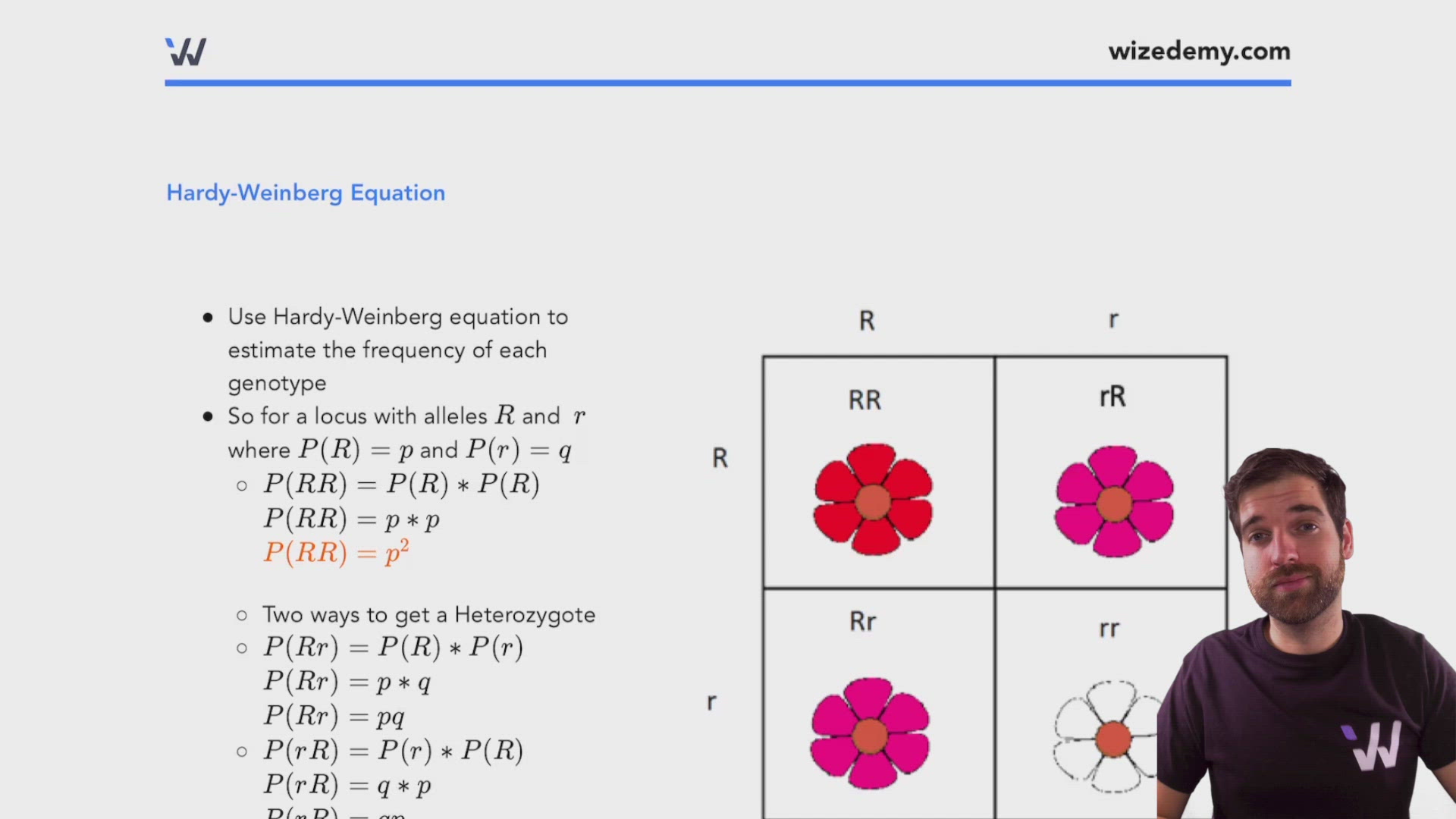
- Calculate what the allele frequencies should be if the population is not evolving
- Null hypothesis
- If the real world is different, then population may be evolving
- Hardy-Weinberg Equilibrium (HWE): allele frequencies in a population should remain constant
- No change with each new generation
- We think about all possible crosses between individuals in a population
- Consider all alleles floating around in gene pool
- Each generation we take a random scoop from that pool, and that becomes the next generation
- Probability of getting one specific allele = allele frequency
- Assumptions of Hardy-Weinberg
- No mutations
- Random mating
- No natural selection
- Large population size
- No gene flow
0:00 / 0:00
Hardy-Weinberg Equation
Hardy-Weinberg Equation
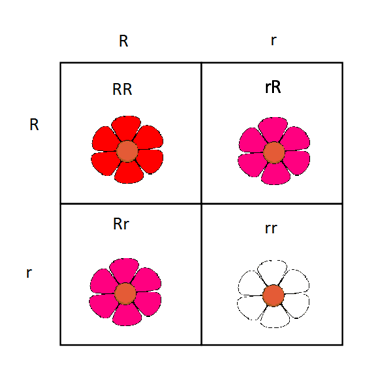
- Use Hardy-Weinberg equation to estimate the frequency of each genotype
- So for a locus with alleles and where and
- Two ways to get a Heterozygote
- The allele frequencies and probabilities must all = 1
Applying the Hardy-Weinberg Equation
- Compare the actual distribution of homozygotes and heterozygotes in a population to the predicted HWE
- If they do not match, there may be selection or evolution
- If we assume the population is in HWE
- If we know the frequency of one allele (p or q) we can calculate the rest
- If we know the frequency of any homozygous genotype we can calculate the rest
0:00 / 0:00
Example: Hardy-Weinberg
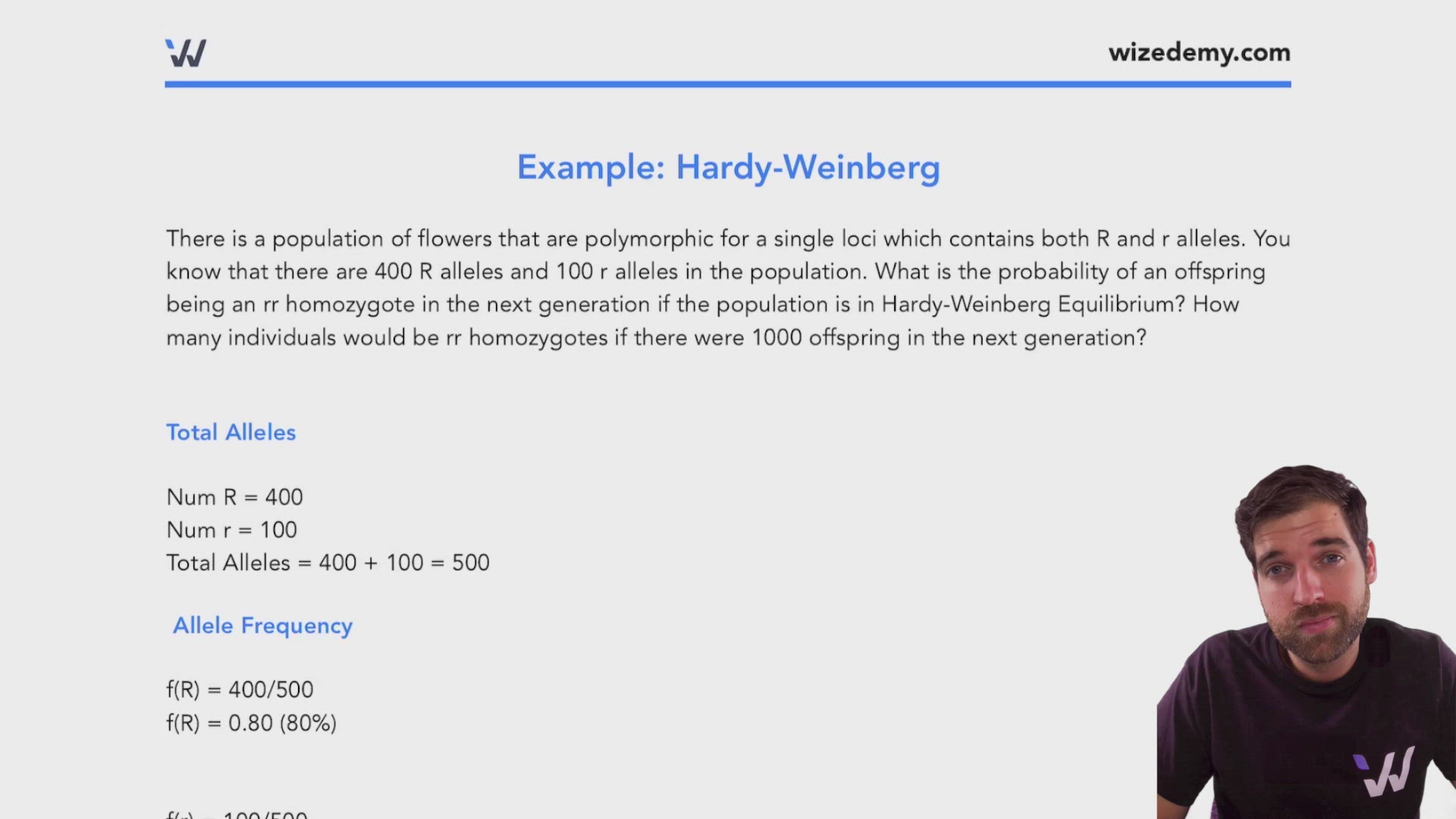
There is a population of flowers that are polymorphic for a single loci which contains both R and r alleles. You know that there are 400 R alleles and 100 r alleles in the population. What is the probability of an offspring being an rr homozygote in the next generation if the population is in Hardy-Weinberg Equilibrium? How many individuals would be rr homozygotes if there were 1000 offspring in the next generation?
Total Alleles
Num R = 400
Num r = 100
Total Alleles = 400 + 100 = 500
Allele Frequency
f(R) = 400/500
f(R) = 0.80 (80%)
f(r) = 100/500
f(r) = 0.20 (20%)
P(r) = 0.20
Probability
Recall that the probability is the same as the frequency
P(R) = 0.80
let p = P(R)
p = 0.80
P(r) = 0.20
let q = P(r)
q = 0.20
Hardy-Weinberg Equation
p2 + 2pq + q2 = 1
(0.8)2 + 2*(0.16) + (0.2)2 = 1
0.64 + 0.32 + 0.04 = 1 (correct!)
From the question: What is the probability of an offspring being an rr homozygote in the next generation
P(rr) = q2
P(rr) = (0.2)2
P(rr) = 0.04
From the Question: How many individuals would be rr homozygotes if there were 1000 offspring in the next generation?
Number of rr offspring = P(rr) * Number of offspring
Number of rr offspring = 0.04 * 1000
Number of rr offspring = 40
0:00 / 0:00
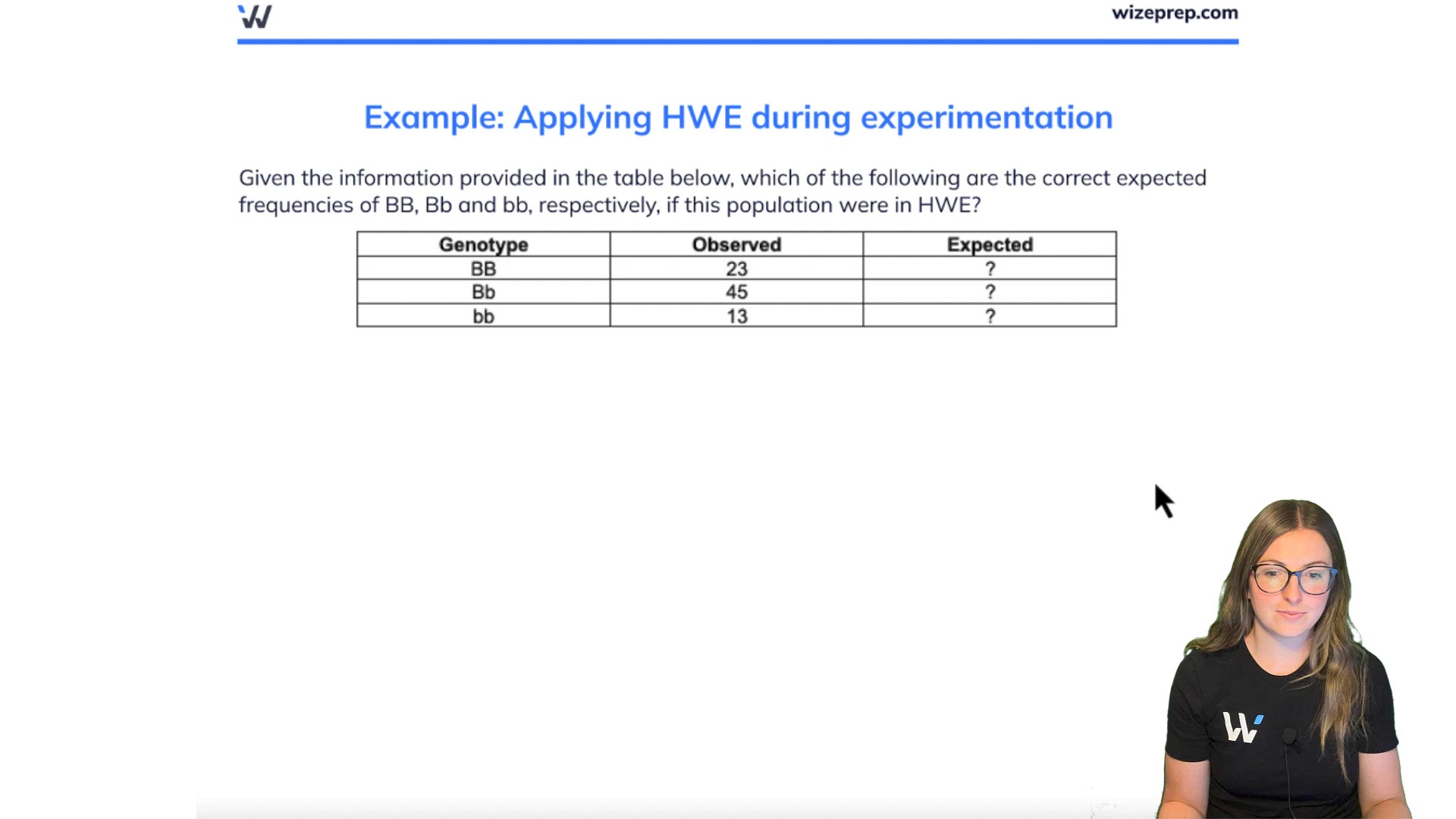
Example: Applying HWE During Experimentation
Given the information provided in the table below, which of the following are the correct expected frequencies of BB, Bb and bb, respectively, if this population were in HWE?


Mark Yourself Question
- Grab a piece of paper and try this problem yourself.
- When you're done, check the "I have answered this question" box below.
- View the solution and report whether you got it right or wrong.
There is a population of mice that are heterozygous for a single locus with g and G alleles. This population is thought to be in Hardy-Weinberg Equilibrium. If 100 out of 1000 individuals are homozygous recessive (gg), how man heterozygotes would you expect to find?
Mark Yourself Question
- Grab a piece of paper and try this problem yourself.
- When you're done, check the "I have answered this question" box below.
- View the solution and report whether you got it right or wrong.
Imagine that there is a population of rabbits that are polymorphic for a single locus which has a and A alleles. You find that there are 300 AA homozygotes and 200 Heterozygotes in a population of 800 rabbits. Is this population in Hardy-Weinberg Equilibrium? Why not?
Which of the following populations is likely undergoing assortative mating?