Wize University Biology Textbook > Energy & Metabolism
Enzyme Regulation
Popular Courses
MCAT
General Course
AP Biology Exam Prep Course
AP Exam Prep
Biology
General Course
General Biology
University Study Guides
BIOLOGY 1002B
Western University
BIOL 211
University of Calgary
BIOL 102
Queen's University
BIOL 112
University of British Columbia
Grade 12 Biology
Canada High School
DAT
General Course
High School Biology
US High School
BIOL 200
McGill University
General Biology
University Study Guides
BIOL 130
University of Waterloo
SC/BIOL 1000 3.00
York University
BIO 1141
University of Ottawa
BLG 143
Toronto Metropolitan University
BIOL 112
McGill University
BIOL 186
University of Victoria
BIOL-1101
University of Windsor

0:00 / 0:00
Enzyme Regulation
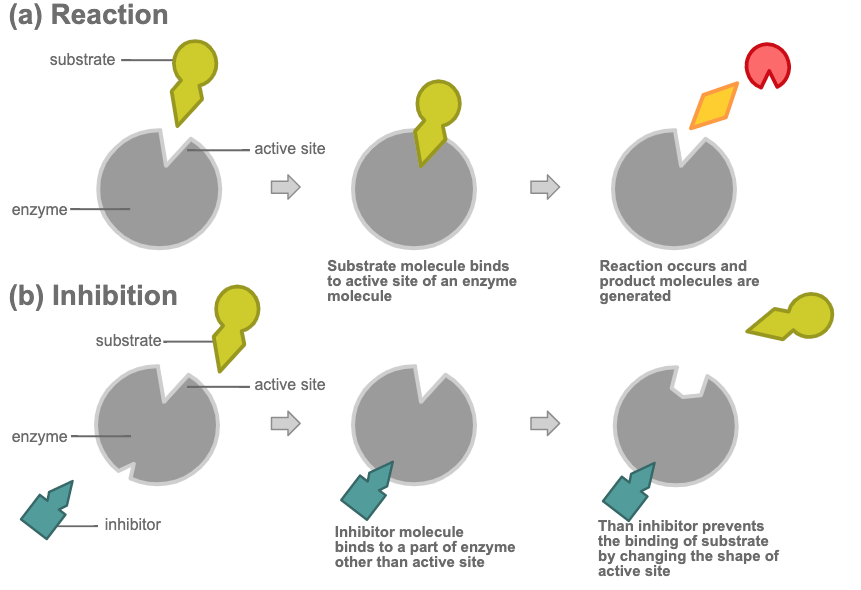
The rate at which enzymes work or how well they function can be regulated by other molecules that are not their substrate. An enzyme inhibitor is any chemical which binds to an enzyme and inhibits its function without producing gross alterations to its 3D structure. Inhibition of an enzyme will slow the rate of reaction.
- Irreversible inhibitors – Enzyme inhibitors that permanently inactivate enzymes. Usually form covalent bonds with the enzyme.
- Reversible inhibitors – Enzyme inhibitors that reversibly inactivate enzymes. These include competitive and non-competitive inhibitors.
- Competitive Inhibitors – Compete with the substrate for active-site binding, thereby reducing the rate that a “real” substrate binds.

- Non-Competitive Inhibitors - Molecule binds non-covalently to an allosteric site (location other than the active site), causing the enzyme to change shape and decreasing its affinity for the substrate.
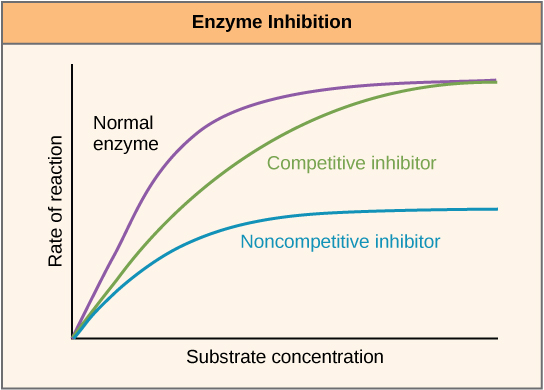
Effect of Inhibitors on Reaction Rate
Different types of inhibitors affect an enzyme's rate of reaction differently.
- Note that in the presence of competitive inhibitors, enzyme can still reach its maximum rate if enough substrate is added.
- With non-competitive inhibitors, the maximum reaction rate is decreased.
0:00 / 0:00
Feedback Inhibition
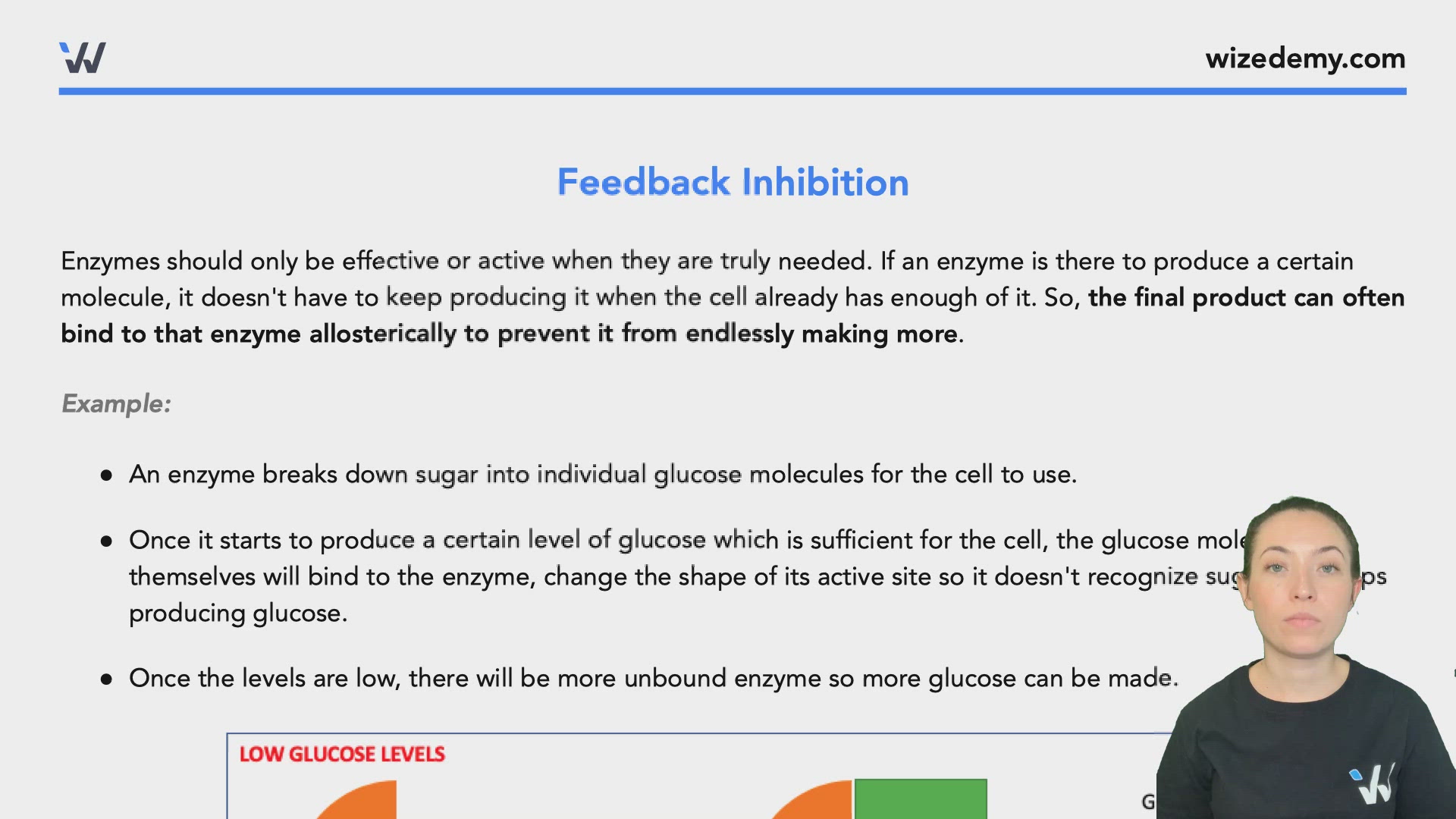
Enzymes should only be effective or active when they are truly needed. If an enzyme is there to produce a certain molecule, it doesn't have to keep producing it when the cell already has enough of it. So, the final product can often bind to that enzyme allosterically to prevent it from endlessly making more.
Example:
- An enzyme breaks down sugar into individual glucose molecules for the cell to use.
- Once it starts to produce a certain level of glucose which is sufficient for the cell, the glucose molecules themselves will bind to the enzyme, change the shape of its active site so it doesn't recognize sugar and stops producing glucose.
- Once the levels are low, there will be more unbound enzyme so more glucose can be made.

0:00 / 0:00
Example: Non-Competitive Inhibitors
Non-competitive inhibitors block the binding of the substrate to the active site. Is this statement true or false? Draw how they affect an enzyme's overall reaction rate.
0:00 / 0:00
Example: Inhibitor Effects
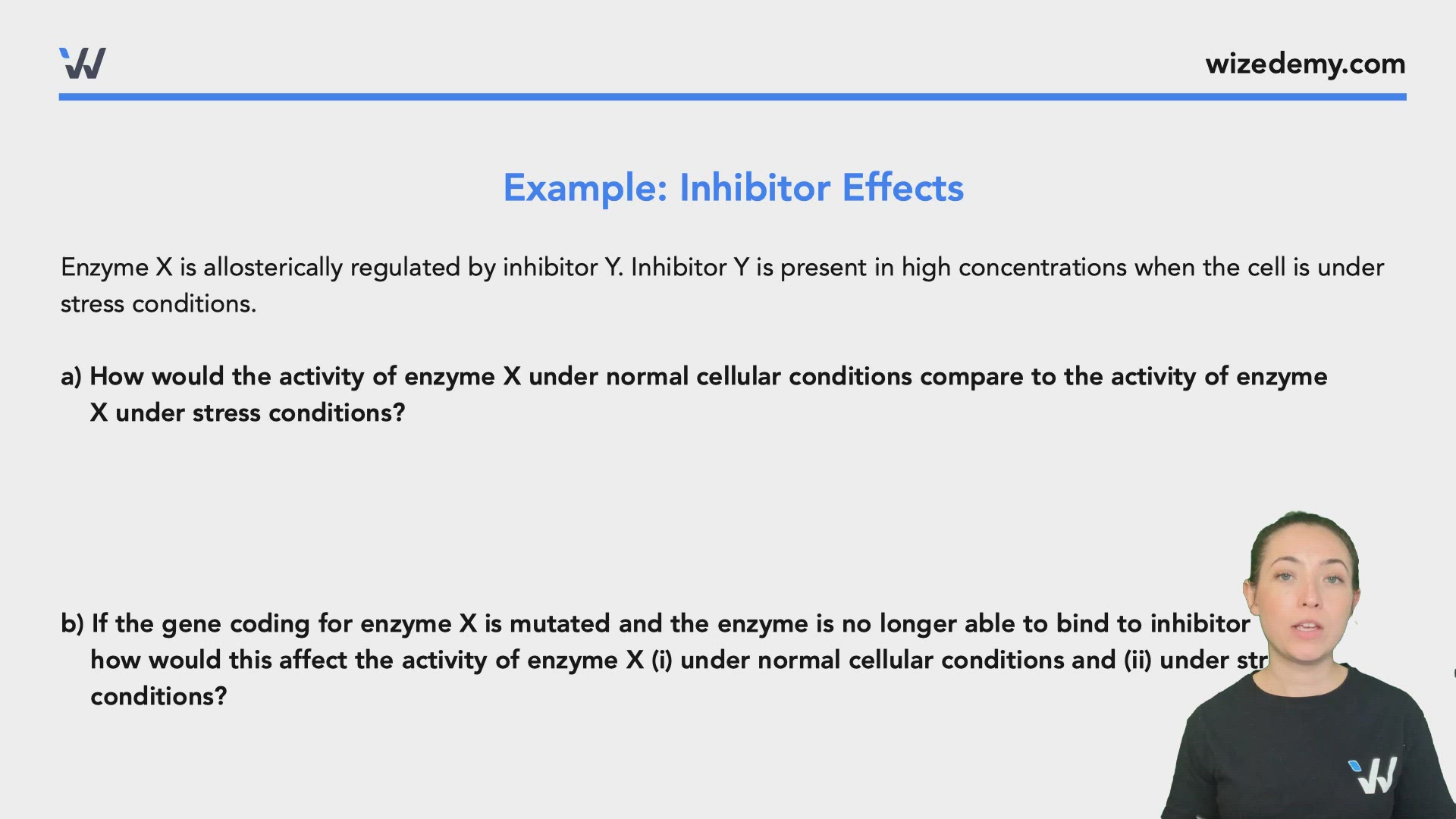
Enzyme X is allosterically regulated by inhibitor Y. Inhibitor Y is present in high concentrations when the cell is under stress conditions.
a) How would the activity of enzyme X under normal cellular conditions compare to the activity of enzyme
X under stress conditions?
Under normal conditions, the concentration of the inhibitor is low so the activity of the enzyme would be high. Under stressed conditions, the inhibitor concentration is high so the activity of the enzyme will be low.
b) If the gene coding for enzyme X is mutated and the enzyme is no longer able to bind to inhibitor Y,
how would this affect the activity of enzyme X (i) under normal cellular conditions and (ii) under stress
conditions?
Under stress conditions the concentration of the inhibitor will be high, but if the enzyme cannot bind the inhibitor the activity of the enzyme will not be affected by the presence of the inhibitor
c) Would increasing concentrations of the substrate of enzyme X increase its activity under stress
conditions? Why or why not?
It says in the question that the enzyme is allosterically regulated. This means it is NOT a competitive inhibitor and we cannot increase the activity of the enzyme by increasing the substrate concentration to out-compete the inhibitor
d) If inhibitor Y was a competitive, reversible inhibitor instead of an allosteric inhibitor, would increasing
concentrations of the substrate increase the enzyme’s activity under stress conditions? Why or why not?
Yes, if the enzyme is a regulated by a competitive inhibitor, increasing the substrate concentration can out-compete the inhibitor
e) If inhibitor Y was a competitive, irreversible inhibitor instead of an allosteric inhibitor, would increasing
concentrations of the substrate increase the enzyme’s activity under stress conditions? Why or why not?
No, if it is irreversible increasing the substrate concentration cannot out-compete the inhibitor because once the inhibitor is bound, the enzyme is permanently inactivated
Practice: Enzyme Inhibitors
lnvirase and Nevirapine are both drugs used to treat HIV. Invirase is a competitive inhibitor of HIV protease and nevirapine is a non-competitive inhibitor of reverse transcriptase. If the blue line in the graph below represents uninhibited enzyme activity, which line represents Invirase activity (orange or green)?
