Wize AP Biology Textbook > Biotechnology
In Vitro DNA Replication: Polymerase Chain Reaction (PCR)
Popular Courses
Find My Course
0:00 / 0:00
Polymerase Chain Reaction
In vitro method of replicating/amplifying DNA which means that this lab technique uses the same concepts of DNA replication to amplify a region of choice from a target DNA in a tube.
- Within a test tube there is a thermostable DNA polymerase (Taq polymerase), deoxyribonucleotides of all varieties, the DNA template to be amplified, and primers for both strands of the DNA.
- A thermocycler cycles through various temperature to carry out the process.
- 3 steps involved:
- Denaturation
- Annealing
- Elongation

Differences from DNA Replication in the Cell
- Using heat to unwind DNA strands instead of helicase.
- Completely denatures DNA into single strands (not a progressive unwinding).
- Primers are artificially designed and already provided in the test tube.
- These primers are made of DNA, instead of RNA like in the cell.
- Primers dictate where the replication reaction will occur to allows us to specify the region of interest.
- Only a small region is amplified as opposed to the whole DNA template.
- Millions of copies of the target region is made as opposed to only two copies that occur in the cell before it divides.
- No lagging or leading strands involved.
Primer Design
Primers are required in order to amplify only the region of the genome that is required.
- These primers must be flank the region of DNA that we want to amplify and be complementary to the strands.
- They are usually 18-22 base pairs.
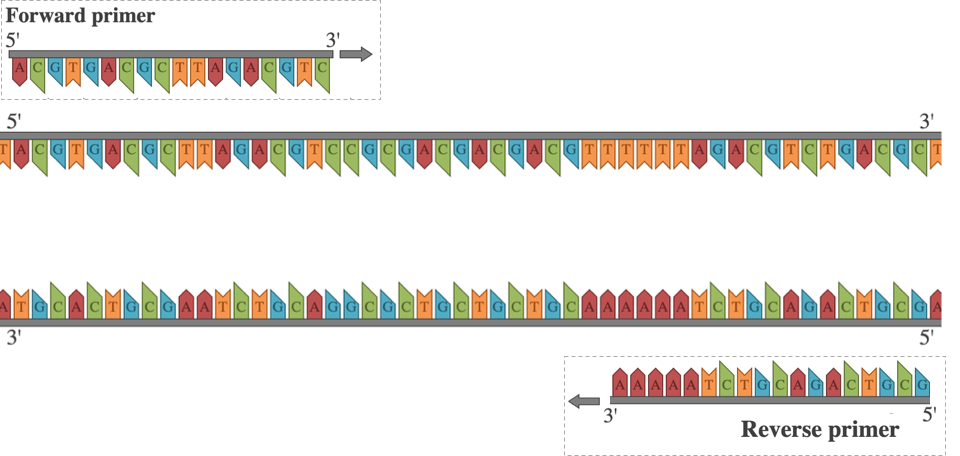
Watch Out!
Exam questions often ask for both primers to be listed in the 5' to 3' direction. In this case, the reverse primer must be listed as the reverse of the bottom strand.
0:00 / 0:00
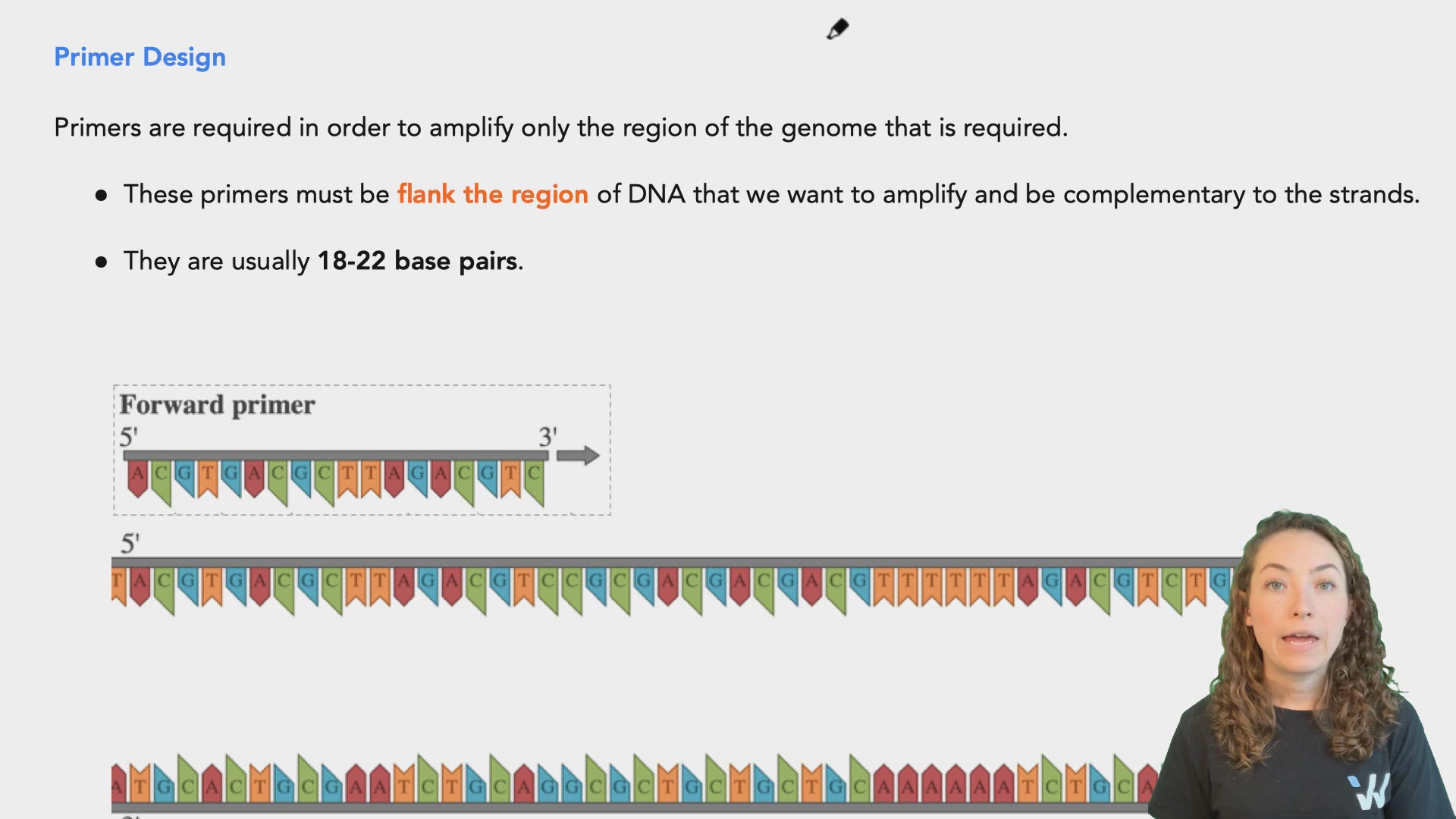
Primer Design
Primers are required in order to amplify only the region of the genome that is required.
- These primers must be flank the region of DNA that we want to amplify and be complementary to the strands.
- They are usually 18-22 base pairs.
Watch Out!
Exam questions often ask for both primers to be listed in the 5' to 3' direction. In this case, the reverse primer must be listed as the reverse of the bottom strand.
0:00 / 0:00
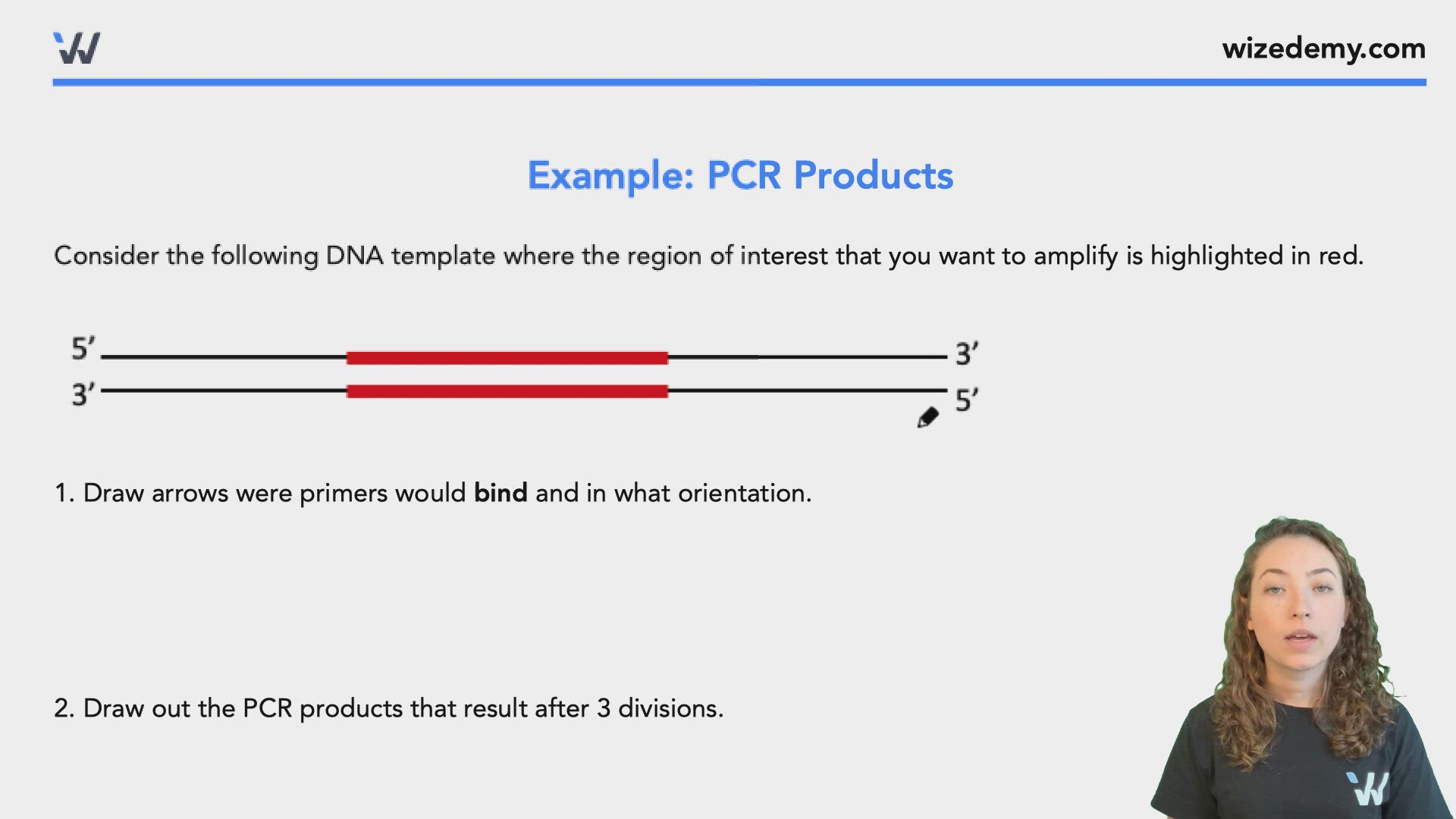
Example: PCR Products
Consider the following DNA template where the region of interest that you want to amplify is highlighted in red.

1. Draw arrows were primers would bind and in what orientation.
Top strand primer goes on the right of the target sequence.
Bottom strand primer goes on the left of the target sequence.
2. Draw out the PCR products that result after 3 divisions.
See video diagram.
3. How many double stranded molecules of DNA do you have after 3 division? How many are ones that match up to only the area of interest?
8, 2 match the target only sequence.
Practice: Steps of PCR
Explain the reasons for using a thermocycler? Why is the temperature raised and lowered at certain points?

Mark Yourself Question
- Grab a piece of paper and try this problem yourself.
- When you're done, check the "I have answered this question" box below.
- View the solution and report whether you got it right or wrong.
Practice: Designing Primers
Given the following DNA sequence, list the 6-base primer you can use to amplify the pink region. Please give directionality.
3'-AGCTGAGTATCGGTCCTAACAGTCAACCGCCT-5'
5'-TCGACTCATAGCCAGGATTGTCAGTTGGCGGA-3'