Wize AP Biology Textbook > Gene Expression & Regulation
Eukaryotic Translational/Post-Translational Regulation
Popular Courses
Find My Course
0:00 / 0:00
Translational and Post-Translational Regulation
Expression of the mRNA can be further regulated before it gets translated or even after, as a protein.
- Translational regulation includes controlling how well the translational machinery is able to bind to the mRNA by phosphorylation of certain proteins.
- Post-translational regulation largely involves chemical modification of translated proteins that can impact how well they work and how long they remain in the cell.
- Modifications can include methylation, acetylation, phosphorylation, etc.
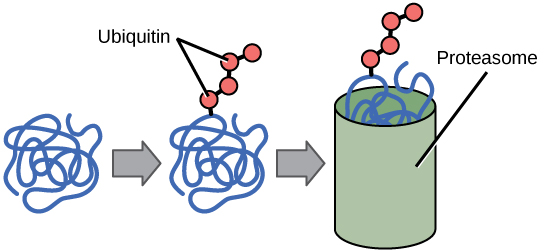
- Another well known modification is addition of ubiquitin (ubiquitination) which tags the protein for degradation by the proteasome.
- The proteasome is a large protein complex shaped like a barrel.
- It degrades proteins to regulate the level of proteins in the cell.
- A protein destined for degradation will have a ubiquitin/degron signal attached to it.
- Recognin is a chaperone that recognizes the degron signal and brings the protein to the proteasome to be broken down and recycled.
Practice: Addition of Ubiquitin
Addition of ubiquitin...
i - Often tags a proteins for degradation
ii - Often tags RNA for degradation
iii - Signals to the proteasome to act on the molecule
iv - Stabilizes the molecule