Popular Courses
ECON 201
Concordia University
ECONOMIC 1021A/B
Western University
Microeconomics
University Study Guides
ECON 201
University of Calgary
ECON 101
University of British Columbia
ECON 1B03
McMaster University
ECON*1050
University of Guelph
ECON 101
University of Alberta
Microeconomics
General Course
ECO101H1
University of Toronto
Microeconomics
University Study Guides
ECON 208
McGill University
ECON 101
University of Waterloo
ECON 110A
Queen's University
ECN 104
Toronto Metropolitan University
ECO 1104
University of Ottawa
EC120
Wilfrid Laurier University
AP/ECON 1000 3.00
York University
ECON 103
University of Victoria
ECON 1101
Dalhousie University

0:00 / 0:00
Price Floor
A price floor is a lower limit on the price that producers can legally charge consumers.
The best example is the minimum wage law, where the government prevents employers from paying a wage below a certain amount.

Wize Tip
A price floor means what you think it would mean - it's a minimum price. But on the graph it's the opposite! You would think it should be below equilibrium, but to be effective (binding) it must be above the equilibrium.
The reason why a price floor is above equilibrium is because it is meant to protect the producers.
Example: If bananas are currently selling for $3 per kilogram the government can put a price floor at $4 (which means the supermarket has to charge at least $4) so that the farmers make more money.
In the diagram below, if the equilibrium wage is at $10 per hour, the government can put a minimum wage (price floor) at $15 per hour to protect the workers. When we are talking about supply and demand for labor, the supply is the workers willing to work at that job and the demand is the company that wants to hire workers.

Inefficiencies of Price Floors
Price Floors lead to:
- Surplus or excess supplyfor the product in the market place. In the diagram above, there would be a surplus of50 - 30 = 20workers. The quantity of workers actually hired would be30
- Black market activity - sometimes employers cannot afford to pay their workers the minimum wage so they hire some people illegally at a lower wage and pay them cash (under the table).
0:00 / 0:00
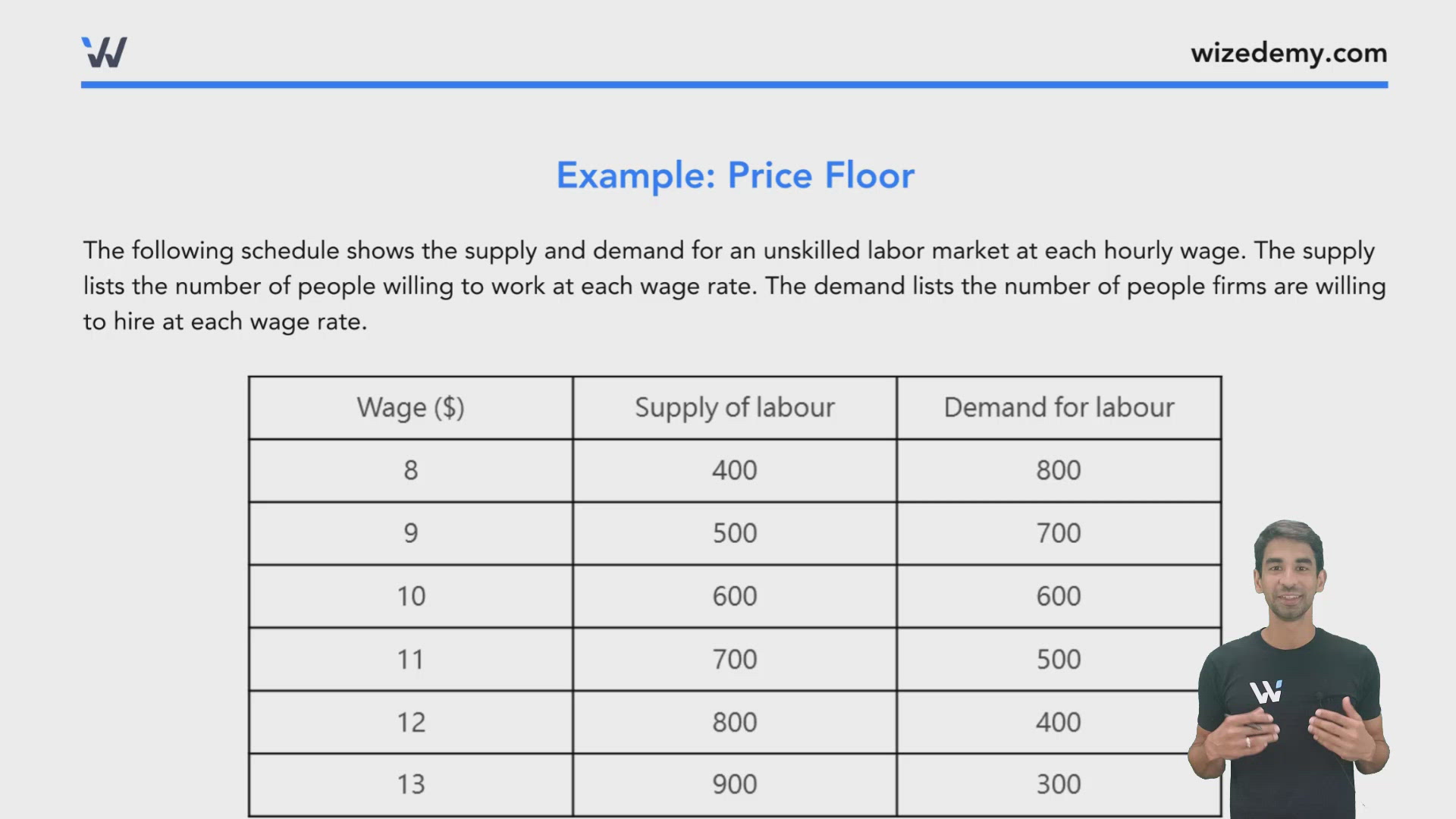
Example: Price Floor
The following schedule shows the supply and demand for an unskilled labor market at each hourly wage. The supply lists the number of people willing to work at each wage rate. The demand lists the number of people firms are willing to hire at each wage rate.
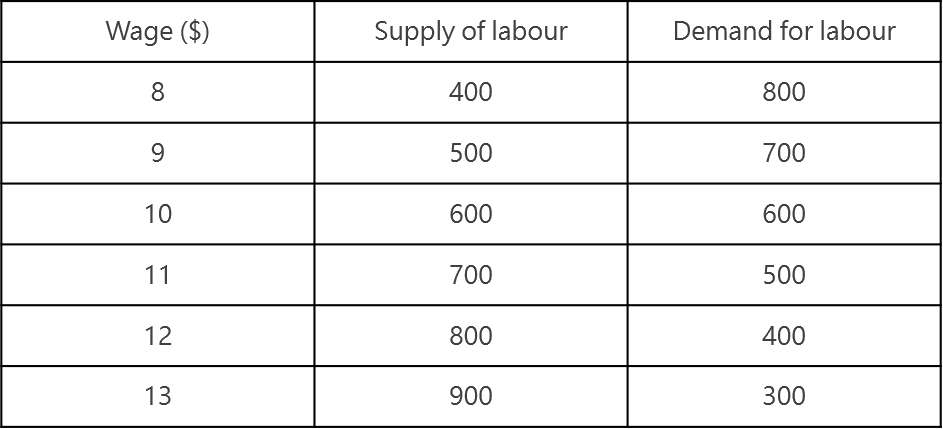
Suppose that the government imposes a minimum wage of $13 an hour. How many people will be unemployed?
600 workers.
At $13 the supply of labor is 900 and the demand for labor is 300. This means there is an excess supply of 900 - 300 = 600 workers. These workers will be unemployed. This is because 900 people are willing to work, but the firm can only afford to hire 300 workers. The excess supply is always the number of people unemployed.
Practice: Price Floor
A binding minimum wage will increase the total dollar earnings of workers if: