Wize University Microeconomics Textbook > Oligopoly
Game Theory and Nash Equilibrium
Popular Courses
ECON 201
Concordia University
ECONOMIC 1021A/B
Western University
Microeconomics
University Study Guides
ECON 201
University of Calgary
ECON 1B03
McMaster University
ECON*1050
University of Guelph
ECON 101
University of Alberta
Microeconomics
General Course
ECO101H1
University of Toronto
Microeconomics
University Study Guides
ECON 208
McGill University
ECON 101
University of Waterloo
ECN 104
Toronto Metropolitan University
ECON 110A
Queen's University
ECO 1104
University of Ottawa
EC120
Wilfrid Laurier University
AP/ECON 1000 3.00
York University
ECON 1101
Dalhousie University
ECON 111
Queen's University
ECON 103
Simon Fraser University
0:00 / 0:00
Oligopoly and Game Theory
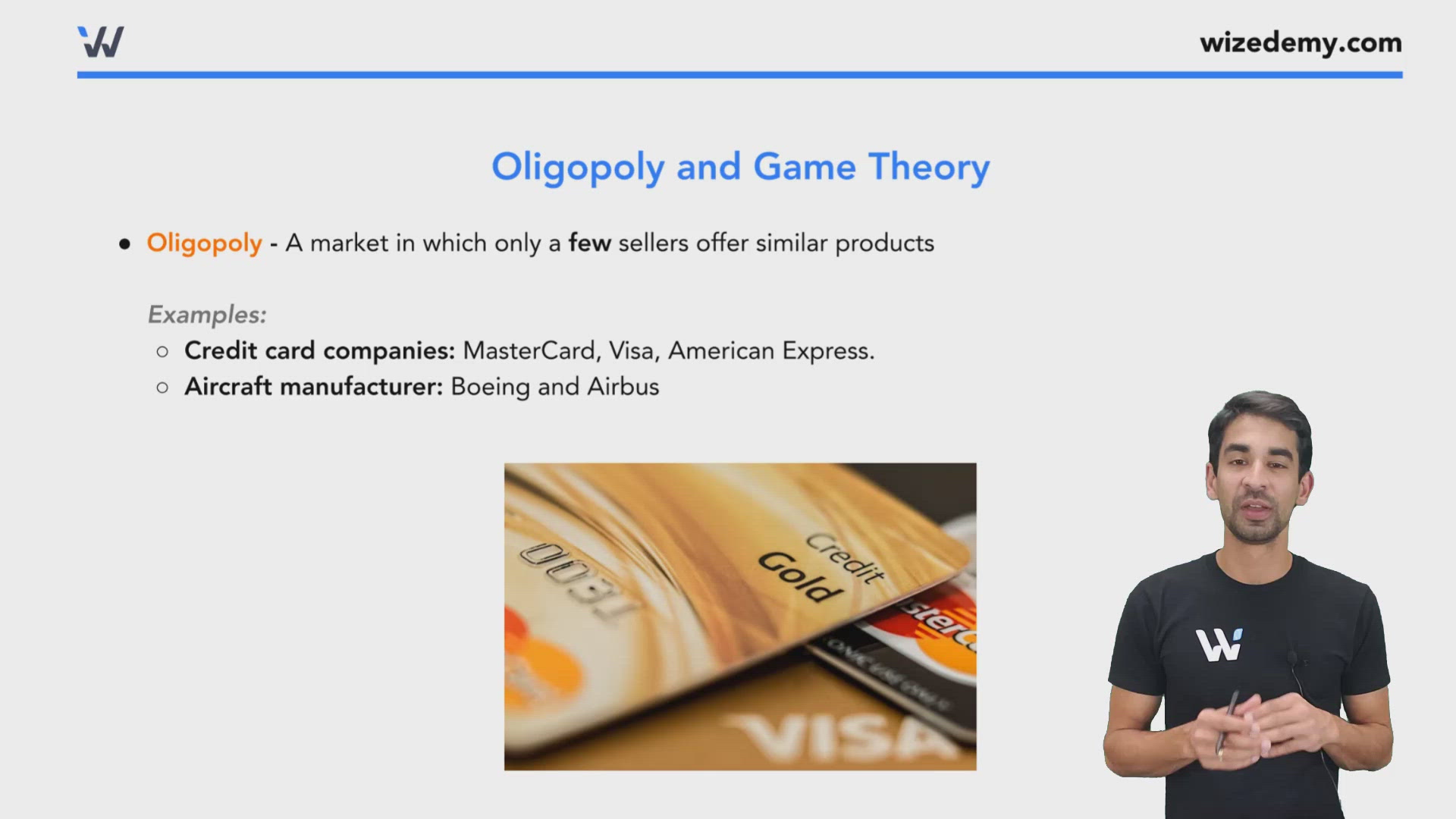
- Oligopoly - A market in which only a few sellers offer similar products Examples:
- Credit card companies: MasterCard, Visa, American Express.
- Aircraft manufacturer: Boeing and Airbus

- Duopoly - An oligopoly that consists of only two firms that dominate the market Example: Apple and Android dominate the smartphone market.
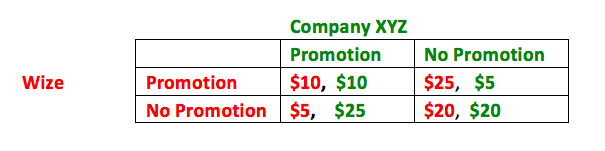
- Game Theory – A game in which there are players (firms) and payoffs (profits). It studies how people behave in strategic situations and can be seen in a payoff matrix like the one below. The outcomes are interdependent (which means profit for one company depends on what the other company does)
Dominant Strategy
A dominant strategy is your best strategy no matter what the other firm (player) does. The firm does not necessarily have a dominant strategy.
Dominant Strategy for Wize
- In the diagram above, the payoffs (profits) for Wize are the numbers in red.
- If XYZ does a promotion then Wize should doa promotionbecause they would make$10instead of$5.
- If XYZ does no promotion then Wize should doa promotionbecause they would make$25instead of$20.
- No matter what XYZ does it is better for Wize to do a promotion therefore doing a promotion is Wize's dominant strategy.
Dominant Strategy for XYZ
- In the diagram above, the payoffs (profits) for XYZ are the numbers in green.
- If Wize does a promotion then XYZ should doa promotionbecause they would make$10instead of$5.
- If Wize does no promotion then XYZ should doa promotionbecause they would make$25instead of$20.
- No matter what Wize does it is better for XYZ to do a promotion therefore doing a promotion is XYZ's dominant strategy.
Nash Equilibrium
The Nash equilibrium is a sustainable point where neither player has an incentive to cheat (change their strategy).
- In the diagram above, this would occur when both firms are doinga promotionwith a payoff of$10each.
- If we are in the top left box and Wize decides to cheat (change their strategy) and do no promotion, their profit would drop to$5.
- If we are in the top left box and XYZ decides to cheat and do no promotion, their profit would drop to$5.
- Neither player has an incentive to cheat that is why it is the Nash equilibrium
Collusion
The outcome with collusion is also called the mutually beneficial outcome or the outcome with commitment or a cartel.
- In the diagram above, the outcome with collusion would be where both firms are doingno promotionwith a payoff of$20each.
- However, this point is not sustainable because there is an incentive tocheat.

0:00 / 0:00
Example: Oligopoly and Game Theory

The diagram above shows the payoff matrix for Wizedemy and ABC Inc showing their profits based on whether they spend on advertising or not.
a) Does ABC Inc have a dominant strategy? If yes, what is it?
Yes, ABC's dominant strategy is to advertise because no matter what Wizedemy does, ABC makes more profit when they advertise (160>150 and 130>125)
b) Does Wizedemy have a dominant strategy? If yes, what is it?
No. If ABC does no advertising then its better for Wizedemy to not advterise (140>130) but if ABC advertises it is better for Wizedemy to advertise (120>110). Since the strategy changes it means Wizedemy does not have a dominant strategy.
c) What is the Nash equilibrium? What are their total combined profits at Nash equilbrium?
They both advertise and make profits of (120, 130). The combined profits are 120 + 130 = $250.
d) Do the two firms have a reason to collude? If yes, what would be the combined profits at this outcome?
Yes, compared to the Nash equilibrium they are both better off doing no advertising and making profits of (140, 150). Their combined profits would be 140 + 150 = $290
Practice: Oligopoly and Game Theory
Which of the following statements is true about the Nash equilibrium?