Wize University Microeconomics Textbook > Economic Efficiency and Government Intervention
Production and Allocative Efficiency
Popular Courses
Microeconomics
University Study Guides
ECON 101
University of British Columbia
ECON 101
University of Alberta
Microeconomics
General Course
Microeconomics
University Study Guides
ECON 208
McGill University
ECON 110A
Queen's University
AP/ECON 1000 3.00
York University
ECON 1101
Dalhousie University
ECON 111
Queen's University
ECON 103
Simon Fraser University
COMM 171
Queen's University
ECON-1100
University of Windsor
MET EC 101
Boston University
ECON-B 251
Indiana University - Bloomington
ECN 101
Toronto Metropolitan University
EC 201
Michigan State University
ECON 102
University of Illinois at Urbana - Champaign
ECON 1010
University of Manitoba
ECON 1001
Carleton University

0:00 / 0:00
Production and Allocative Efficiency
This section looks at the main difference between productive efficiency and allocative efficiency.
Productive Efficiency
- For the firm, productive efficiency is producing on it’s LRATC (Long Run Average Total Cost), which is at the lowest cost for each output
- For the industry cost to be minimized, marginal cost (MC) must be equal for every firm. Just because each firm is being efficient does not mean the whole industry is producing at minimum cost. Example: Marginal cost for firm A is $30 and for firm B is $40. If B makes one less book and A makes one more book, the output would be the same but the industry saves $10.

Allocative Efficiency
- A market has allocative efficiency when the Price (Marginal Value/Benefit) = MC
- When the market has allocative efficiency the total surplus (Consumer Surplus + Producer Surplus) is maximized.
- In the diagram below, allocative efficiency occurs where demand intersects with the marginal cost, which occurs at an output of20and price of$15.
- Anywhere on the left of 20 the marginal value isgreaterthan marginal cost somoreunits should be produced and consumed.
- Anywhere on the right of 20 the marginal value islessthan marginal cost solessunits should be produced and consumed

Efficiency in Different Types of Markets
Perfect Competition
Perfect competition is productively efficient because each firm has the same MC. It’s also allocatively efficient because Price = MC
Monopoly
- Monopoly is productively efficient (no other firm in the market so industry has the same MC). It does not have allocative efficiency because P > MC.
- The only exception to this rule is a monopoly with perfect price discrimination that will charge every consumer the maximum that they are willing to pay. In this case allocative efficiency will be achieved because they will produce till the point where Price = MC.
Oligopoly and Monopolistic Competition
Oligopoly and monopolistic competition do not have productive or allocative efficiency because each firm does not necessarily have the same MC and they produce where Price > MC.
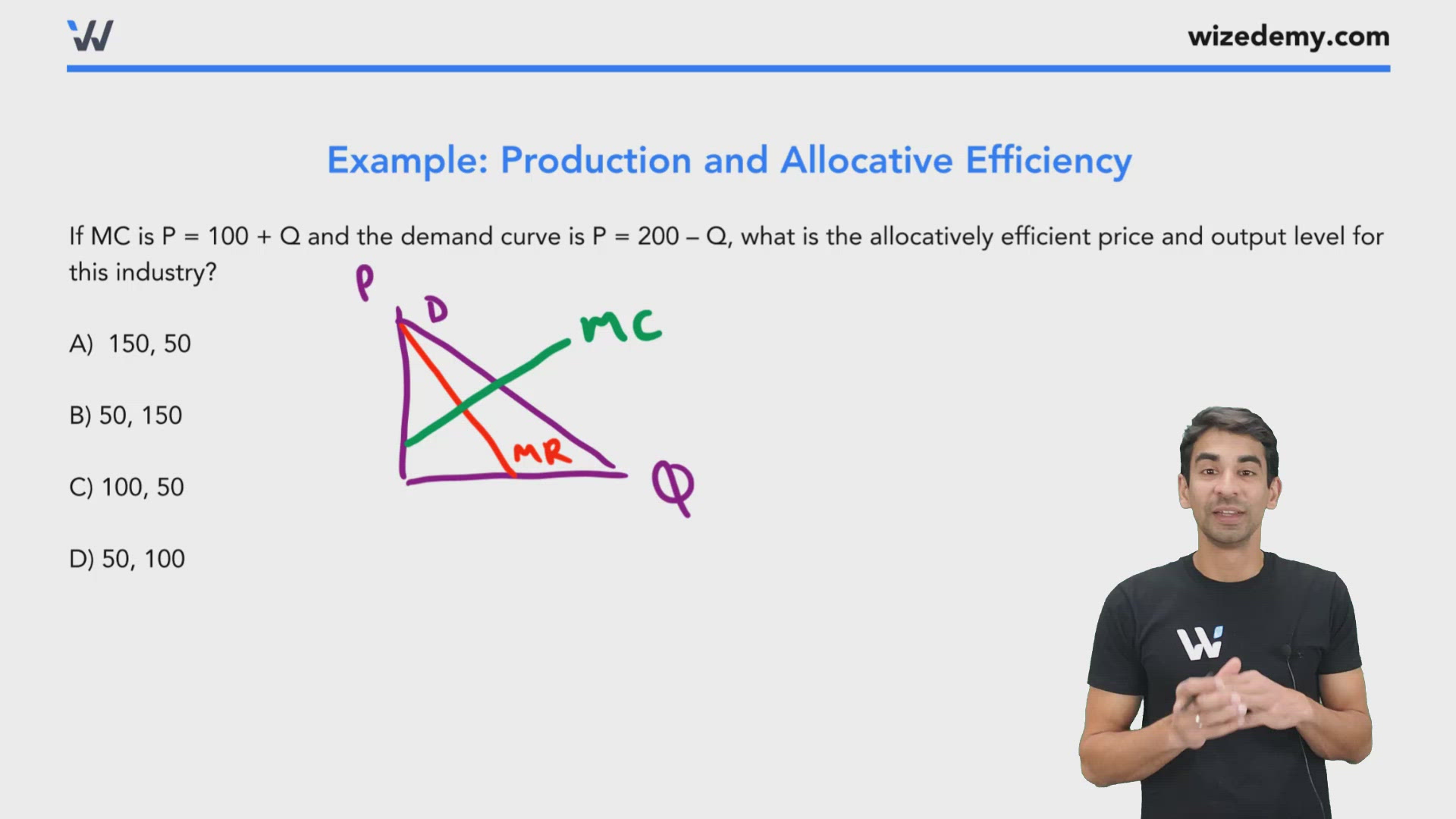
0:00 / 0:00
Example: Production and Allocative Efficiency
If MC is P = 100 + Q and the demand curve is P = 200 – Q, what is the allocatively efficient price and output level for this industry?
A) 150, 50
B) 50, 150
C) 100, 50
D) 50, 100
A.
Allocative efficiency is when Price (Demand) = MC which is at the equilibrium level:
200 - Q = 100 + Q
2Q = 100
Q = 50
P = 200 - 50 = 150

0:00 / 0:00
Example: Efficiency with Different Market Structures
What type of market structure is this industry if it produces at the level of output from the previous question?
A) Monopoly
B) Monopolistic competition
C) Perfect competition
D) Oligopoly
C.
Only in perfect competition do they achieve allocative efficiency. The only exception to this rule is if they had said a monopoly that uses perfect price discrimination (then that would be correct also).