Wize University Microeconomics Textbook > Labor Market
Monopsony and Perfectly Competitive Labor Market
Popular Courses
ECONOMIC 1021A/B
Western University
Microeconomics
University Study Guides
ECON 201
University of Calgary
ECON*1050
University of Guelph
ECON 101
University of Alberta
Microeconomics
General Course
Microeconomics
University Study Guides
ECO 1104
University of Ottawa
EC120
Wilfrid Laurier University
AP/ECON 1000 3.00
York University
ECON 1101
Dalhousie University
ECON 111
Queen's University
ECON 103
Simon Fraser University
ECON-1100
University of Windsor
MET EC 101
Boston University
ECON-B 251
Indiana University - Bloomington
ECN 101
Toronto Metropolitan University
EC 201
Michigan State University
ECON 102
University of Illinois at Urbana - Champaign
ECON 1010
University of Manitoba

0:00 / 0:00
Monopsony and Perfectly Competitive Labor Market
A monopsony is when there is a single buyer that has a lot of control over the market. This is different to a monopoly which is a single seller

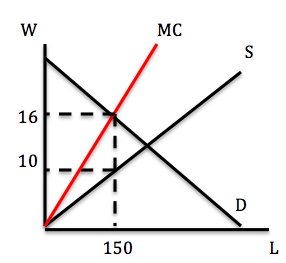
The marginal cost of the worker is also called the Marginal Factor Cost (MFC). This means the additional cost of hiring one extra worker.
Profit Maximization for Monopsony
- If VMP (Value of Marginal Product) > Marginal Cost of the worker, the firm should hiremoreworkers. In the diagram above this is on theleftof 100 workers.
- If VMP < Marginal Cost of the worker, the firm should hirelessworkers. This is on therightof 100 workers.
- If VMP = Marginal Cost of the worker, the firm ismaximizing profitsand should keep this number of workers. This is at the employment of100workers and wage of$12(where 100 hits the supply curve).
Wize Tip
Remember the Value of Marginal Product is the same thing as Marginal Revenue Product. The Marginal Cost of a worker is the same thing as Marginal Factor Cost. Different professors mix these terms up sometimes.
Perfectly Competitive Labor Market
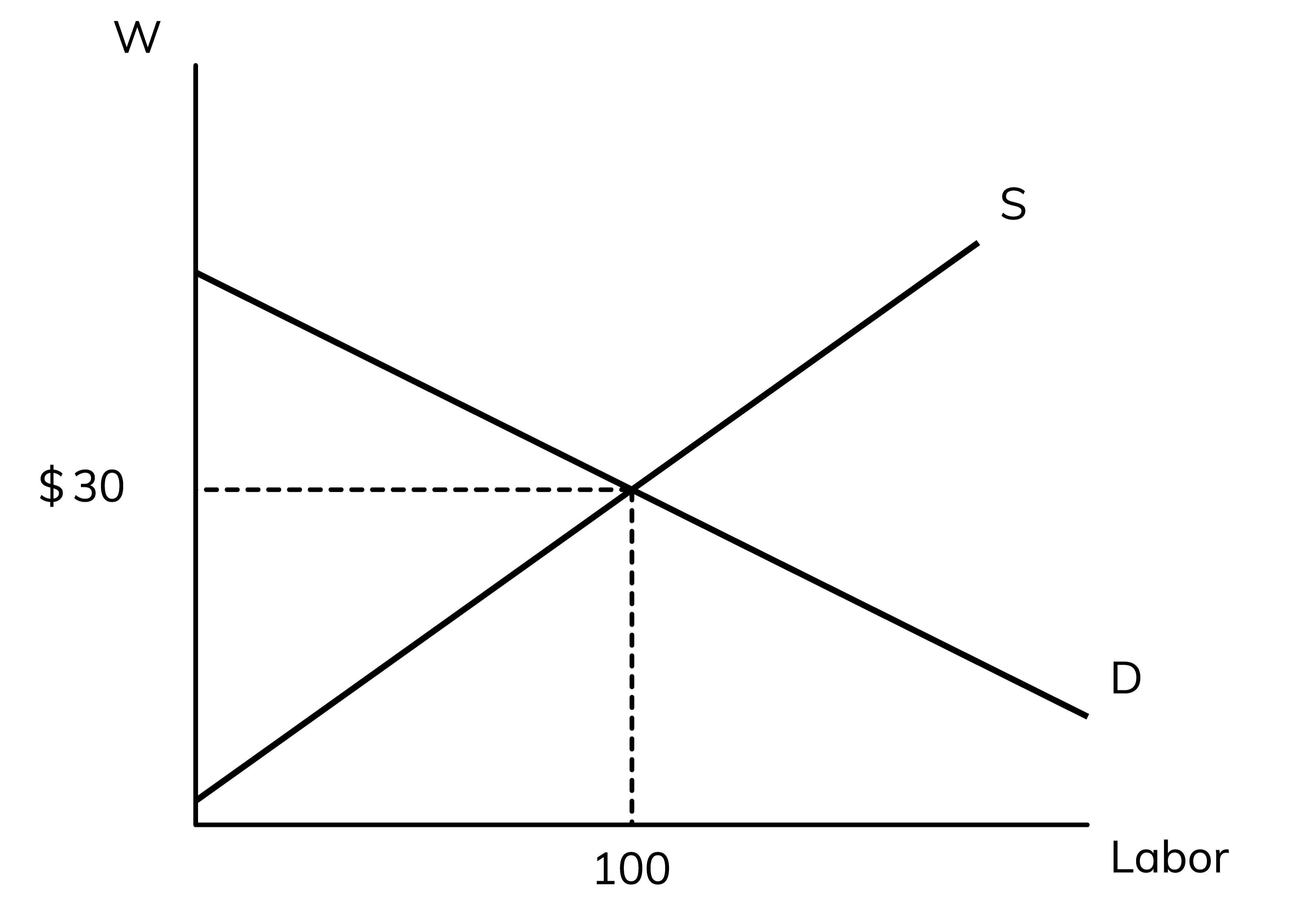
The perfectly competitive labor market has a regular downward sloping demand and upward sloping supply.
Firm in a Perfectly Competitive Labor Market
- The individual firms in a perfectly competitive labor market face a horizontal supply curve which is also called the marginal cost (MC) or marginal factor cost (MFC).
- This is because the firm can hire any amount of workers at that wage rate.
- The firm will use the quantity of workers that maximizes their profits which is where the Value of Marginal Product (VMP) = MC. In the diagram below this is at an employment of4workers.

0:00 / 0:00
Example: Labor Market and Monopsony
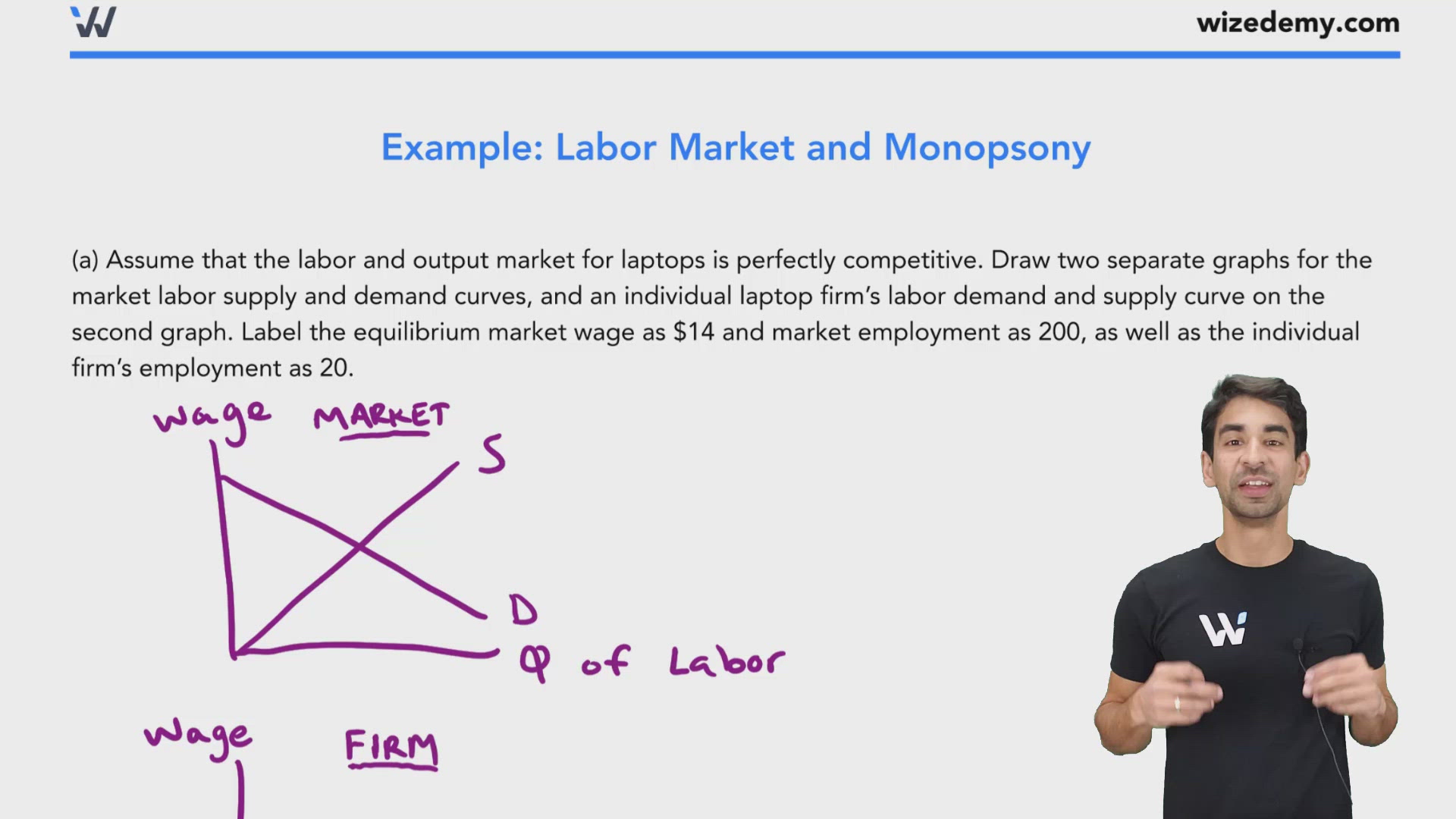
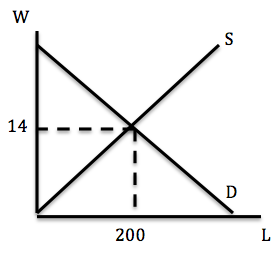
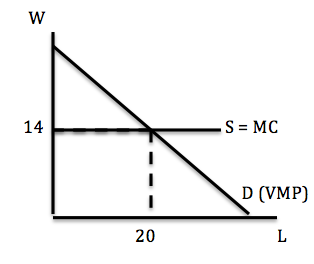
(a) Assume that the labor and output market for laptops is perfectly competitive. Draw two separate graphs for the market labor supply and demand curves, and an individual laptop firm’s labor demand and supply curve on the second graph. Label the equilibrium market wage as $14 and market employment as 200, as well as the individual firm’s employment as 20.
Market:
Firm:
b) Suppose that all the laptop firms unite into an employers’ organization and coordinate their actions in the labor market so that now they behave as a single employer. Draw the employer’s individual labor supply and demand and marginal cost curves. Label the monopsony wage as $10 and employment at 150. Is the monopsony efficient?
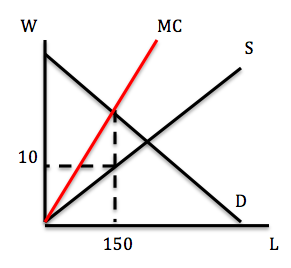
The monopsony is not efficient because employment is not at the level where supply = demand of labor.
c) The labor union proposes a minimum wage, above the monopsony wage (which is called a bilateral monopoly). They argue that when laptop firms behave as a single employer, such a minimum wage will always increase employment. Are they correct?
No. If the minimum wage is higher than the intersection of demand and MC (in the graph that would be above $16) then the employment will decrease because the demand for labor is less than 150. If the minimum wage is between $10 and $16 the employment will increase because supply and demand will be more than 150. A market with a monopsony and a labor union is called a Bilateral Monopoly. If the labor union has more power, the wage will be closer to $16 in the diagram below. If the monopsony has more power then the wage will be closer to $10.