Wize University Macroeconomics Textbook > Saving, Investment and the Financial System
Government Budget and Debt
Popular Courses
ECON 203
Concordia University
ECON 203
Concordia University
Macroeconomics
University Study Guides
AP Macroeconomics Exam Prep Course
AP Exam Prep
ECONOMIC 1022A/B
Western University
Macroeconomics
General Course
ECON 102
University of British Columbia
ECON*1100
University of Guelph
Macroeconomics
University Study Guides
ECON 203
University of Calgary
ECON 102
University of Alberta
ECO102H1
University of Toronto
ECO 1102
University of Ottawa
ECON 209
McGill University
ECON 1BB3
McMaster University
COMM 171
Queen's University
ECON 112
Queen's University
AP/ECON 1010 3.00
York University
ECON 295
McGill University
ECON 110
Queen's University
0:00 / 0:00
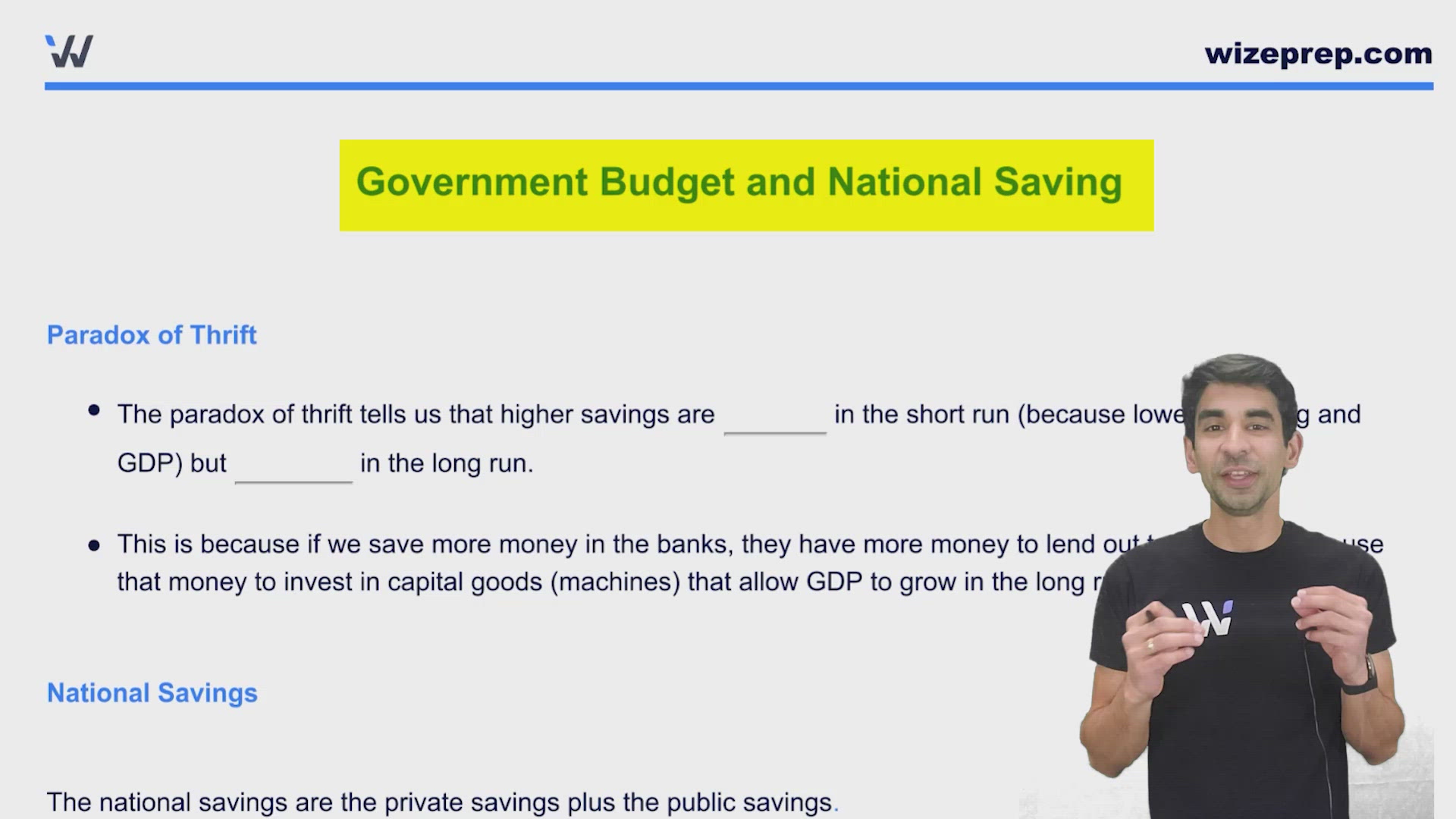
Government Budget and National Saving
Paradox of Thrift
- The paradox of thrift tells us that higher savings arebadin the short run (because lower spending and GDP) butgoodin the long run.
- This is because if we save more money in the banks, they have more money to lend out to firms that can use that money to invest in capital goods (machines) that allow GDP to grow in the long run.
National Savings
The national savings are the private savings plus the public savings.
Example: If the national income is $1000, the consumption is $300, tax revenue is 400 and government expenditure is $250, what will the private, public and national savings be?
Private savings =
1000 - 300 - 400 = $300
Public savings =
400 - 250 = $150
National savings =
1000 - 300 - 250 = $450
- Budget Surplus - when tax revenue is greater than government spending
- Budget Deficit - when tax revenue is less than government spending
In a closed economy (no exports or imports) at equilibrium remember:
and rearranging the above equation gives us:
or :
0:00 / 0:00
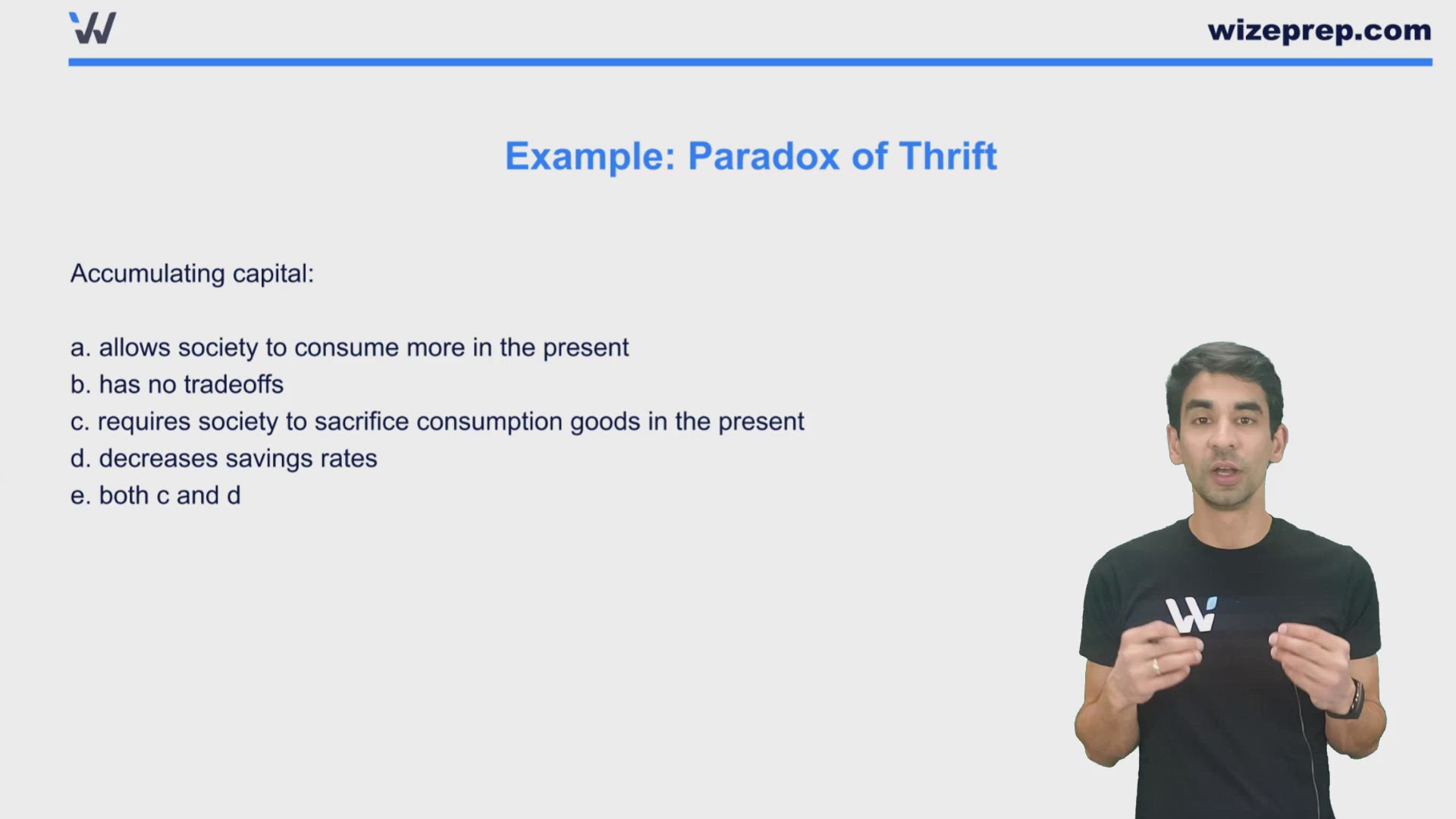
Example: Paradox of Thrift
Accumulating capital:
a. allows society to consume more in the present
b. has no tradeoffs
c. requires society to sacrifice consumption goods in the present
d. decreases savings rates
e. both c and d
C.
When we save more, banks have more money to loan out to firms that spend it on capital (accumulation). To have higher savings means we have to spend less on consumption.
Practice: Paradox of Thrift
Governments can encourage growth and in the long run, raise their country's standard of living by encouraging:
Practice: National Savings
All else held constant, an increase in government spending would cause: