Wize University Macroeconomics Textbook > Open Economy Macroeconomics
Purchasing Power Parity
Popular Courses
ECON 203
Concordia University
Macroeconomics
University Study Guides
AP Macroeconomics Exam Prep Course
AP Exam Prep
ECONOMIC 1022A/B
Western University
Macroeconomics
General Course
ECON 102
University of British Columbia
ECON*1100
University of Guelph
Macroeconomics
University Study Guides
ECON 203
University of Calgary
ECON 102
University of Alberta
ECO102H1
University of Toronto
ECO 1102
University of Ottawa
ECON 1BB3
McMaster University
AP/ECON 1010 3.00
York University
ECON 110
Queen's University
ECON 105
Simon Fraser University
ECON 1102
Dalhousie University
ECON 1002
Carleton University
ECON 1BA3
McMaster University
ECON 330
McGill University
0:00 / 0:00
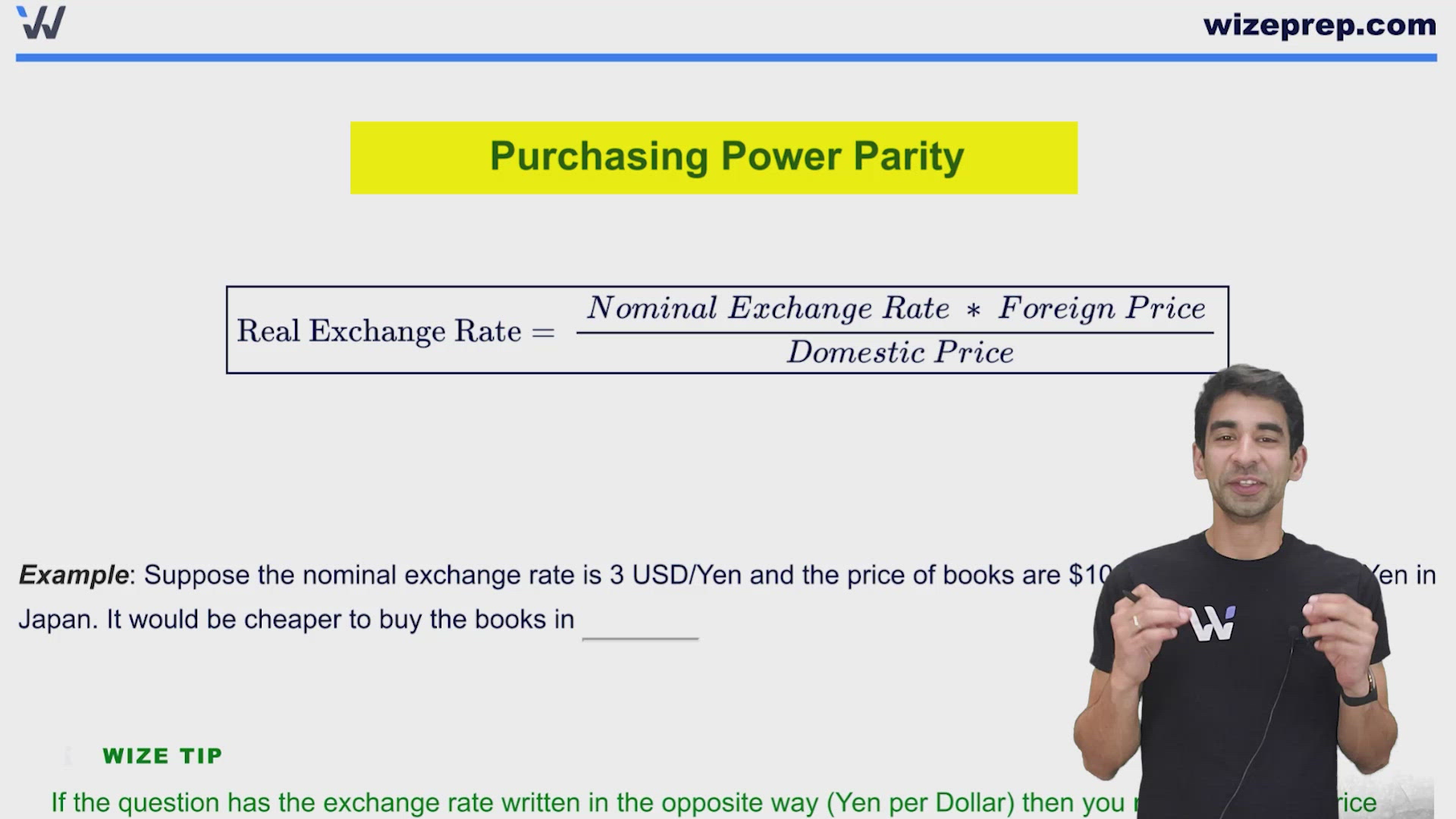
Purchasing Power Parity
Example: Suppose the nominal exchange rate is 3 USD/Yen and the price of books are $100 in the USA and 40 Yen in Japan. It would be cheaper to buy the books in
USA
Wize Tip
If the question has the exchange rate written in the opposite way (Yen per Dollar) then you replace foreign price with domestic price in the equation above.
- Purchasing power parity (PPP) - when the real exchange rate = 1. It only applies to tradable goods like books, clothes, shoes (but does not apply to golf lessons, for example). In the example above, according to purchasing power parity the nominal exchange rate would eventually be2.5USD/Yen.
- Small open economy - an economy that trades goods and services with other economies and, by itself, has a negligible effect on world prices and interest rates.
- Perfect capital mobility - full access to world financial markets.
- Interest rate parity - a theory where the real interest rate on comparable financial assets should be the same in all countries. It does not always occur if assets have different risk and taxes.
Wize Tip
This is the formula if they give the exchange rate as domestic currency per unit of foreign currency (like USD/Yen). If it is written the opposite way then you change the plus sign to a minus.
0:00 / 0:00
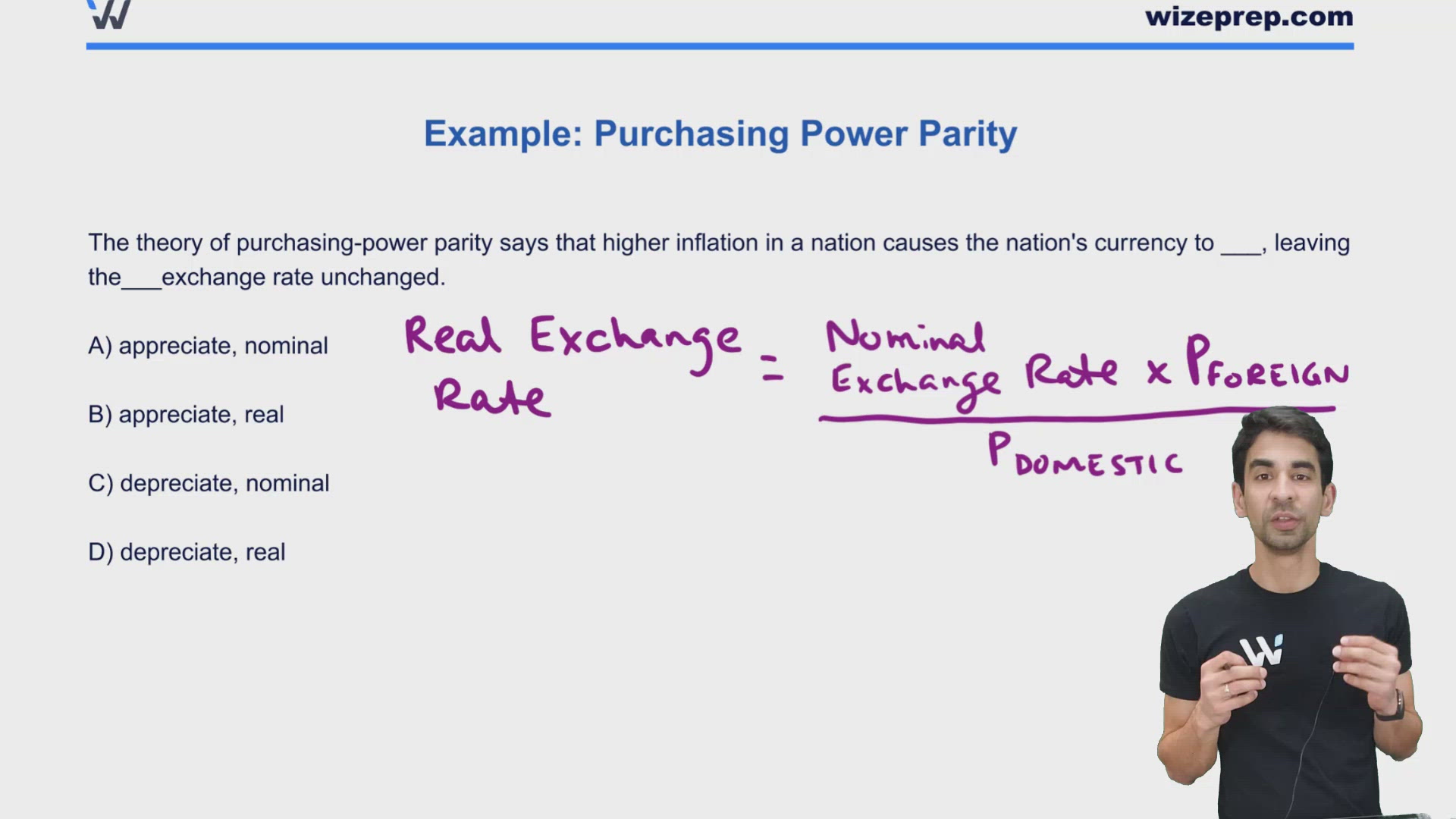
Example: Purchasing Power Parity
The theory of purchasing-power parity says that higher inflation in a nation causes the nation's currency to ___, leaving the___exchange rate unchanged.
A) appreciate, nominal
B) appreciate, real
C) depreciate, nominal
D) depreciate, real
D.
Higher inflation means other countries will not buy from your country so your currency will depreciate. However, according to purchasing power parity, the real exchange rate will still be equal to 1.
Practice: Purchasing Power Parity
If a cup of coffee costs 2 euros in Paris and $6 in Toronto and purchasing-power parity holds, what is the exchange rate?
Practice: Exchange Rate
If a nation's currency doubles in value on foreign exchange markets, the currency is said to___, reflecting a change in the ___ exchange rate.