Wize University Macroeconomics Textbook > Open Economy Macroeconomics
International Flows of Goods and Services
Popular Courses
ECON 203
Concordia University
Macroeconomics
University Study Guides
AP Macroeconomics Exam Prep Course
AP Exam Prep
ECONOMIC 1022A/B
Western University
Macroeconomics
General Course
ECON 102
University of British Columbia
ECON*1100
University of Guelph
Macroeconomics
University Study Guides
ECON 203
University of Calgary
ECON 102
University of Alberta
ECO102H1
University of Toronto
ECO 1102
University of Ottawa
ECON 1BB3
McMaster University
AP/ECON 1010 3.00
York University
ECON 110
Queen's University
ECON 105
Simon Fraser University
ECON 1102
Dalhousie University
ECON 1002
Carleton University
ECON 1BA3
McMaster University
ECON 330
McGill University
0:00 / 0:00
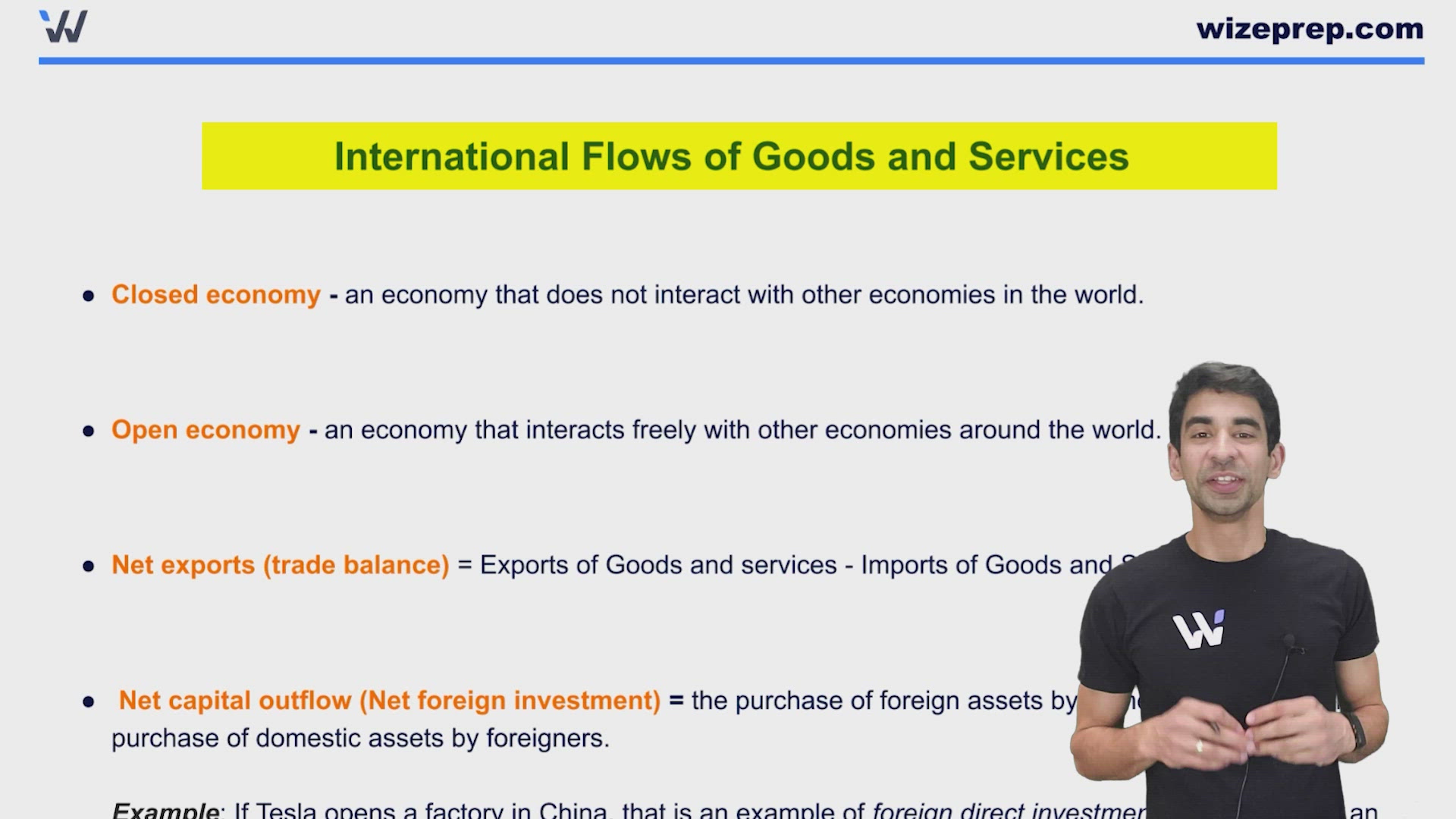
International Flows of Goods and Services
- Closed economy - an economy that does not interact with other economies in the world.
- Open economy - an economy that interacts freely with other economies around the world.
- Net exports (trade balance) = Exports of Goods and services - Imports of Goods and Services
- Net capital outflow (Net foreign investment) = the purchase of foreign assets by domestic residents - the purchase of domestic assets by foreigners. Example: If Tesla opens a factory in China, that is an example of foreign direct investment. Alternatively, if an American buys stocks in a Chinese company, that is an example of foreign portfolio investment. Both are considered capital outflows for the USA.
Example: If Bombardier, a Canadian company, sells some planes to a Japanese airline it causes Canadian net exports to increase. Let's say Bombardier exchanges the yen it got for dollars with a Canadian investment firm that wants the yen to buy stocks in a Japanese company like Sony. In this case, Bombardier's net export of planes equals the investment firm's net capital outflow in Sony stock. So, NX and NCO rise by an equal amount.
- When savings exceed domestic investment the net capital outflow must bepositiveand when the savings are less than domestic investment the net capital outflow must benegative
0:00 / 0:00
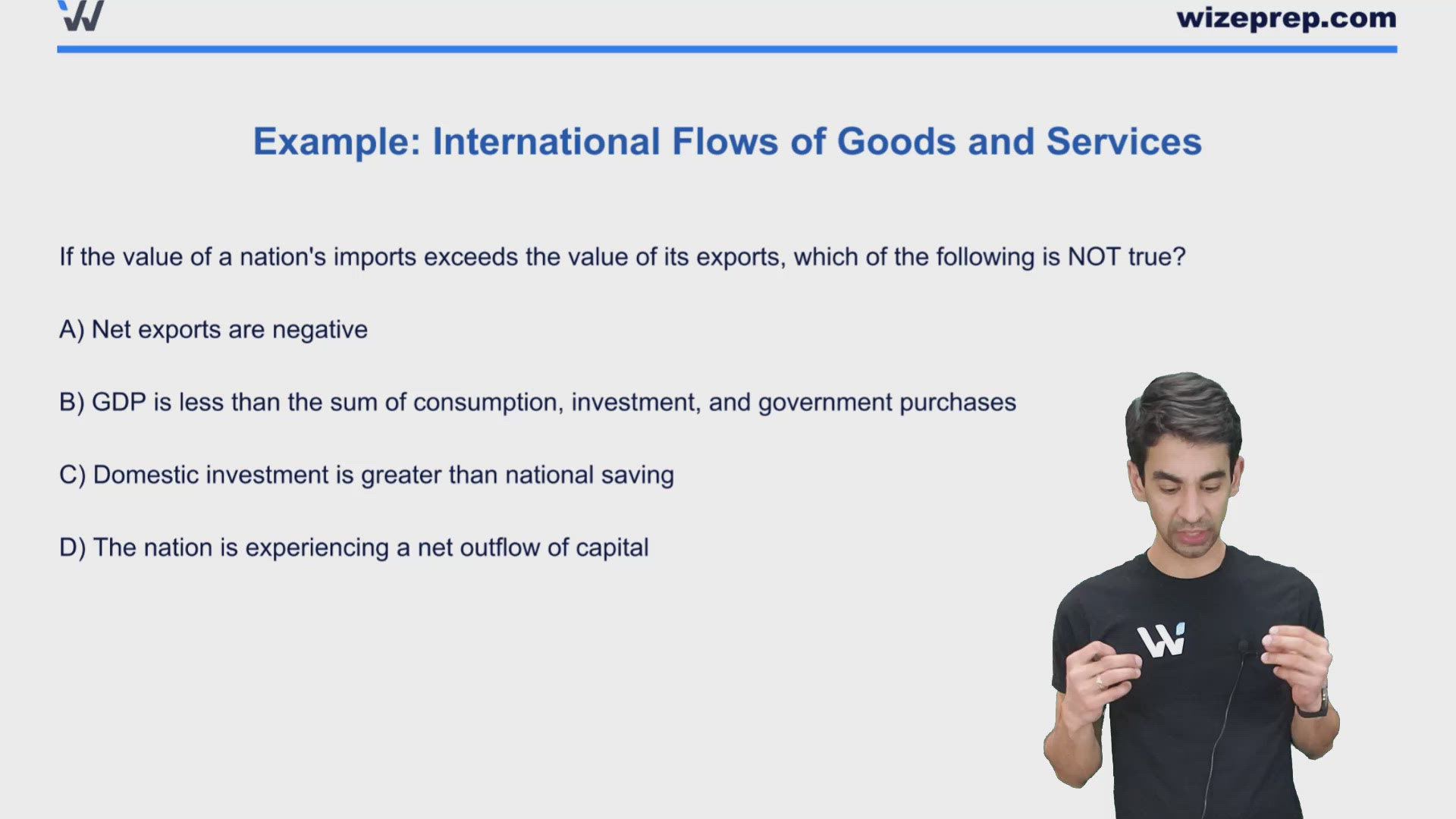
Example: International Flows of Goods and Services
If the value of a nation's imports exceeds the value of its exports, which of the following is NOT true?
A) Net exports are negative
B) GDP is less than the sum of consumption, investment, and government purchases
C) Domestic investment is greater than national saving
D) The nation is experiencing a net outflow of capital
D.
NX = NCO
If net exports are negative then this means net capital outflow is also negative, which means it is a capital inflow.
Practice: International Flows of Goods and Service
Comparing the North American economy today to that of 1950, what does one find to be true about exports and imports today as a percentage of GDP?
Practice: Net Capital Outflow
In an open economy, national saving equals domestic investment