Wize University Calculus 1 Textbook > Applications of Differentiation
L’Hopital’s Rule & Indeterminate Forms
Popular Courses
CALCULUS 1000A/B
Western University
Calculus 1
University Study Guides
AP Calculus (AB) Exam Prep Course
AP Exam Prep
MATH 1LS3
McMaster University
MATH 1LS3
McMaster University
MATH 249
University of Calgary
MATH 265
University of Calgary
Calculus 1
General Course
MATH 275
University of Calgary
MATH 140
McGill University
MATH 121
Queen's University
MAT135H1
University of Toronto
MATH*1080
University of Guelph
MATH 134
University of Alberta
Calculus 1
University Study Guides
MAT 1320
University of Ottawa
MATH 100
University of Alberta
MATH 203
Concordia University
MAT 1330
University of Ottawa
MTH 140
Toronto Metropolitan University

0:00 / 0:00
L’Hopital’s Rule (LHR)
Derivatives can actually help us solve limit problems. When we obtain the indeterminate forms or we can try to use L’Hopital’s Rule.
L’Hopital’s Rule
Consider two differentiable functions and on an open interval containing the number ( could be infinite). If either or . Then
provided the limit exists.
Note: LHR also applied to one-sided limits, i.e. when .
Watch Out!
You may have to apply L’Hopital’s Rule multiple times in the same limit to find a solution!
0:00 / 0:00
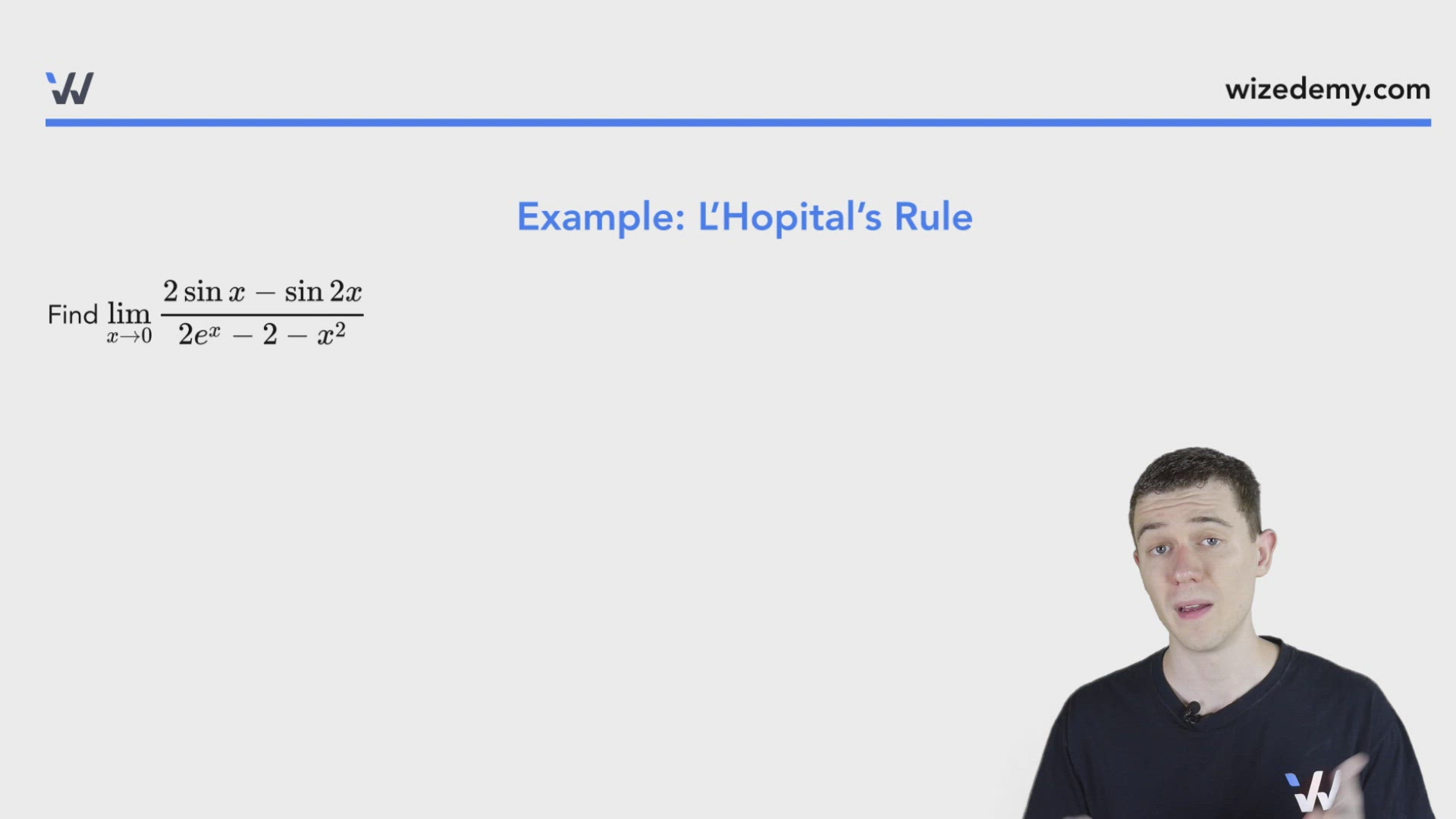
Example: L’Hopital’s Rule
Find
Find .