Newton's Method
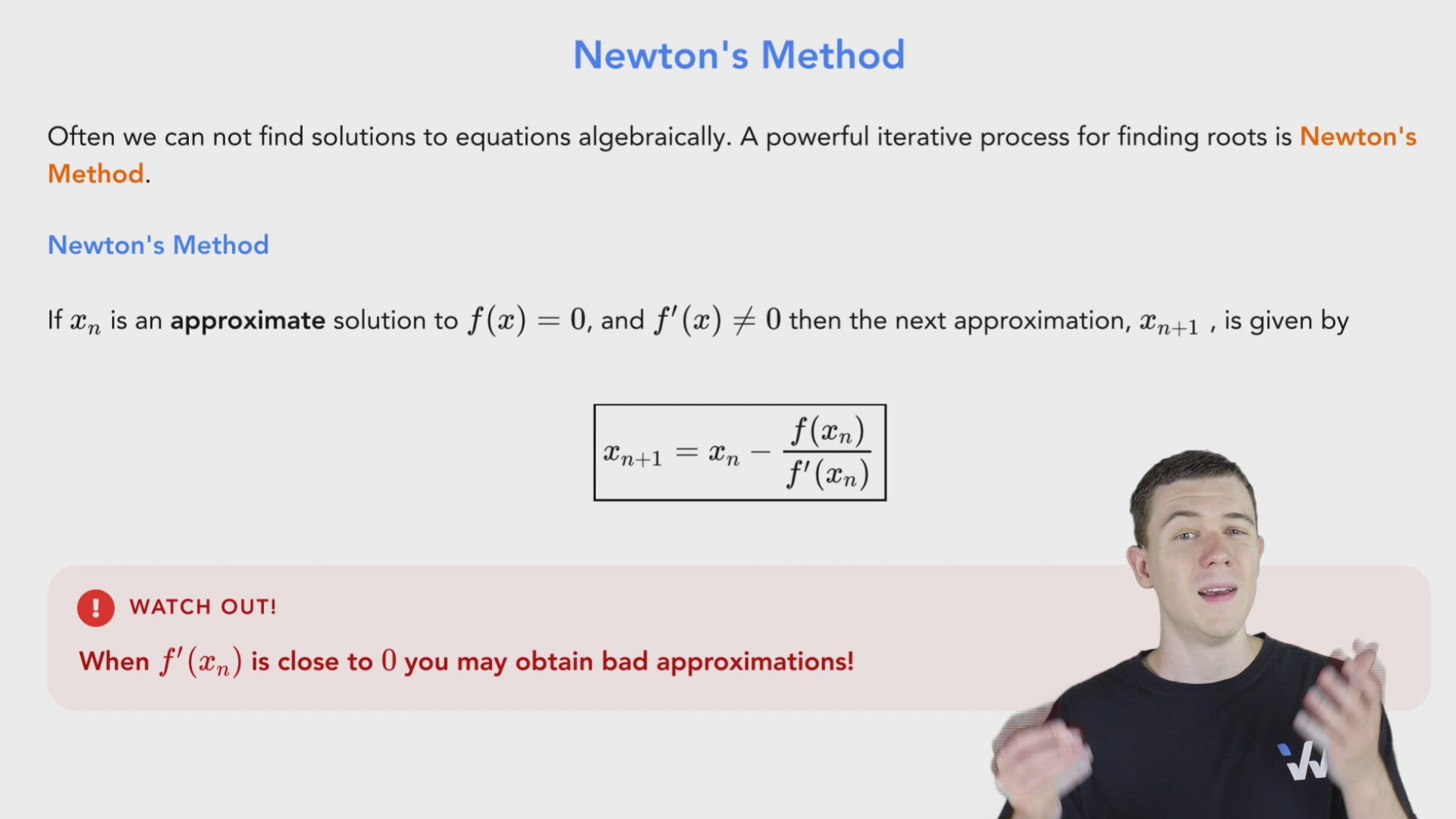
Often we can not find solutions to equations algebraically. A powerful iterative process for finding roots is Newton's Method.
Newton's Method
If is an approximate solution to , and then the next approximation, , is given by
Example: Newton's Method
Apply Newton’s Method three times to the function to approximate a solution to the equation
Start with
Example: Newton's Method
Approximate to 3 decimal places using Newton's method.
Notice that is a solution to the equation . Take ; then , and for ,
Since we know let's take . Since we're looking for three decimal places of accuracy, I'll round all results to four decimal places:
Since agree to (at least) three decimal places, we take