Wize University Calculus 1 Textbook > Applications of Differentiation
Taylor Polynomial Remainder
Popular Courses
Calculus 1
University Study Guides
MATH 100A
University of British Columbia
MATH 100C
University of British Columbia
MATH 1LS3
McMaster University
MATH 249
University of Calgary
MATH 265
University of Calgary
Calculus 1
General Course
MATH 275
University of Calgary
MATH 134
University of Alberta
Calculus 1
University Study Guides
MATH 100
University of Alberta
MATH 100B
University of British Columbia
MATH 100B
University of British Columbia
MTH 140
Toronto Metropolitan University
SC/MATH 1506 3.00
York University
MATH-1720
University of Windsor
NMM 1412A/B
Western University
MATH 180
University of British Columbia
MATH 222
McGill University
MATH 137
University of Waterloo

0:00 / 0:00
Taylor Polynomial Remainder
Since Taylor Polynomials are only evaluated to a finite value, they are approximations. Thus, there is some error when using a Taylor Polynomial. The error is the difference in the exact answer and the Taylor polynomial:
where is "evaluated at infinity”. Clearly, we cannot evaluate n at . However, we have the following result:
Taylor’s Remainder Theorem
The error of the nth degree Taylor Polynomial approximation, ,is given by
where is an unknown number between and .
Bounding Error
To find a bound on the error , we can maximize If we let
then
Procedure for Taylor Remainder
- Determine the function , the degree of the approximation , and the point at which it is centered about .
- Find a point , between and the in question, that maximizes .
- Use the equation above to compute a bound on the error.
0:00 / 0:00
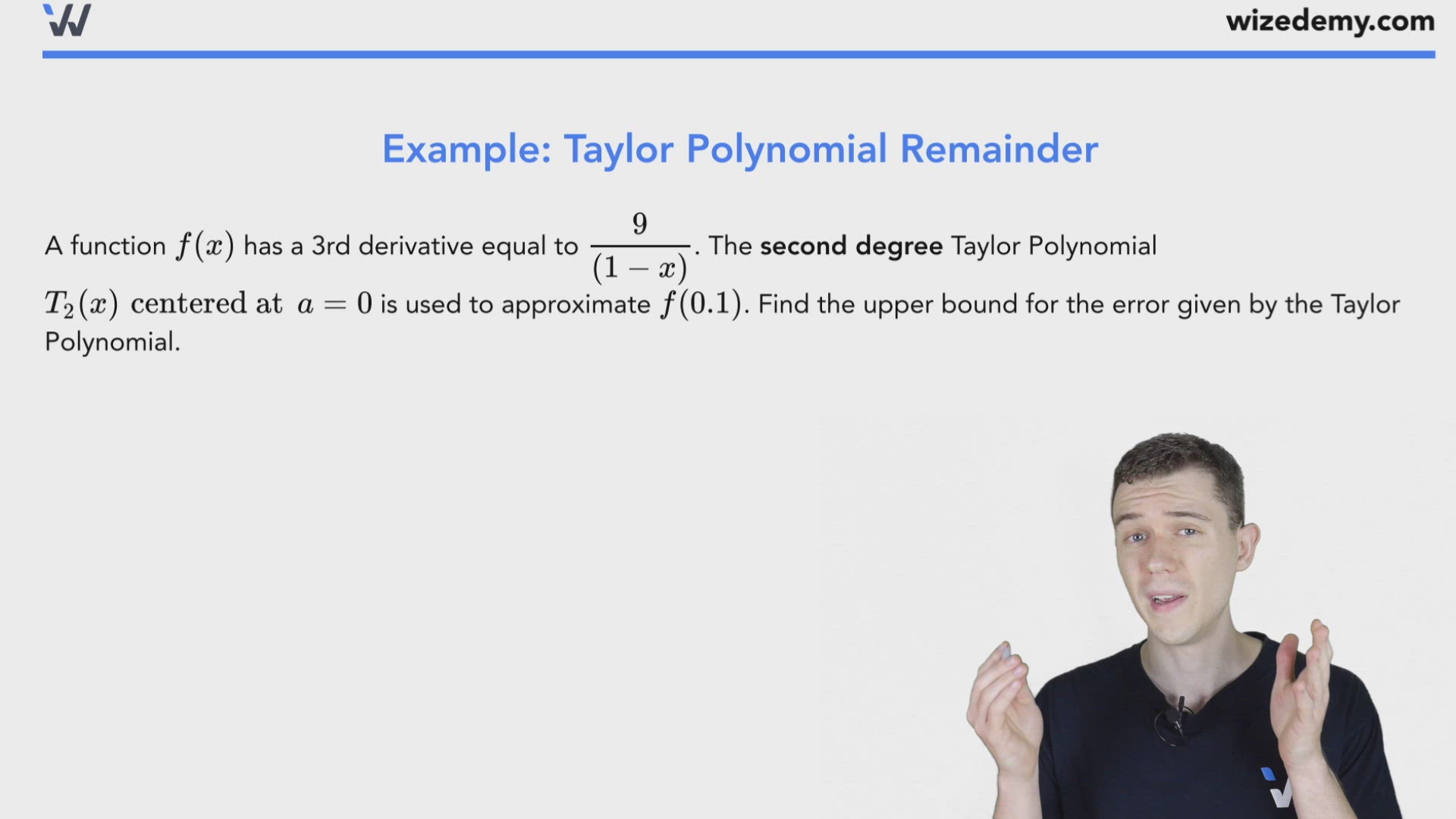
Example: Taylor Polynomial Remainder
A function has a 3rd derivative equal to . The second degree Taylor Polynomial is used to approximate . Find the upper bound for the error given by the Taylor Polynomial.
Thus the upper bound for the error is .
Practice: Taylor Polynomial Remainder
Use the remainder theorem check if the following inequality is true or false:
Let .