0:00 / 0:00

Trigonometric Substitution

Integrals containing a2−x2, a2+x2, or x2−a2\sqrt{a^2-x^2},\ \sqrt{a^2+x^2},\ \text{or} \ \sqrt{x^2-a^2} are often complicated to deal with. Thankfully, we can use our knowledge of trig identities and trig integrals to perform Trig Substitution.

Wize Concept
Don't do extra work! Remember the following forms don't require substitution:

∫1a2−x2dx=arcsin⁡(xa)+C∫1a2+x2dx=1aarctan⁡(xa)+C\begin{array}{} \displaystyle\int_{ }^{ }\frac{1}{\sqrt{a^2-x^2}}dx=\arcsin\left(\frac{x}{a}\right)+C \\ \\ \displaystyle \int_{ }^{ }\frac{1}{a^2+x^2}dx=\frac{1}{a}\arctan\left(\frac{x}{a}\right)+C \end{array}


PAGE BREAK

Trigonometric Substitutions

ExpressionSubstitutionIntervalTrigonometric Identitya2−x2x=asin⁡θ−π2≤θ≤π2cos⁡2θ=1−sin⁡2θa2+x2x=atan⁡θ−π2<θ<π2sec⁡2θ=1+tan⁡2θx2−a2x=asec⁡θ0≤θ<π2tan⁡2θ=sec⁡2θ−1or  π≤θ<3π2\def\arraystretch{2.5} \begin{array}{c|c|c|c} \text{Expression} & \text{Substitution} & \text{Interval} & \text{Trigonometric Identity} \\ \hline \sqrt{a^2-x^2} & x=a\sin\theta & -\frac{\pi}{2}\le\theta\le\frac{\pi}{2} & \cos^2\theta=1-\sin^2\theta\\ \hline \sqrt{a^2+x^2} & x=a\tan\theta & -\frac{\pi}{2}<\theta<\frac{\pi}{2} & \sec^2\theta=1+\tan^2\theta\\ \hline \sqrt{x^2-a^2}& x=a\sec\theta & 0\le\theta<\frac{\pi}{2} & \tan^2\theta=\sec^2\theta-1\\&& \text{or} \space \space \pi\le\theta<\frac{3\pi}{2} \end{array}

Note:aa is the constant; xx is the variable expression (this can be something like x−bx-b).

Watch Out!
Sometimes you need to make the integral appear this way. For example, by completing the square

x2−4x+7=(x−2)2+3\sqrt{x^2-4x+7}=\sqrt{\left(x-2\right)^2+3}


PAGE BREAK

Steps for Trig Substitutions

  1. Identify the expression
  • You may need to adjust it to the correct form
  • bx2→factor out the bbx^2 \rightarrow \text{factor out the b}
  • Trinomials→complete the square\text{Trinomials} \rightarrow \text{complete the square}
  1. Substitute for xx and dxdx
  2. Use the appropriate trig identity and simplify
  3. Compute the integral
  4. Back substitute to write the expression in terms of xx
  • You may need to draw a triangle and use the Pythagorean Theorem
0:00 / 0:00

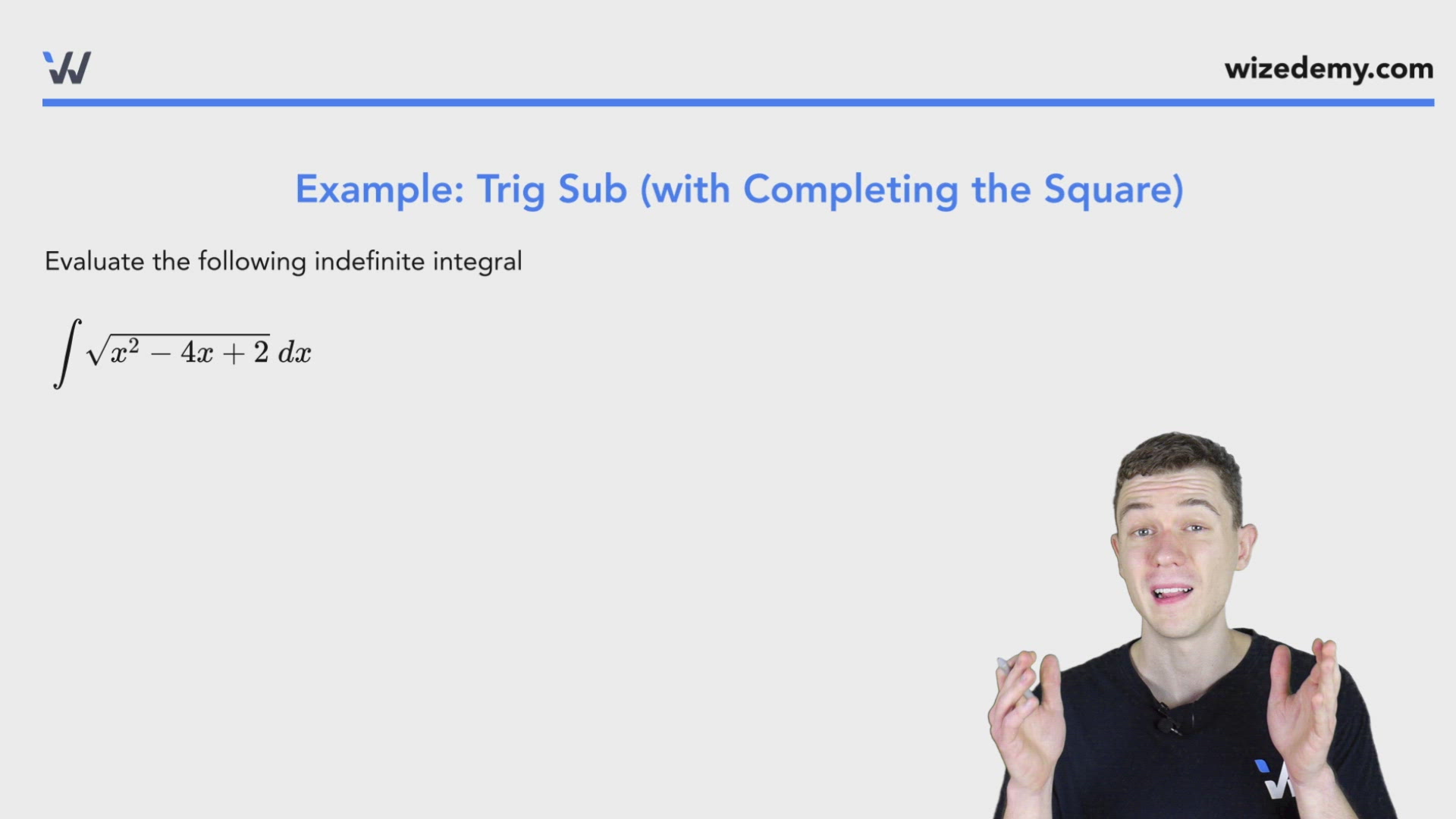
Example: Trig Sub (with Completing the Square)

Evaluate the following indefinite integral

∫x2−4x+2 dx{\displaystyle\int} \sqrt{x^2-4x+2 }\space dx

1. Identity the expression


This doesn't have the form we need yet, but we do have ...x2...\sqrt{...x^2...}.
Since we have a trinomial, we need to complete the square.

=∫(x−2)2−2 dx={\displaystyle \int}\sqrt{\left(x-2\right)^2-2} \ dx
The expression we have is x2−a2\sqrt{x^2-a^2} where the variable term is x−2x-2 and the constant term is a=2a=\sqrt{2}.

2. Substitute the appropriate terms for x and dx


Let x−2=a sec⁡θ  →  x−2=2sec⁡θx-2=a\ \sec\theta\ \ \to\ \ x-2=\sqrt{2}\sec\theta.
Then dx=2sec⁡θ tan⁡θ dθdx=\sqrt{2}\sec\theta\ \tan\theta\ d\theta
The new integral becomes:

=∫(2sec⁡θ)2−2(2sec⁡θ tan⁡θ dθ)={\displaystyle \int}\sqrt{\left(\sqrt{2}\sec\theta\right)^2-2}\left(\sqrt{2}\sec\theta\ \tan\theta\ d\theta\right)
=∫2sec⁡2θ−2(2sec⁡θ tan⁡θ dθ)={\displaystyle \int}\sqrt{2\sec^2\theta-2}\left(\sqrt{2}\sec\theta\ \tan\theta\ d\theta\right)
=∫2sec⁡2θ−1(2sec⁡θ tan⁡θ dθ)={\displaystyle \int}\sqrt 2\sqrt{\sec^2\theta-1}\left(\sqrt{2}\sec\theta\ \tan\theta\ d\theta\right)
=∫2sec⁡2θ−1(sec⁡θ tan⁡θ dθ)={\displaystyle \int}2\sqrt{\sec^2\theta-1}\left(\sec\theta\ \tan\theta\ d\theta\right)

3. Use the trig identity to simplify


=∫2tan⁡2θ(sec⁡θ tan⁡θ dθ)={\displaystyle \int}2\sqrt{\tan^2\theta}\left(\sec\theta\ \tan\theta\ d\theta\right)
=∫2tan⁡θ(sec⁡θ tan⁡θ dθ)={\displaystyle \int}2\tan \theta\left(\sec\theta\ \tan\theta\ d\theta\right)
=2∫sec⁡θ tan⁡2θ dθ=2{\displaystyle \int} \sec \theta \ \tan^2\theta\ d\theta
=2∫sec⁡θ (sec⁡2θ−1) dθ=2{\displaystyle \int}\sec \theta \ (\sec^2\theta-1)\ d\theta
=2∫(sec⁡3θ−sec⁡θ) dθ=2{\displaystyle \int}(\sec^3\theta-\sec\theta)\ d\theta

4. Solve the integral

We will use the known forms for both these integrals.

=2[sec⁡θ tan⁡θ+ln⁡∣sec⁡θ+tan⁡θ∣2−ln⁡∣sec⁡θ+tan⁡θ∣]+C\displaystyle =2\left[\frac{\sec\theta\ \tan\theta+\ln\left|\sec\theta+\tan\theta\right|}{2}-\ln\left|\sec\theta+\tan\theta\right|\right]+C
=sec⁡θ tan⁡θ+ln⁡∣sec⁡θ+tan⁡θ∣−2ln⁡∣sec⁡θ+tan⁡θ∣+C=\sec\theta\ \tan\theta+\ln\left|\sec\theta+\tan\theta\right|-2\ln\left|\sec\theta+\tan\theta\right|+C
=sec⁡θ tan⁡θ−ln⁡∣sec⁡θ+tan⁡θ∣+C=\sec\theta\ \tan\theta-\ln\left|\sec\theta+\tan\theta\right|+C

5. Back substitute to make it in terms of x
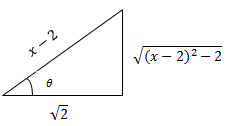
Since we let x−2=2sec⁡θx-2=\sqrt{2}\sec\theta, we can rearrange to get sec⁡θ=x−22 → cos⁡θ=2x−2 \sec\theta=\frac{x-2}{\sqrt{2}}\ \to\ \cos\theta=\frac{\sqrt{2}}{x-2}. Using this, we can draw a triangle where the adjacent side is 2\sqrt{2} and the hypotenuse is x−2x-2. We can also find the opposite side using Pythagorean theorem.


Now we are able to replace the trig ratios in our answer and rewrite it back in terms of x:
=(x−22)((x−2)2−22)−ln⁡∣x−22+(x−2)2−22∣+C\displaystyle =\left(\frac{x-2}{\sqrt{2}}\right)\left(\frac{\sqrt{\left(x-2\right)^2-2}}{\sqrt{2}}\right)-\ln\left|\frac{x-2}{\sqrt{2}}+\frac{\sqrt{\left(x-2\right)^2-2}}{\sqrt{2}}\right|+C
=(x−2)(x−2)2−22−ln⁡∣x−2+(x−2)2−22∣+C\displaystyle =\frac{\left(x-2\right)\sqrt{\left(x-2\right)^2-2}}{2}-\ln\left|\frac{x-2+\sqrt{\left(x-2\right)^2-2}}{\sqrt{2}}\right|+C

Practice: Trig Sub

Evaluate the following indefinite integral

∫1x24−x2 dx\displaystyle \int \frac{1}{x^2\sqrt{4-x^2}} \,dx

Practice: Trig Sub

Evaluate the following indefinite integral

∫1(x2−6x+11)2dx\displaystyle\int \frac{1}{(x^2-6x+11)^2} dx

Extra Practice