Wize University Physics Textbook (Master) > Work and Energy
Work-Energy Theorem
Popular Courses
MCAT
General Course
PHYSICS 1201A/B
Western University
Intro to Physics
University Study Guides
PHYSICS 1D03
McMaster University
AP Physics C: Mechanics Exam Prep Course
AP Exam Prep
Physics
General Course
PHYS 115
Queen's University
PCS 211
Toronto Metropolitan University
PHYS 204
Concordia University
PHYS*1300
University of Guelph
Intro to Physics
University Study Guides
PHY 1321
University of Ottawa
PHYS 131
McGill University
APSC 111
Queen's University
PHYS 111
University of Waterloo
PCS 120
Toronto Metropolitan University
PHYS 110
University of Victoria
LE/PHYS 1800 3.00
York University
PHYS-1400
University of Windsor
PHY131H1
University of Toronto

0:00 / 0:00
Work-Energy Theorem
An object that moves with velocity v has kinetic energy calculated by:
- Kinetic energy is a scalar quantity and measured in Joule.
- Kinetic energy is also shown by .
Work-Energy Theorem
The work done by all forces acting on a body is equal to the change in the body's kinetic energy.
Example:
Work can be either positive or negative or zero!
- If , the net force speeds up the object
- If , the net force slows down the object
Watch Out!
, because . If you don't believe me, try plugging in numbers to see!
0:00 / 0:00
Example: Work-Energy Theorem
A 200-kg load is lifted 20.0 m vertically with an acceleration a = 0.160g by a single cable. Determine
(a) the tension in the cable,
(b) the net work done on the load,
(c) the work done by the cable on the load,
(d) the work done by gravity on the load, and
(e) the final speed of the load assuming it started from rest
Solution: Free body diagram
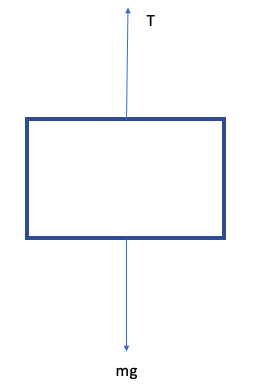
Part a)
To find T
Part b)
To find net work done on the load
Part c)
work done by cable on the load
Part d)
work done by gravity on the load
Part e)
since
A 1.60-m tall person lifts a 2.10-kg book from the ground so it is 2.20 m above the ground. What is the potential energy of the book relative to
(a) the ground
(b) and the top of the person’s head?
(c) How is the work done by the person related to the answers in parts ( a) and ( b)?
A man carries a box up a flight of stairs. If the angle of the stairs is and the man travels a total distance of , how much work does he do to the box? How much work does he do in total?
A 2.00-kg block is pushed against a spring with negligible mass and force constant k= 400 N/m, compressing it 0.220 m. When the block is released , it moves along a friction-less , horizontal surface and then up a friction-less incline with slope (Fig).
(a) What is the speed of the block as it slides along the horizontal surface after having left the spring?
(b) How far does the block travel up the incline before starting to slide back down?
