Popular Courses
PHYSICS 1201A/B
Western University
Intro to Physics
University Study Guides
Grade 12 Physics
Ontario High School
PHYSICS 1D03
McMaster University
AP Physics C: Mechanics Exam Prep Course
AP Exam Prep
Physics
General Course
High School Physics
US High School
Grade 12 Physics
Canada High School
PHYS 115
Queen's University
PHYS 211
University of Calgary
PHYSICS 1401A/B
Western University
PCS 211
Toronto Metropolitan University
PHYS 204
Concordia University
PHYS 204
Concordia University
Intro to Physics
University Study Guides
Physics 30
Alberta High School
PHYS*1080
University of Guelph
PHY 1321
University of Ottawa
PHYS 131
McGill University
APSC 111
Queen's University
0:00 / 0:00
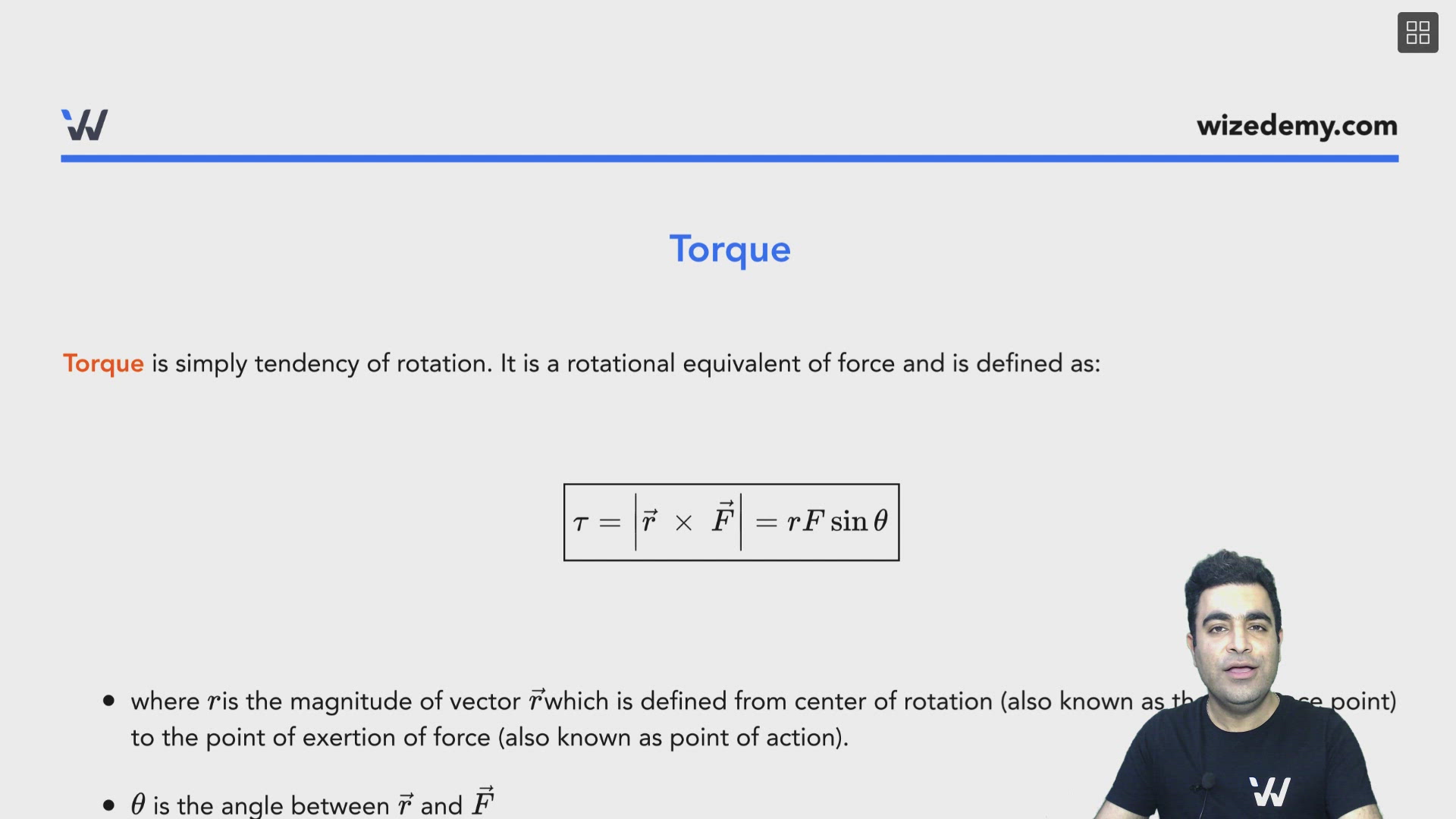
Torque
Torque is simply tendency of rotation. It is a rotational equivalent of force and is defined as:
- where is the magnitude of vector which is defined from center of rotation (also known as the reference point) to the point of exertion of force (also known as point of action).
- is the angle between and
- unit for torque is

Watch Out!
Torque is a vector so it has magnitude and direction. In two dimensions, torque is positive if it generates a counter-clockwise rotation and it is negative if it generates a clockwise rotation.
Exam Tip
If there are more than one force acting on an object, net torque of the system would be the sum of all torque vector corresponding to different forces. Make sure to add them as Vectors!!
Example:
Wize Tip
Forces cause NO torque when they are:
- Parallel to the axis of rotation,
- Acting at the center of rotation (r=0)
0:00 / 0:00
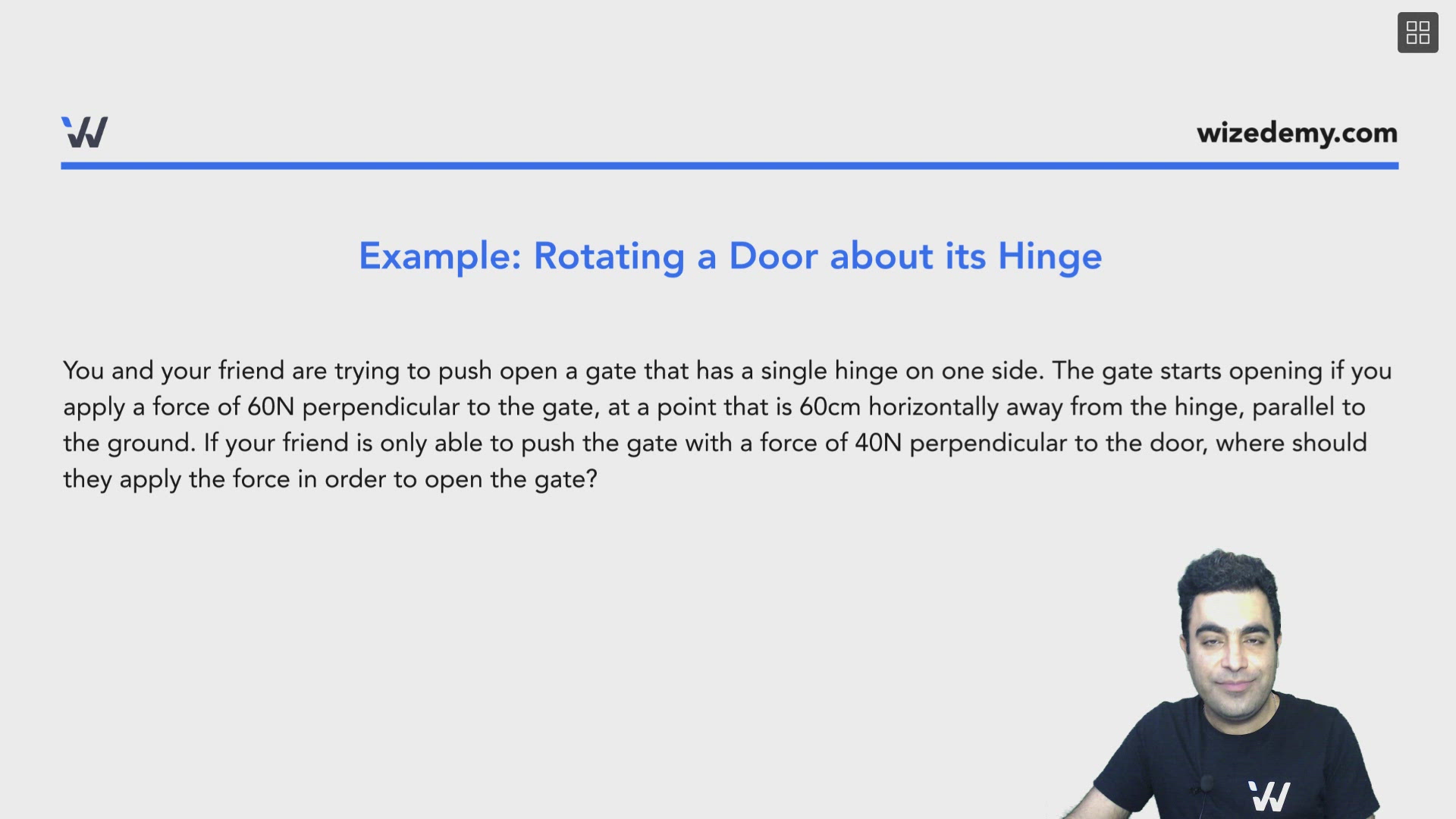
Example: Rotating a Door about its Hinge
You and your friend are trying to push open a gate that has a single hinge on one side. The gate starts opening if you apply a force of 60N perpendicular to the gate, at a point that is 60cm horizontally away from the hinge, parallel to the ground. If your friend is only able to push the gate with a force of 40N perpendicular to the door, where should they apply the force in order to open the gate?
Solution:
The same amount of torque is required to open the gate.
You
Since you apply a force of 60N perpendicular to the gate, the angle between and is :
Your friend
Therefore, your friend should push the door at a distance of 90 cm away from the hinge, parallel to the ground.
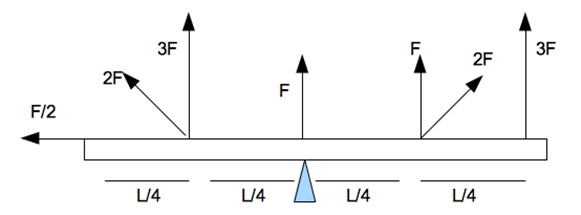
Seven forces are applied to a beam supported at the center as shown. Rank the torques produced by each force about the hinge from greatest to least, labeling the forces from 1-7 starting left to right (2F forces make an angle of respect to the beam)