Popular Courses
PHYSICS 1201A/B
Western University
Intro to Physics
University Study Guides
PHYSICS 1D03
McMaster University
AP Physics C: Mechanics Exam Prep Course
AP Exam Prep
Physics
General Course
PHYS 211
University of Calgary
PHYSICS 1401A/B
Western University
PHYS 101
McGill University
PCS 211
Toronto Metropolitan University
PHYS 204
Concordia University
PHYS 204
Concordia University
Intro to Physics
University Study Guides
PHYS*1080
University of Guelph
PHY 1321
University of Ottawa
PHYS 131
McGill University
APSC 111
Queen's University
PHYS 111
University of Waterloo
PHYS 110
University of Victoria
LE/PHYS 1800 3.00
York University
PHYS-1400
University of Windsor
0:00 / 0:00
Moment of Inertia of Discrete Particles
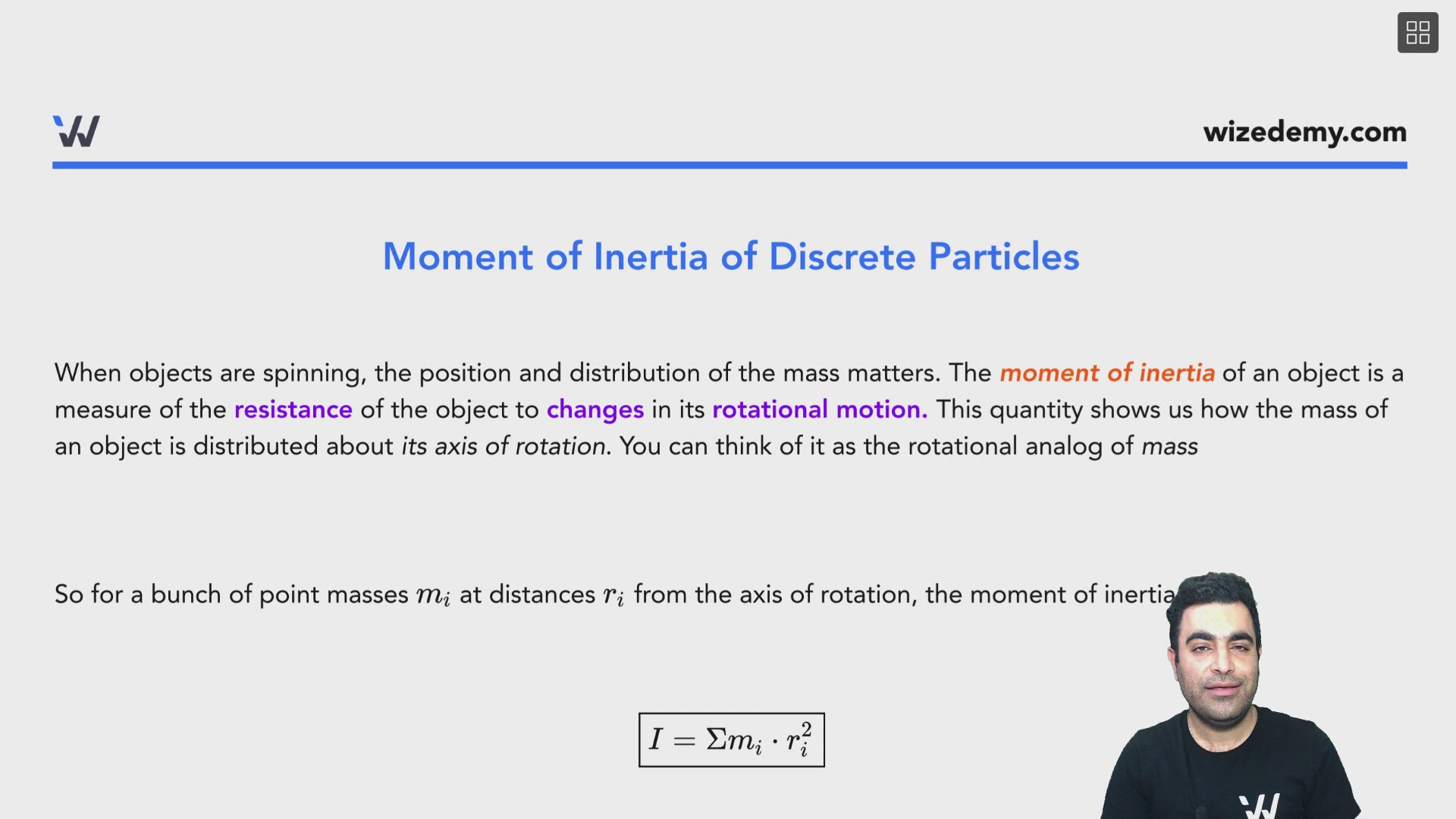
When objects are spinning, the position and distribution of the mass matters. The moment of inertia of an object is a measure of the resistance of the object to changes in its rotational motion. This quantity shows us how the mass of an object is distributed about its axis of rotation. You can think of it as the rotational analog of mass
So for a bunch of point masses at distances from the axis of rotation, the moment of inertia is
and it has units of SI units of .
Watch Out!
Based on its definition, the value of changes if the axis of rotation changes.
0:00 / 0:00
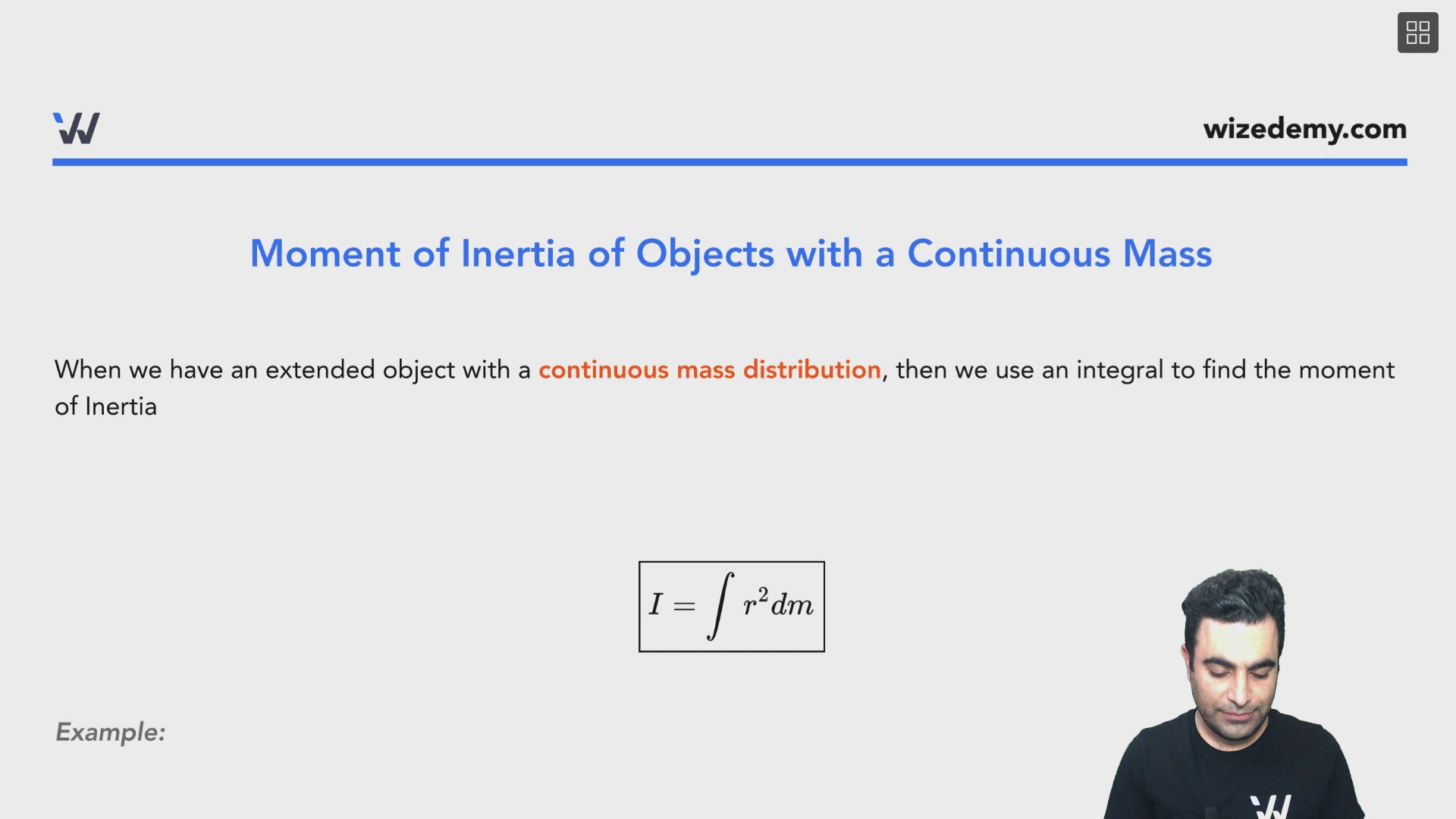
Moment of Inertia of Objects with a Continuous Mass
When we have an extended object with a continuous mass distribution, then we use an integral to find the moment of Inertia
Example:
Watch Out!
Moment of Inertia changes if a different axis of rotation is chosen. Thus, pay attention to the axis of rotation introduced in the problem.
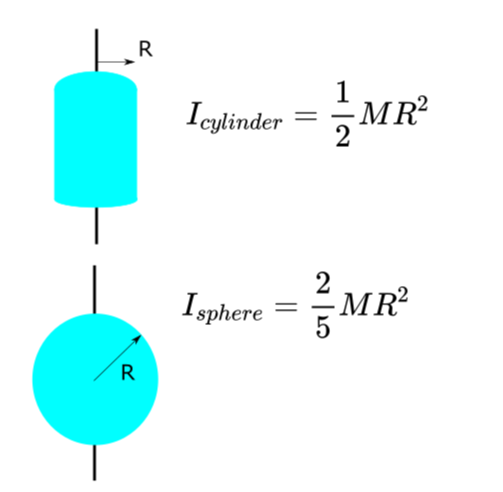
Here are the moments of inertia formulas for some common shapes:
0:00 / 0:00
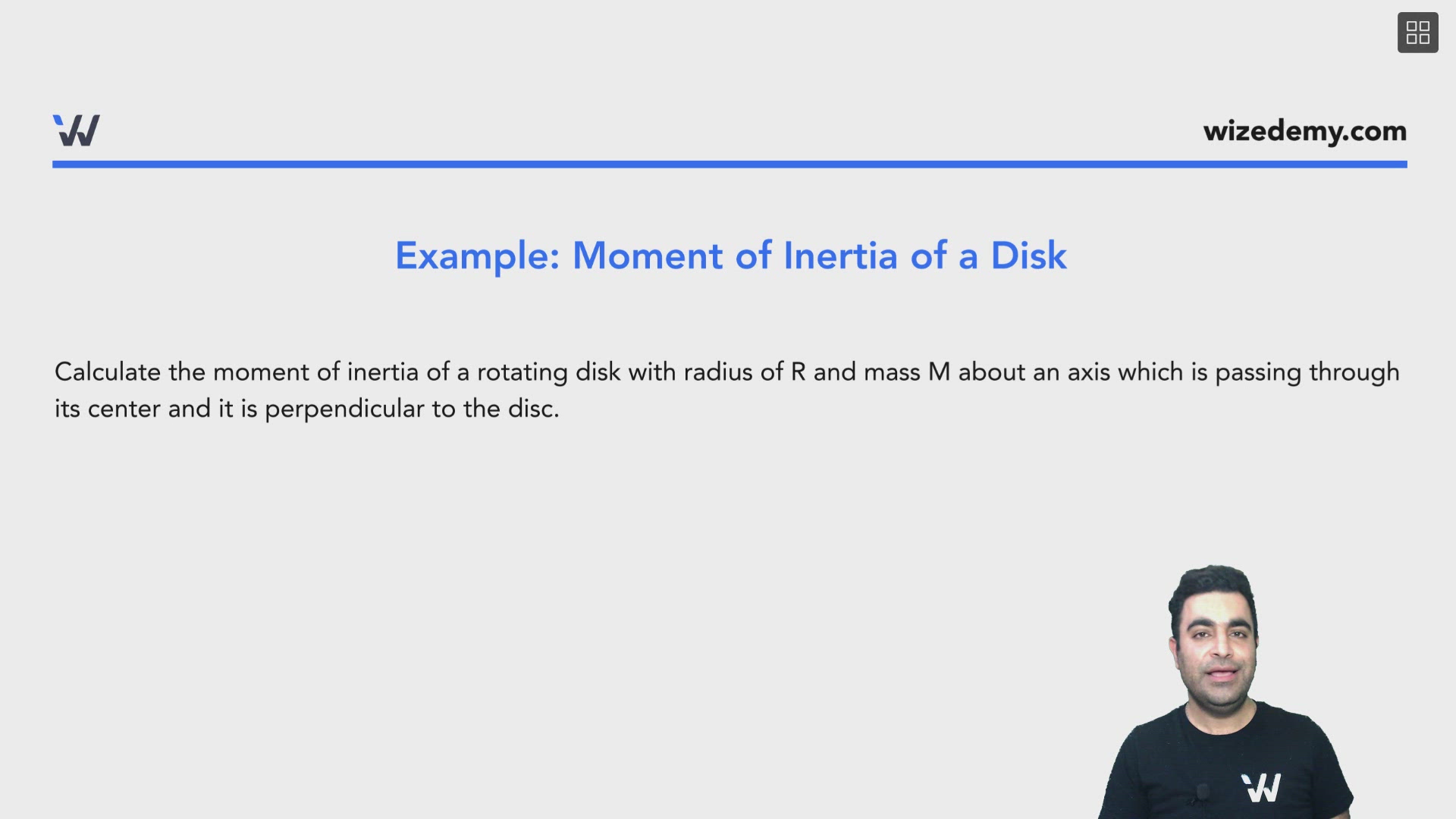
Example: Moment of Inertia of a Disk
Calculate the moment of inertia of a rotating disk with radius of R and mass M about an axis which is passing through its center and it is perpendicular to the disc.
Solution
Since we have a continuous mass distribution, we have to use integration to find its moment of inertia:
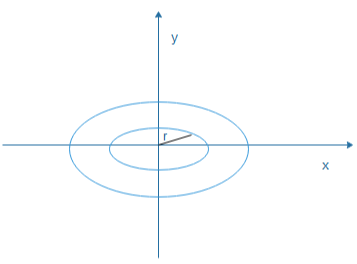
You can consider r to be the position of dis particles respect to the axis of rotation as shown in the above picture.
Furthermore, can be considered as the mass of all disk particles at distance away from the axis of rotation. These particles make a ring with radius of r and infinitesimally small thickness of :
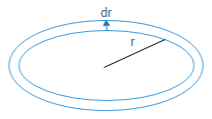
We can estimate the area of the disk covered by this ring to be: and its mass would be its area multiplied by mass density where mass density can be found as:
Now we are ready to insert above expression for into the integral definition for moment of inertia and do the integral:
A satellite is rotating once per minute. It has a moment of inertia of 10,000kg⋅m2. Erin, an astronaut, extends the satellite's solar panels, increasing its moment of inertia to 30,000kg⋅m2. How quickly is the satellite now rotating?
The engine of a turbine has a torque of 100 Nm. The engine rotates a 20 m long and 100 kg blade. How long does it take the blade to reach to 400 rpm? Model the blade as a thin rod.