Wize University Physics Textbook (Master) > Angular / Rotational Motion
Parallel Axis Theorem
Popular Courses
PHYSICS 1201A/B
Western University
Intro to Physics
University Study Guides
PHYSICS 1D03
McMaster University
AP Physics C: Mechanics Exam Prep Course
AP Exam Prep
Physics
General Course
PHYSICS 1401A/B
Western University
PCS 211
Toronto Metropolitan University
PHYS 204
Concordia University
PHYS 204
Concordia University
Intro to Physics
University Study Guides
PHY 1321
University of Ottawa
PHYS 131
McGill University
APSC 111
Queen's University
PHYS 111
University of Waterloo
PHYS 110
University of Victoria
LE/PHYS 1800 3.00
York University
PHY 1331
University of Ottawa
PHYS 142
McGill University
PHYC 1190
Dalhousie University
ENGG 212
University of Calgary
0:00 / 0:00
Parallel Axis Theorem
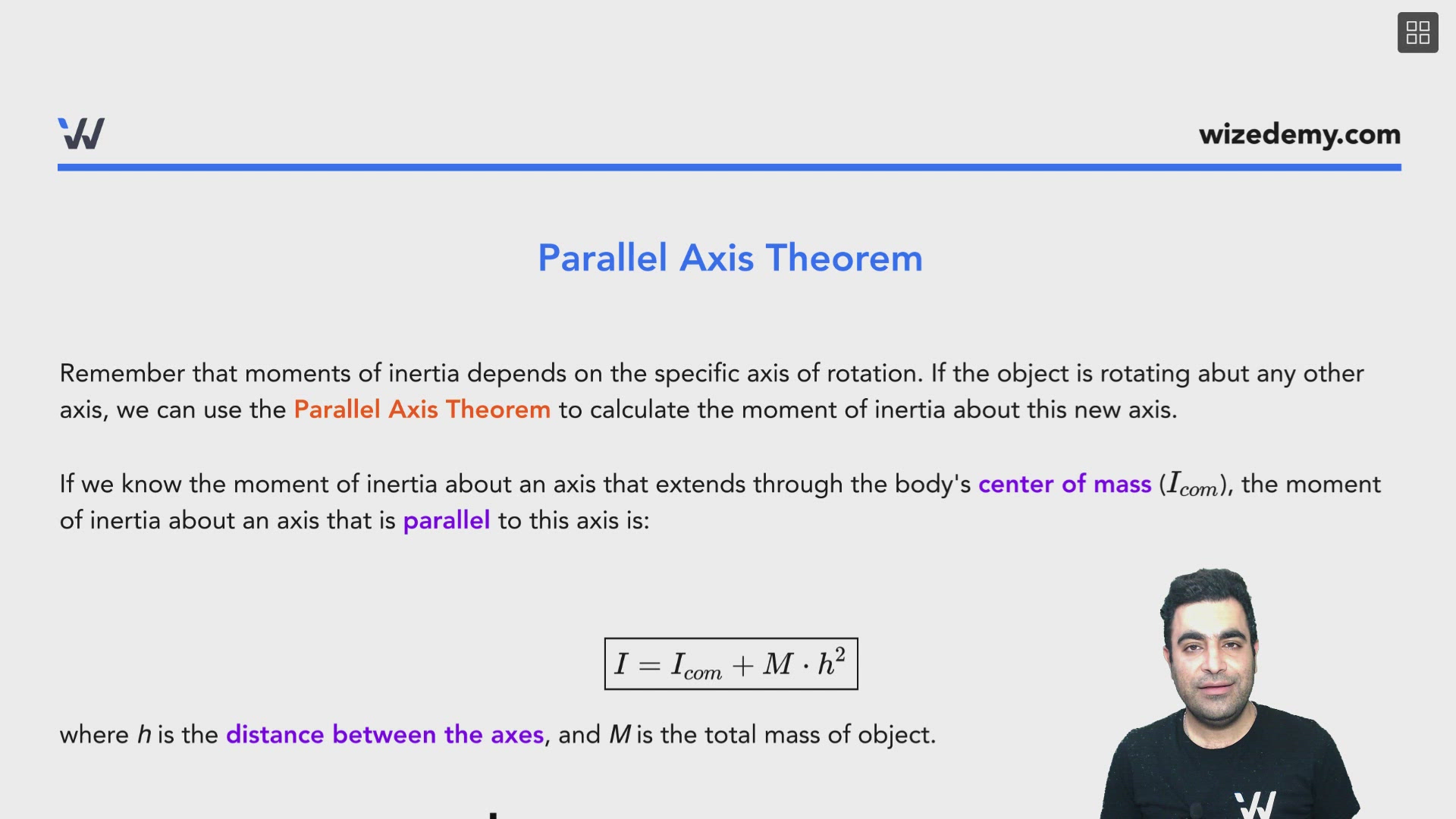
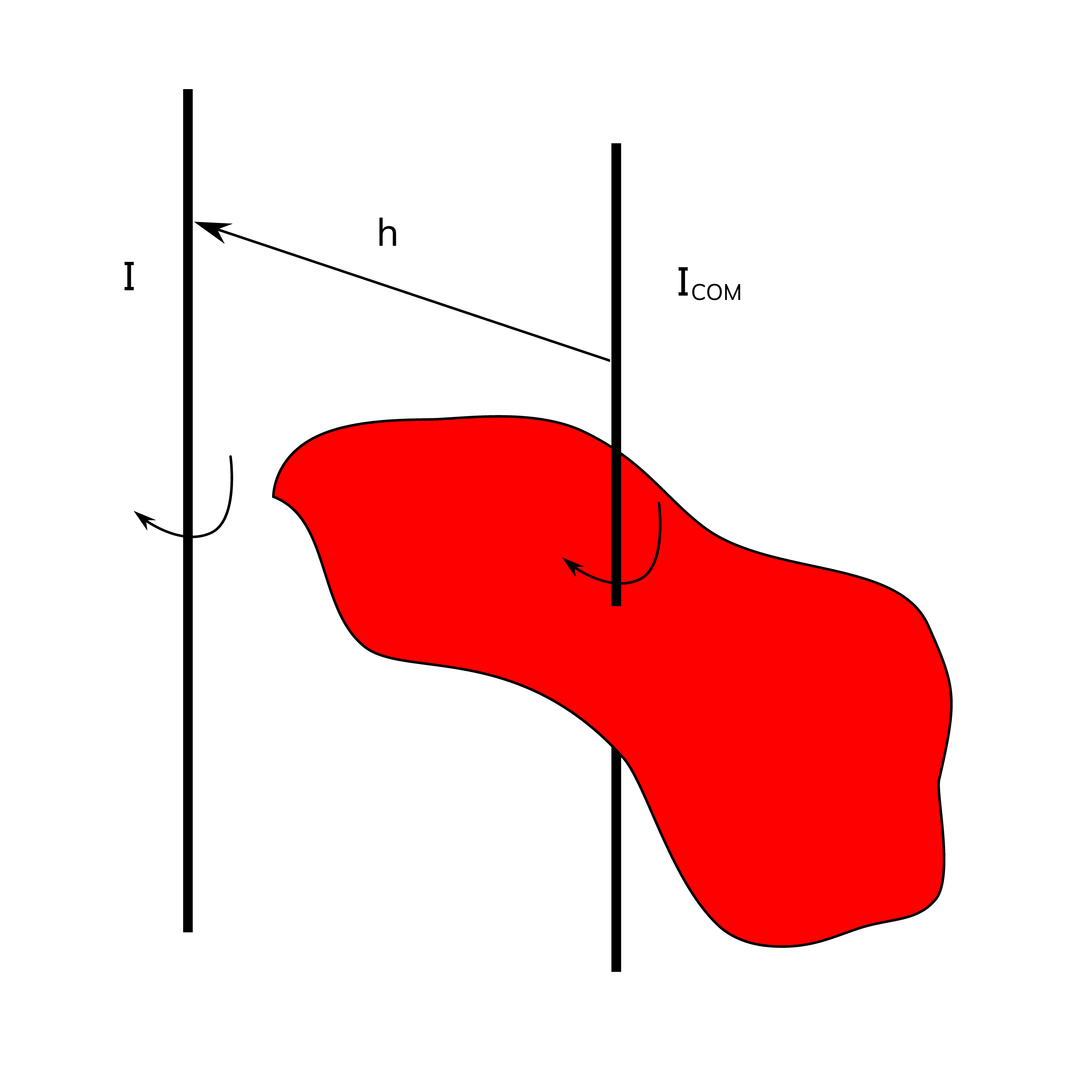
Remember that moments of inertia depends on the specific axis of rotation. If the object is rotating abut any other axis, we can use the Parallel Axis Theorem to calculate the moment of inertia about this new axis.
If we know the moment of inertia about an axis that extends through the body's center of mass (), the moment of inertia about an axis that is parallel to this axis is:
where h is the distance between the axes, and M is the total mass of object.
Watch Out!
The moments of inertia given in the tables usually assume rotation about the center of mass. Most likely you will get problems on the exam assuming the same. However, if the object is rotating about any other axis, use the Parallel Axis Theorem.
Moment of Inertia of Composite Shapes
Exam Tip
Note that moment of inertia is additive. For composite shapes, you can use the moments of inertia of their sub-components to find the moment of inertia, as long as you are careful with the axis of rotation for each sub-component.
0:00 / 0:00
Example: Snowman Moment of Inertia
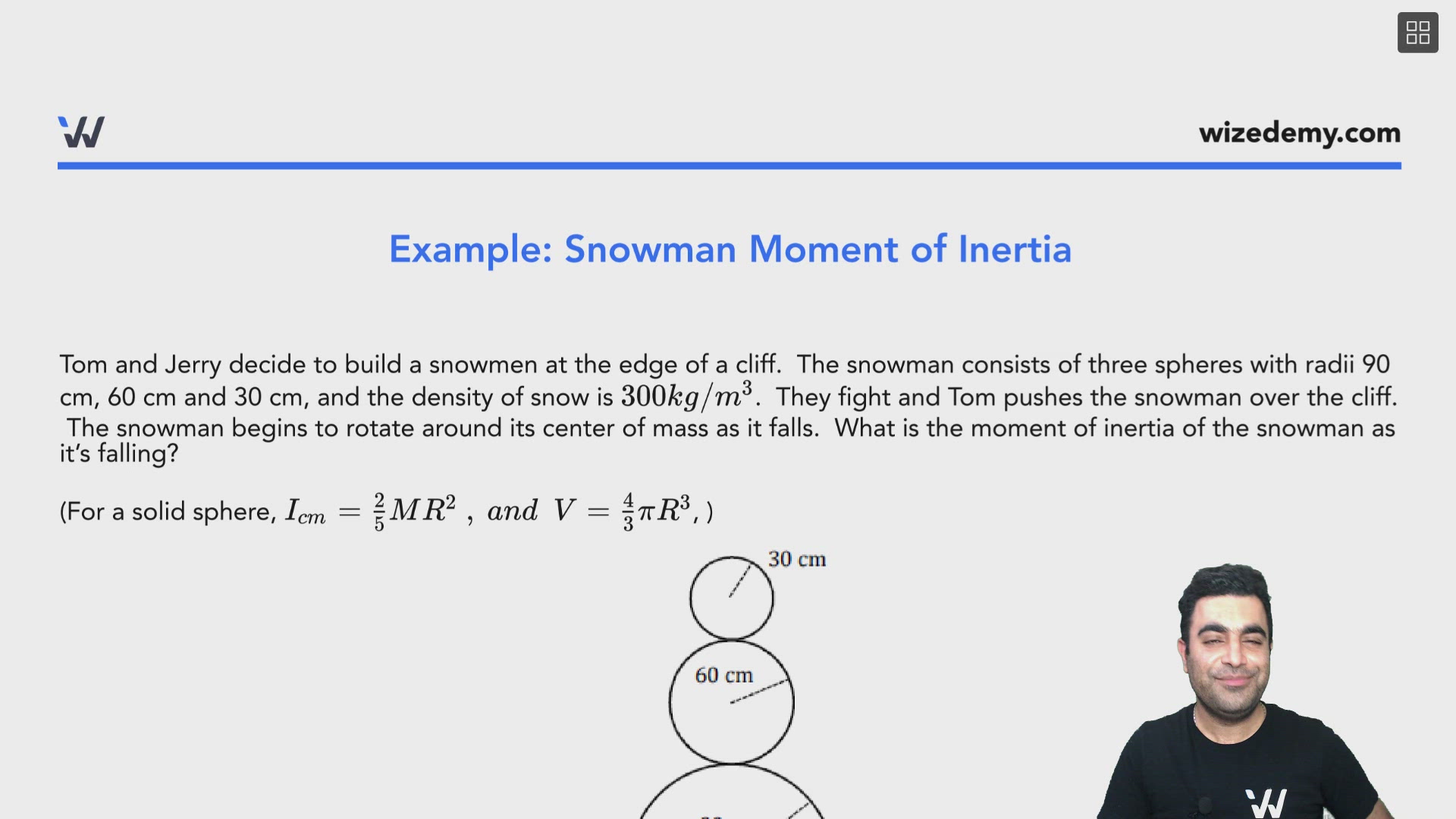
Tom and Jerry decide to build a snowmen at the edge of a cliff. The snowman consists of three spheres with radii 90 cm, 60 cm and 30 cm, and the density of snow is . They fight and Tom pushes the snowman over the cliff. The snowman begins to rotate around its center of mass as it falls. What is the moment of inertia of the snowman as it’s falling?
(For a solid sphere, , )
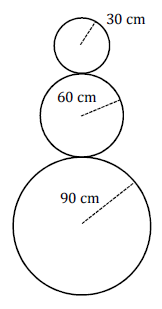
Solution:
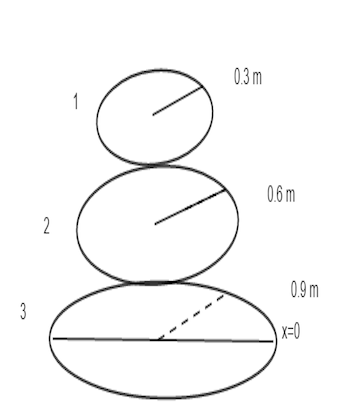
Let's label spherical snowballs as 1, 2 and 3 as shown in the picture.
First we can find mass of each snowball using their radius and density of snow:
Now we need to find the center mass position. We can guess that due to symmetry it should be on the line passing through center of all snowballs. We can find its height respect to any arbitrary point. I chose the center of lowest snowball (the third one in the picture).
So, the position of the snowman center of mass respect to the center of the lowest snowball is:
So, the snowman center of mass is 0.4m above the center of the lowest snowball or 1.3m above the ground.
Since the snowman is rotating about its center of mass, we need to find its moment of inertia respect to this point. We can use the formula given to us to find the moment of inertia of each snowball about its own center of mass and then use parallel axis theorem to calculate its moment of inertia about the snowman's center of mass.
We can use the radius of snowballs to find the distance between their center of mass and the snowman's center of mass (axis of rotation)
Finally, we need to add above moments of inertia to find the snowman's moment of inertia
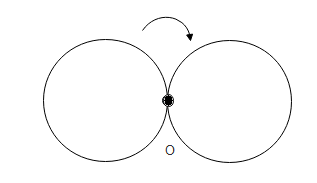
Two thin Hoops each of mass M and radius of R are joined together as shown in the figure. What is the moment of inertia for rotations in the plane of the page about pint O?
(The moment of inertia of a hoop with mass M and Radius R about an axis perpendicular to it and passing through its center is equal to )