Popular Courses
PHYSICS 1201A/B
Western University
PHYSICS 1201A/B
Western University
Intro to Physics
University Study Guides
PHYSICS 1D03
McMaster University
AP Physics C: Mechanics Exam Prep Course
AP Exam Prep
Physics
General Course
PCS 211
Toronto Metropolitan University
PHYS 204
Concordia University
PHYS 204
Concordia University
Intro to Physics
University Study Guides
PHYS*1080
University of Guelph
PHY 1321
University of Ottawa
PHYS 131
McGill University
APSC 111
Queen's University
APSC 111
Queen's University
PHYS 111
University of Waterloo
PHYS 110
University of Victoria
LE/PHYS 1800 3.00
York University
PHYS-1400
University of Windsor
PHY131H1
University of Toronto

0:00 / 0:00
Rolling without Slipping
Rolling without slipping is a combination of two motions:
1- A transitional motion of the center of the mass with the velocity of:
2- A rotational motion of all the points on the object
Watch Out!
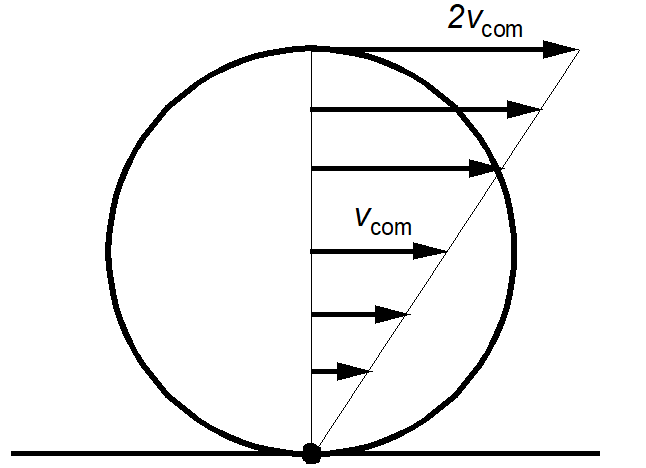
In rolling without slipping, the point of contact (point in contact to the surface) is instantaneously at rest! So all points of the rolling object are rotating about this point of contact.
Figure below shows the velocity distribution with respect to distance from the point of contact.
Wize Tip
The rolling without slipping motion is usually caused by the static friction between the point of contact and surface.
Exam Tip
For rolling without slipping:
Energy of a Rolling Object
Since a rolling object has both translational and rotational motion, the total kinetic energy for an object rolling without slipping is
where the first term is the translational kinetic energy of the center of mass and the second term is the rotational kinetic energy of the object.
0:00 / 0:00
Example: Static Friction for Rolling Down a Slope
Show that the friction for a round object of radius R rolling (without slipping) down an incline of angle has magnitude given by

Let clockwise rotation be positive, and let the x and y directions be along the slope and perpendicular to the slope. Positive is up for y, and downward along the slope for x.
Solution:
Consider the forces in the x direction:
Consider the net torque on the system relative to the center of mass: (Note that only friction has a non-zero torque about the object's center of mass)
Because the object is rolling without slipping,
Plugging this into the force equation:
Note that in order to have rolling without slipping this static friction should be smaller than the maximum static friction which is equal to . Otherwise, the object will slip during rolling.
Practice: Rolling Marble on a Loop-the-Loop Track
A marble starts from rest and rolls without slipping on the loop-the-loop track in the figure. Find the minimum starting height h from which the ball will remain on the track throughout the loop. Assume the marble's radius is small compared with R. The moment of inertia for a solid sphere is .
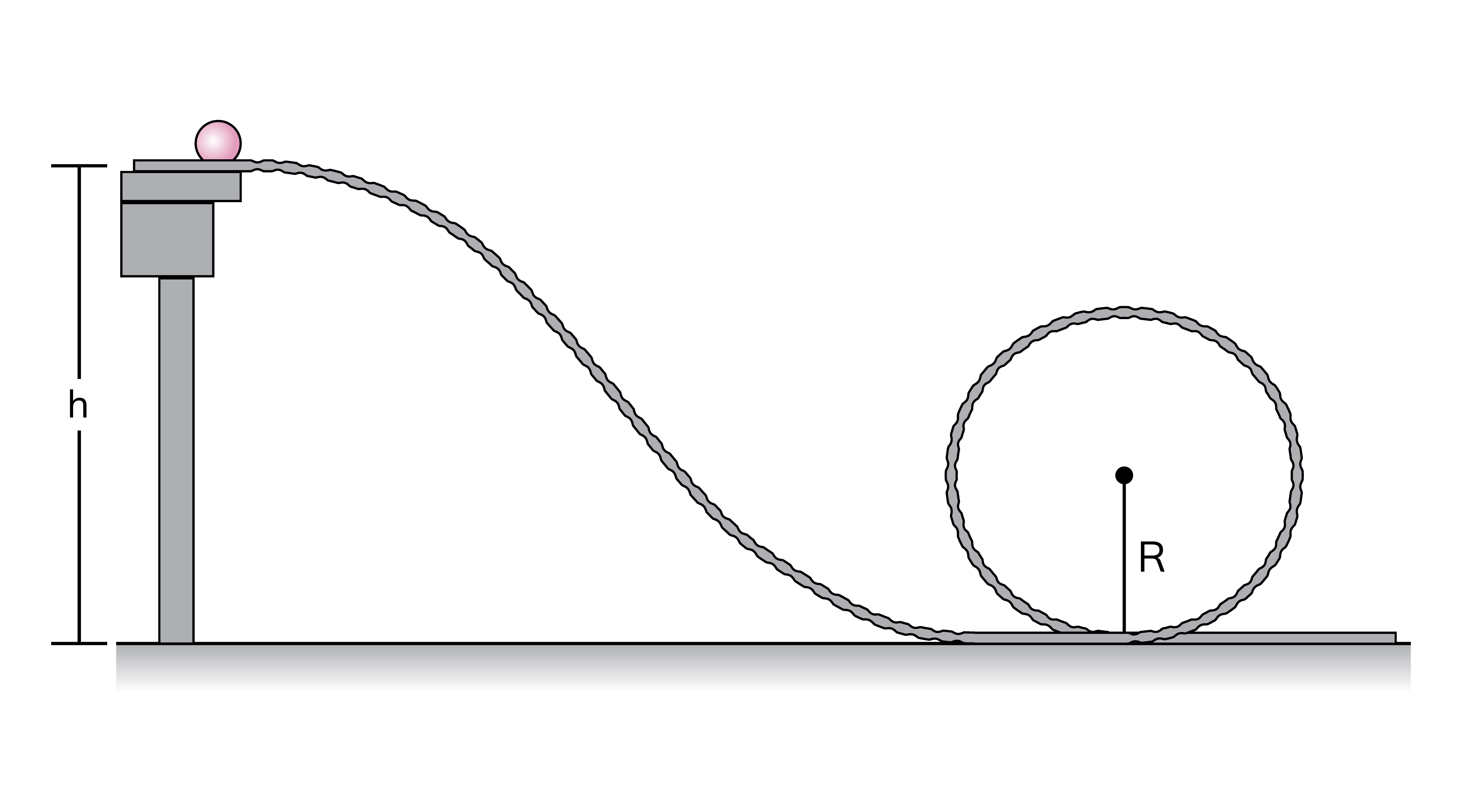
Enter your answer by using R = 70 cm (radius of the loop) and r = 1.0 cm (radius of the marble). Your answer should be in meters with three significant figures.