Wize University Physics Textbook (Master) > Angular / Rotational Motion
Rotational Analog of Newton's Second Law
Popular Courses
PHYSICS 1201A/B
Western University
PHYSICS 1201A/B
Western University
Intro to Physics
University Study Guides
PHYSICS 1D03
McMaster University
AP Physics C: Mechanics Exam Prep Course
AP Exam Prep
Physics
General Course
PHYS 115
Queen's University
PHYS 211
University of Calgary
PHYSICS 1401A/B
Western University
PHYS 101
McGill University
PCS 211
Toronto Metropolitan University
PHYS 204
Concordia University
PHYS 204
Concordia University
Intro to Physics
University Study Guides
PHYS*1080
University of Guelph
PHY 1321
University of Ottawa
PHYS 131
McGill University
APSC 111
Queen's University
APSC 111
Queen's University
PHYS 111
University of Waterloo

0:00 / 0:00
Rotational Analog of Newton's Second Law
Torque is the rotational analog for force. When we apply a torque, we are changing the angular acceleration (making it spin faster or slower). This change is given by Newton's second law for rotations
where is the moment of inertia and is the angular acceleration.
Exam Tip
Above Law looks a lot like Newton's second law, except we use moment of inertia for mass, and angular acceleration for acceleration.
Wize Tip
In the above formula, is in rad/s2.
0:00 / 0:00
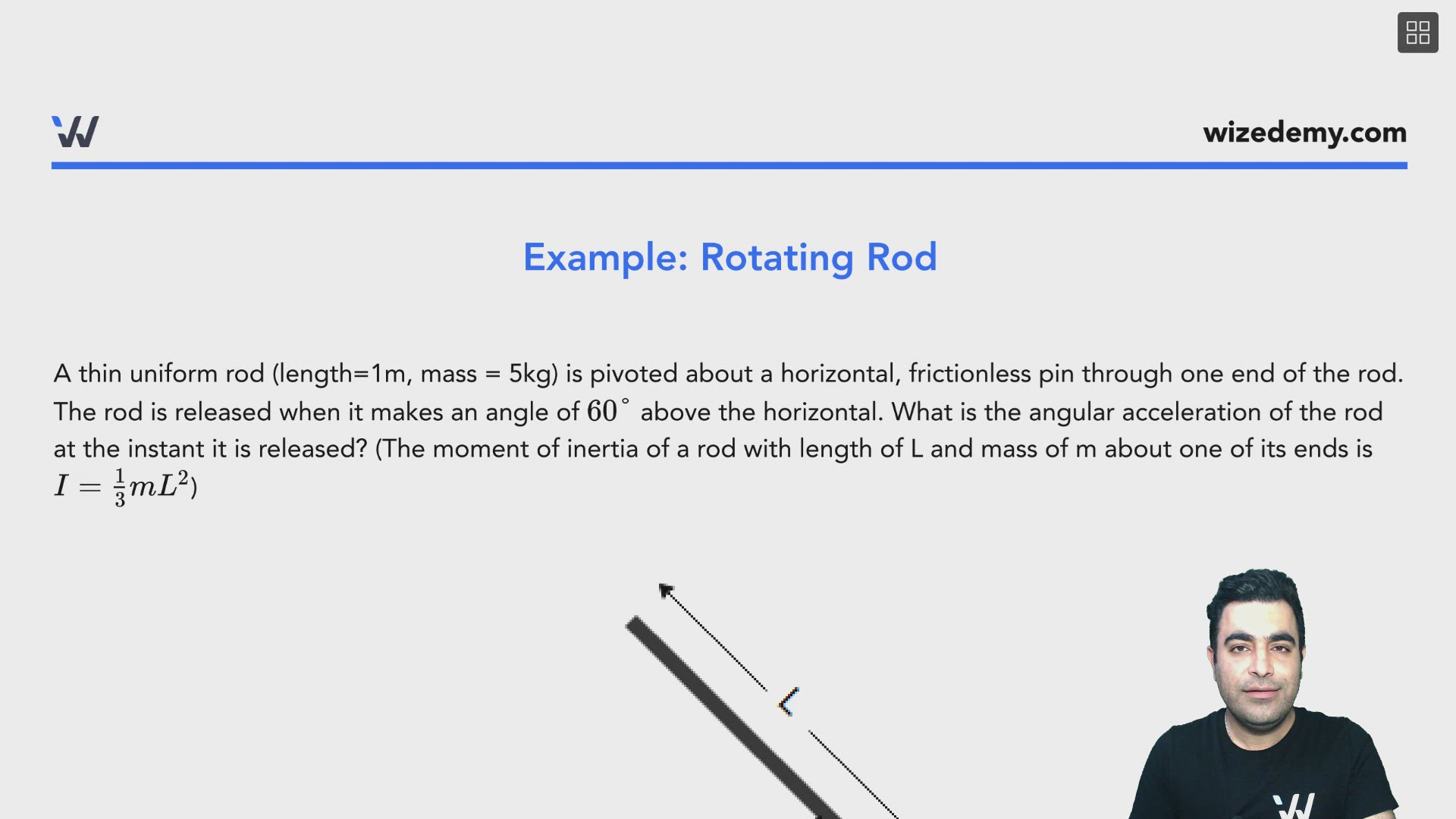
Example: Rotating Rod
A thin uniform rod (length=1m, mass = 5kg) is pivoted about a horizontal, frictionless pin through one end of the rod. The rod is released when it makes an angle of above the horizontal. What is the angular acceleration of the rod at the instant it is released? (The moment of inertia of a rod with length of L and mass of m about one of its ends is )

Solution:
The only force acting on the rod is gravity, and so this produces a torque at the centre of mass. We write:
To find the torque caused by gravity, we need the distance from the pivot point to the center of mass which is half of the length of rod and also the angle gravity force makes with the position vector along the rod. This angle is
Solving for we get:
A 10 kg mass is hanging from a rope wrapped around a cylindrical pulley. The falling mass causes the pulley to rotate. The mass of the pulley is 3 kg. (The moment of inertia of a solid cylinder with radius R and mass of M about its axis of symmetry is )
What is the acceleration of the falling mass? (choices are in )