Wize University Physics Textbook (Master) > Angular / Rotational Motion
Rotational Kinetic Energy
Popular Courses
PHYSICS 1201A/B
Western University
PHYSICS 1201A/B
Western University
Intro to Physics
University Study Guides
PHYSICS 1D03
McMaster University
AP Physics C: Mechanics Exam Prep Course
AP Exam Prep
Physics
General Course
PHYS 115
Queen's University
PHYS 211
University of Calgary
PHYSICS 1401A/B
Western University
PHYS 101
McGill University
PCS 211
Toronto Metropolitan University
PHYS 204
Concordia University
PHYS 204
Concordia University
Intro to Physics
University Study Guides
PHYS*1080
University of Guelph
PHY 1321
University of Ottawa
PHYS 131
McGill University
APSC 111
Queen's University
APSC 111
Queen's University
PHYS 111
University of Waterloo

0:00 / 0:00
Rotational Kinetic Energy
When an object is rotating, we have rotational kinetic energy from all the mass elements rotating. It is given by this formula
where I is the moment of inertia about axis of rotation.
Note: Kinetic energy is also shown by or .
Wize Tip
The equation above is similar to that the kinetic energy of translational motion, except mass is replaced by the moment of inertia, and speed is replaced by angular speed.
Watch Out!
The kinetic energy of a rigid body with both translation and rotation:
Conservation of Energy
Similar to translational motion, if there is no friction or other non-conservative forces, total mechanical energy is conserved.
Exam Tip
Conservation of energy is a very powerful tool in solving problems with rotation. But first make sure there is no friction in the problem!
0:00 / 0:00
Example: Falling Stone and Rotating Pulley
A stone with a mass of 9.5kg is hung vertically from the end of a rope that is wound around a pulley on a boat. The moment of inertia of the pulley is 0.47kg m2 and the radius is 0.25m. The stone is released from rest and falls toward the water, causing the pulley to rotate. After the stone has fallen 2.5 m, what is the angular velocity of the pulley? (Mass of the rope is negligible)
Solution:
I = 0.47 kg m2
Radius is 0.25 m
Stone falls 2.5 m
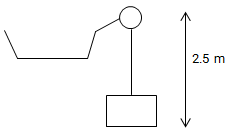
To find the velocity of stone at each moment, we can assume velocity of falling stone is equal to tangential v of pulley. This tagential velocity could be related to angular velocity of pulley rotation as:
Since there is no friction, we can can use conservation of energy (gravitational potential energy is converted to rotational kinetic energy and translation kinetic energy):
A thin rod with mass of M and length of L is hinged to the wall at one end. The rod is held horizontally and then released. What is the speed of the tip of the rod as it hits the wall? Assume the hinge is frictionless. The moment of inertia for a thin rod about one of its ends is .
Hint: Pay attention to the change in position of the center of mass!