Wize University Physics Textbook (Master) > Angular / Rotational Motion
Rotational Work and Torque
Popular Courses
PHYSICS 1201A/B
Western University
Intro to Physics
University Study Guides
PHYSICS 1D03
McMaster University
AP Physics C: Mechanics Exam Prep Course
AP Exam Prep
Physics
General Course
PHYS 211
University of Calgary
PHYSICS 1401A/B
Western University
PHYSICS 1401A/B
Western University
PHYS 101
McGill University
PCS 211
Toronto Metropolitan University
PHYS 204
Concordia University
PHYS 204
Concordia University
Intro to Physics
University Study Guides
PHYS*1080
University of Guelph
PHY 1321
University of Ottawa
PHYS 131
McGill University
APSC 111
Queen's University
PHYS 111
University of Waterloo
PHYS 110
University of Victoria
LE/PHYS 1800 3.00
York University

0:00 / 0:00
Rotational Work and Torque
When we apply a torque to an object, we are performing work. The object is moving in angular variables rather than translational. So the work done by a torque caused by a force which is along the angular displacement is:
Written as an integral:
Wize Tip
If the force is opposite the direction of angular displacement, then the torque is doing negative work. If they are in the same direction, then positive work.
Work-Energy Theorem for Rotational Motion
Work-kinetic energy theorem for rotational motion:
Watch Out!
"Rolling" motion implies frictional force does no work on the rolling object. This leads to Mechanical Energy being conserved
0:00 / 0:00
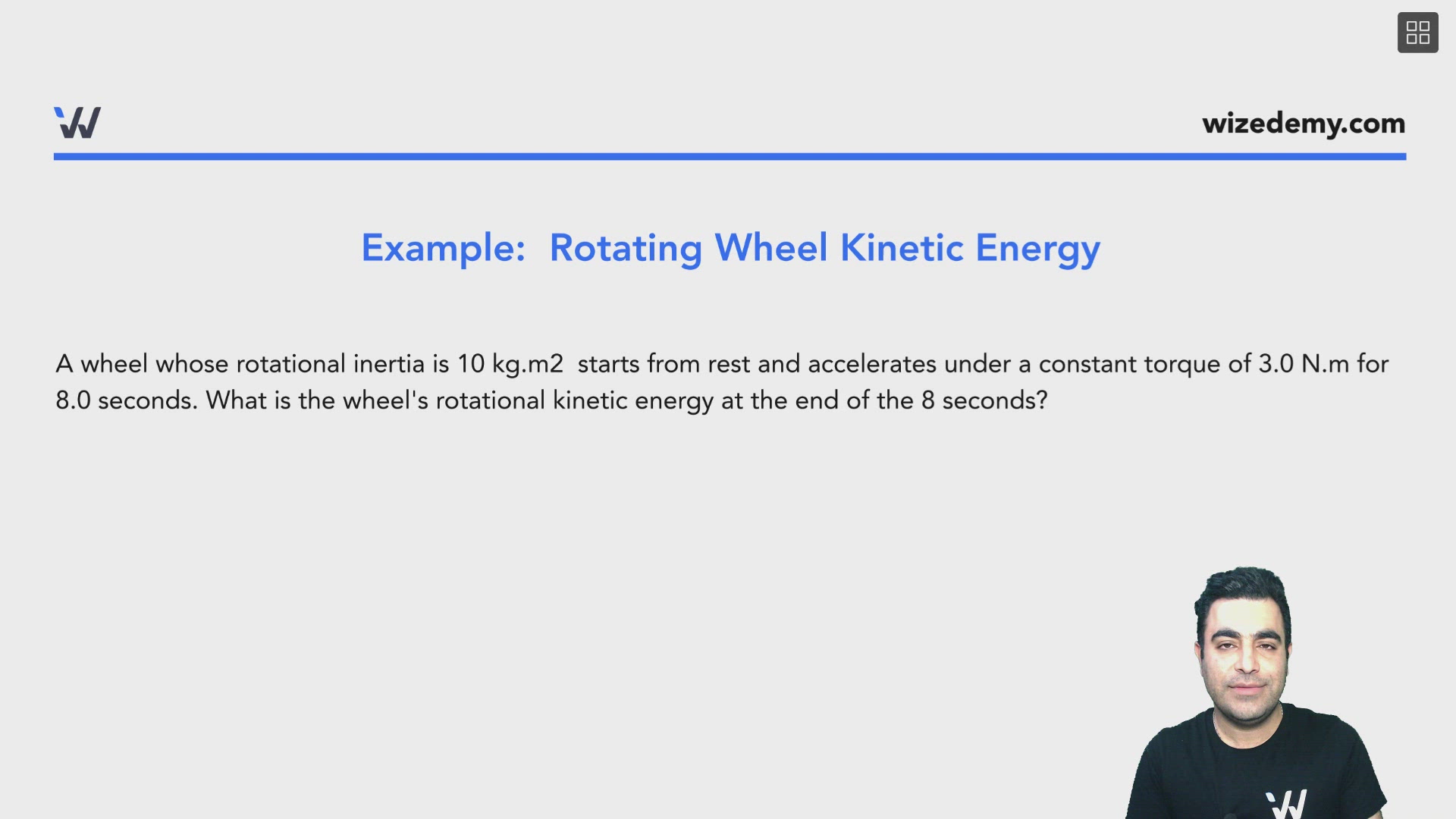
Example: Rotating Wheel Kinetic Energy
A wheel whose rotational inertia is 10 kg.m2 starts from rest and accelerates under a constant torque of 3.0 N.m for 8.0 seconds. What is the wheel's rotational kinetic energy at the end of the 8 seconds?
Solution:
Here are the information given to us:
Since the wheel starts at rest, its initial kinetic energy is zero. So, we can use work-energy theorem to find change in the kinetic energy of the wheel which is its final rotational kinetic energy in this case.
We can find work by knowing the torque acting on the wheel using:
So, we need to first find using rotational kinematic equations.
Thus:
So, the rotational kinetic energy after 8s is .
A thin rod with mass of M and length of L is hinged to the wall at one end. The rod is held horizontally and then released. What is the speed of the tip of the rod as it hits the wall? Assume the hinge is frictionless. The axis of rotation for a thin rod about one of its ends is .
Hint: You should take the CM into consideration for problems of this kind.
This is a classic problem - professors love to ask questions about it!
Consider any round thing you can think of rolling down a hill. Here, we will use four objects: a ring (), a disk (), a solid sphere (), and a hollow sphere ().
You release them from rest at the same time from height h and they all roll without slipping (that is, there is enough static friction to allow for this). The angle of the incline is .
The static friction for this case is .
a) Which one gets to the bottom of the slope first? In what order do the four objects finish?