Popular Courses
PHYSICS 1201A/B
Western University
Intro to Physics
University Study Guides
PHYSICS 1D03
McMaster University
AP Physics C: Mechanics Exam Prep Course
AP Exam Prep
Physics
General Course
PHYS 115
Queen's University
PHYSICS 1401A/B
Western University
PHYS 101
McGill University
PCS 211
Toronto Metropolitan University
PHYS 204
Concordia University
PHYS 204
Concordia University
Intro to Physics
University Study Guides
PHYS*1080
University of Guelph
PHY 1321
University of Ottawa
PHYS 131
McGill University
APSC 111
Queen's University
PHYS 111
University of Waterloo
PHYS 110
University of Victoria
LE/PHYS 1800 3.00
York University
PHYS-1400
University of Windsor
0:00 / 0:00
Angular Momentum
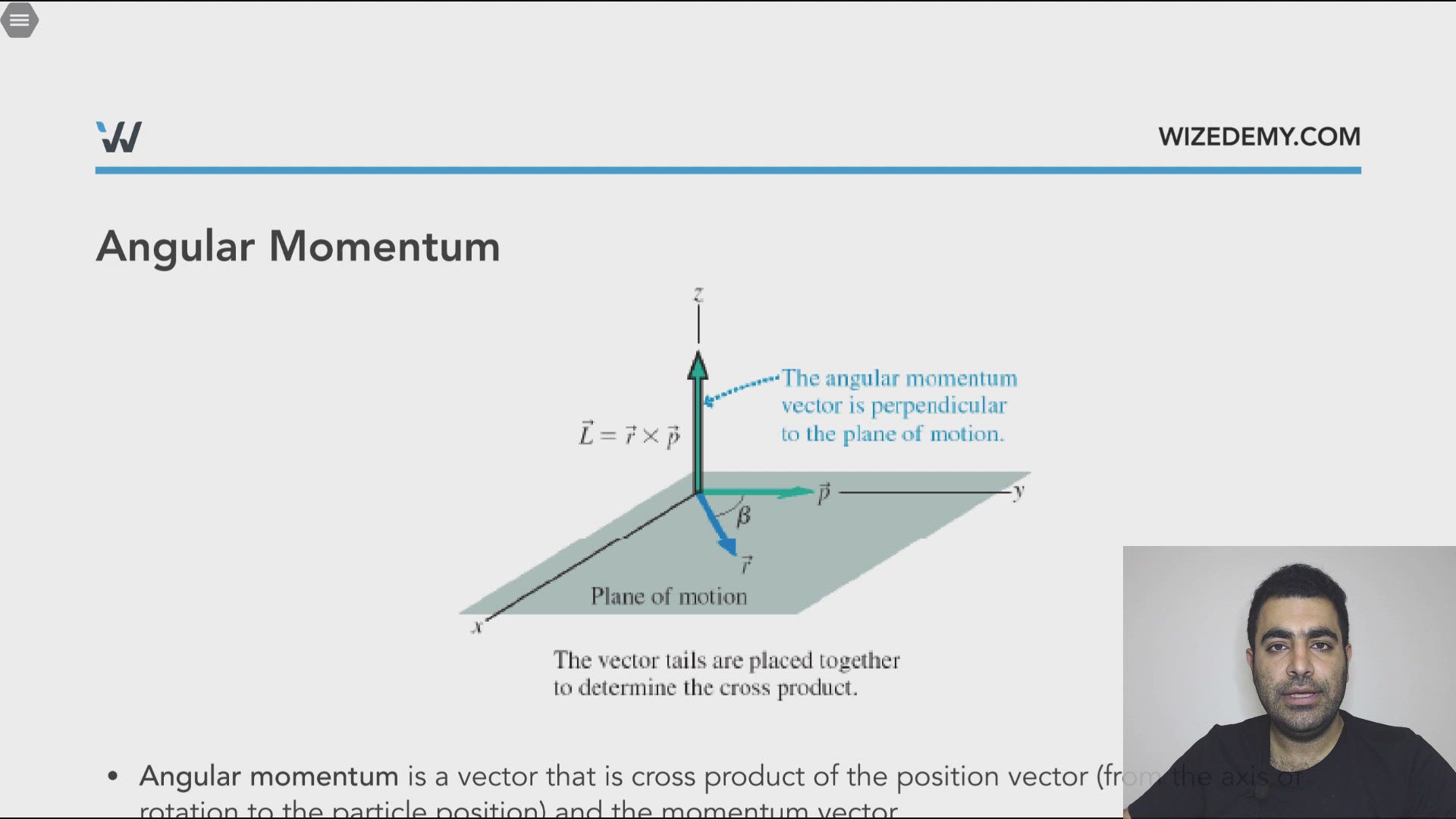
Angular momentum is a vector that is defined as the cross product of the position vector (from the axis of rotation or a pivot point to the particle position) and the momentum vector.
It is also shown by .
- Magnitude of this vector is equal to:
where is the angle between and vectors.
- Its direction is obtained using the Right Hand Rule and it is perpendicular to the plane of position vector and momentum vector
- For Rigid bodies rotating around an axis with the angular frequency of , the magnitude of angular momentum in analogy to linear momentum can be represented by
where I is the moment of inertia about the axis of rotation.
Wize Tip
- The angular momentum is the maximum when
- The angular momentum is zero when and vectors are parallel.
Angular Momentum and Torque
The following relation can be obtained by looking at the torque definition:
This is similar to the statement of Newton's second law in terms of linear momentum.
Exam Tip
In a uniform circular motion L is constant. Because .
0:00 / 0:00
Example: Angular Momentum of a Pendulum
An object of mass m and speed v0 strikes a bob pendulum with mass M and length of which is hanging from the ceiling and sticks to it and they both move (oscillate) to the right. Find the size and direction of the angular momentum with respect to where the rope is attached to the ceiling .
Solution
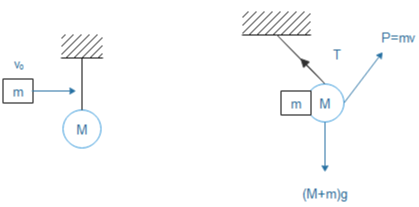
First we need to find the speed of the combination of mass and pendulum after collision. Since they stick together after collision, we have a perfectly inelastic collision. So, we can use conservation of linear momentum:
Now we can find magnitude of angular momentum using its definition:
Note that in the last line, I set the angle between position vector and linear momentum vector to be 90 degrees. The reason is that after collision, they start to oscillate about the pivot point in a circular path, so, their velocity vector is tangent to this circle and as a result perpendicular to the rope. Since linear momentum and velocity vectors are parallel, linear momentum vector is also perpendicular to the rope. Furthermore, position vector is defined from the pivot point to the rotating object, hence, it should be along the rope. Thus, position and linear momentum vectors are perpendicular.
In addition, the length of the position vector is the same as length of the rope and equal to .Finally, in the last step, I inserted the expression we found for .
Now, let's think about direction of the angular momentum. We know that since it is defined as the cross product of position and linear momentum vectors, it is perpendicular to the plane containing these two vectors. So, it should be pointing either into the page or out of the page. We can use Right-Hand Rule for to find direction of the angular momentum to be out of the page.
You're sitting on a rotating stool, initially rotating at 3.0 radians per second. You're holding a 5.0 kg dumbbell very close to you, 0.05 meters away from your center of rotation. You then extend your arms 1.0 meters away from you with the dumbbell. The moment of inertia of you and the stool is 4.0 kg m2. Neglect the mass of your arms and any rotational friction in the seat. What is your new angular velocity?