Wize University Physics Textbook (Master) > Angular / Rotational Motion
Conservation of Angular Momentum
Popular Courses
PHYSICS 1201A/B
Western University
Intro to Physics
University Study Guides
PHYSICS 1D03
McMaster University
AP Physics C: Mechanics Exam Prep Course
AP Exam Prep
Physics
General Course
PHYSICS 1401A/B
Western University
PHYS 101
McGill University
PCS 211
Toronto Metropolitan University
PHYS 204
Concordia University
PHYS 204
Concordia University
Intro to Physics
University Study Guides
PHYS*1080
University of Guelph
PHY 1321
University of Ottawa
PHYS 131
McGill University
APSC 111
Queen's University
PHYS 111
University of Waterloo
PHYS 110
University of Victoria
LE/PHYS 1800 3.00
York University
PHYS-1400
University of Windsor
PHY131H1
University of Toronto
0:00 / 0:00
Conservation of Angular Momentum
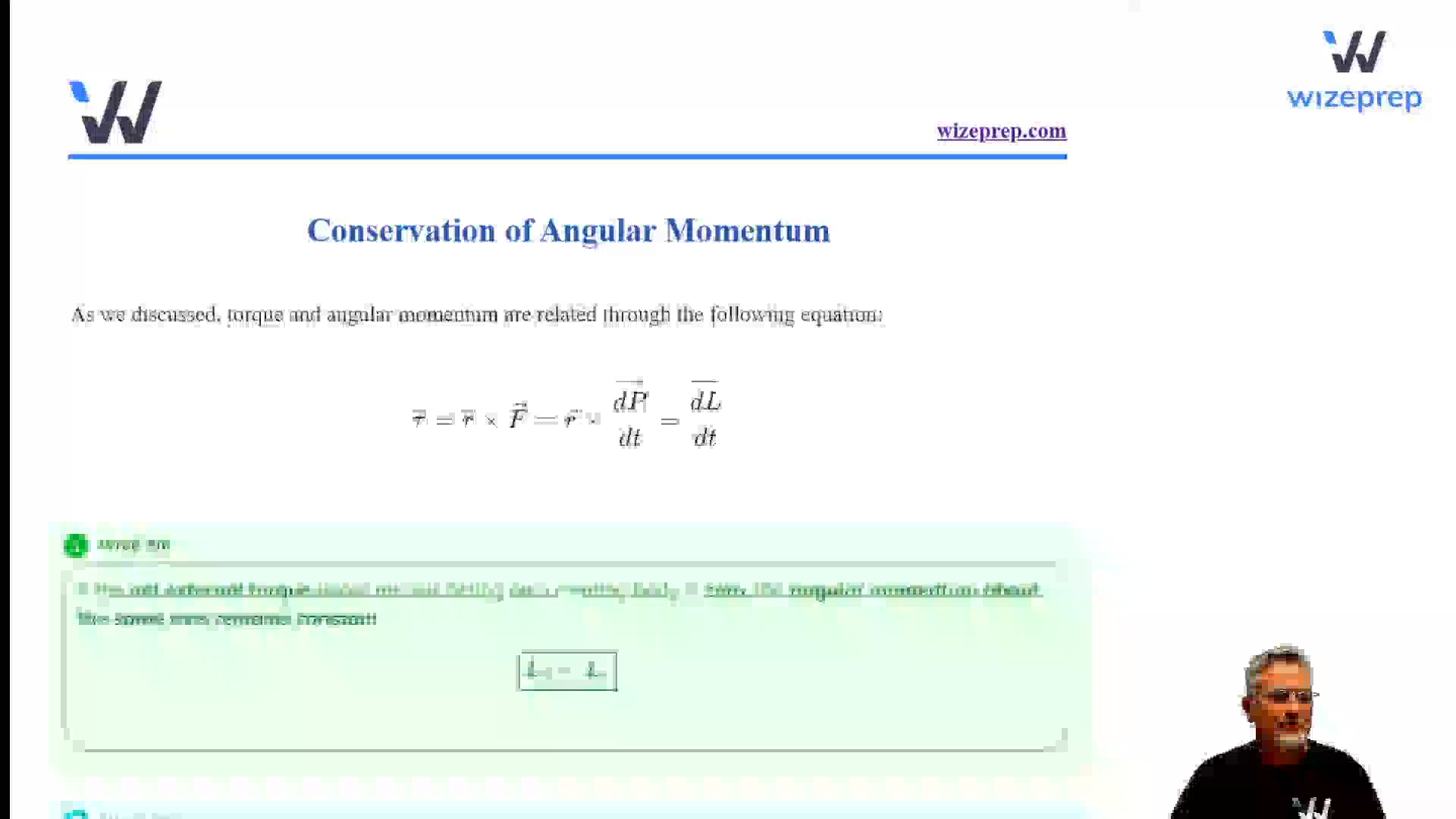
As we discussed, torque and angular momentum are related through the following equation:
Wize Tip
If the net external torque about an axis acting on a rotating body is zero, the angular momentum about the same axis remains constant
Exam Tip
We can either write down the angular momentum as or depending on the information given to us in the question.
Example: Angular Momentum Conservation
In an isolated system, the moment of inertia of a rotating object is halved. What happens to the angular velocity of the object?
A. It is quartered.
B. It is halved.
C. It remains the same.
D. It is doubled.
E.It is quadrupled.
Solution: In an isolated system, there is no net torque. If there is no net torque on the system, then the total angular momentum of the system remains the same.
L=Iω
Therefore, if the moment of inertia, I, is halved, then for the angular momentum, L, to remain constant, the angular velocity, ω, must be doubled.
You're sitting on a rotating stool, initially rotating at 3.0 radians per second. You're holding a 5.0 kg dumbbell very close to you, 0.05 meters away from your center of rotation. You then extend your arms 1.0 meters away from you with the dumbbell. The moment of inertia of you and the stool is 4.0 kg m2. Neglect the mass of your arms and any rotational friction in the seat. What is your new angular velocity?