Wize University Physics Textbook (Master) > Periodic Motion: Oscillations
Velocity and Acceleration
Popular Courses
Intro to Physics
University Study Guides
PHYSICS 1D03
McMaster University
AP Physics C: Mechanics Exam Prep Course
AP Exam Prep
Physics
General Course
PHYS 157
University of British Columbia
PHYS 131
University of British Columbia
PHYS 204
Concordia University
PHYS*1300
University of Guelph
Intro to Physics
University Study Guides
PHYS 131
McGill University
APSC 112
Queen's University
PHYSICS 1402A/B
Western University
LE/PHYS 1800 3.00
York University
PHYS-1400
University of Windsor
PHY131H1
University of Toronto
PHYS 142
McGill University
PHYS 117
University of British Columbia
PHYC 1190
Dalhousie University
ENGG 212
University of Calgary
PHYS 111
University of Victoria
0:00 / 0:00
Velocity and Acceleration in SHM
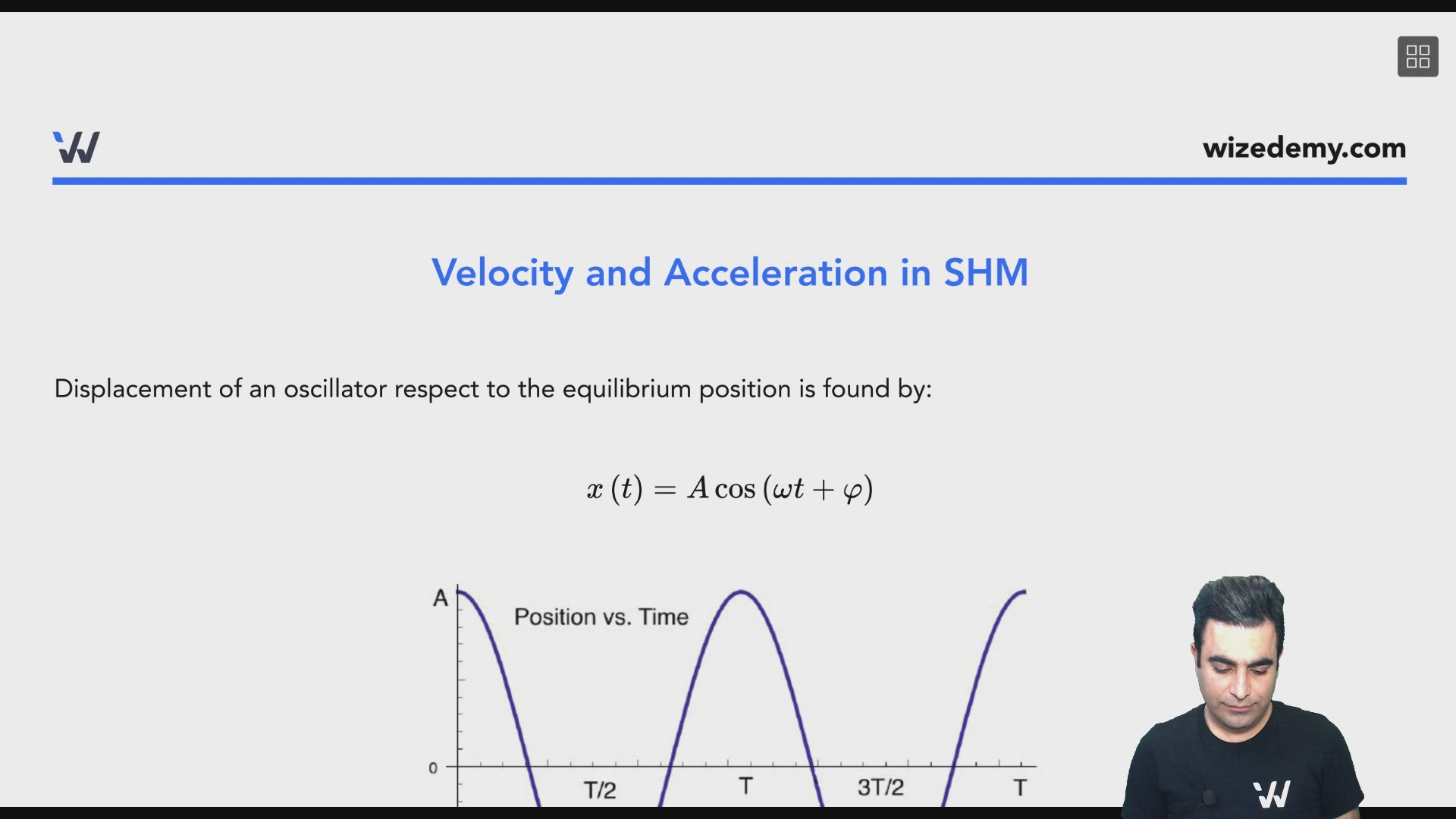
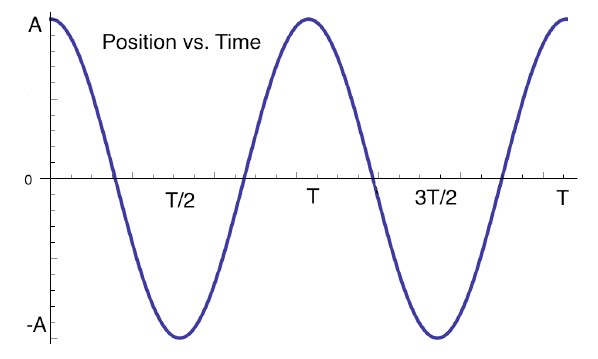
Displacement of an oscillator respect to the equilibrium position is found by:
Velocity
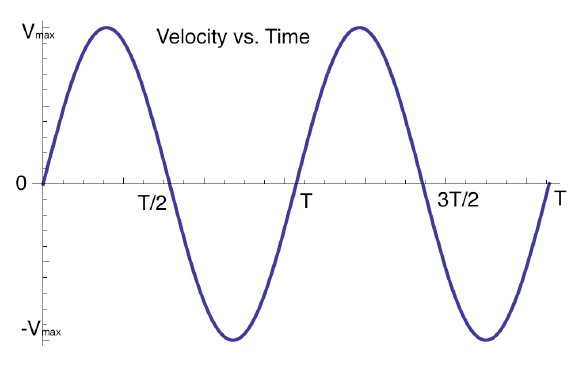
We can find the velocity of an oscillator by taking derivate of displacement respect to time:
Wize Concept
- Velocity of an oscillator is an oscillating function with the same period as .
- Velocity is changing in the following range:
Watch Out!
Velocity is a vector and it could be both positive or negative but speed is the magnitude of velocity vector and it is always positive! Hence:
Acceleration
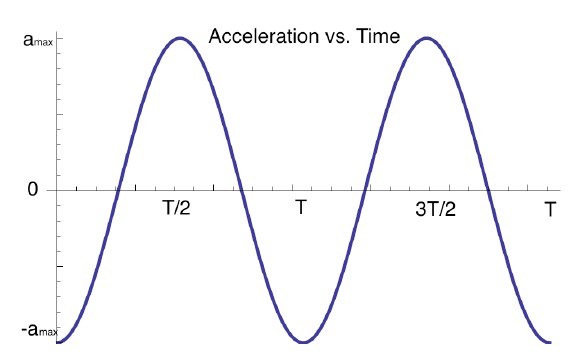
We can find the acceleration of an oscillator by taking derivate of velocity respect to time:
Wize Concept
- Acceleration of an oscillator is an oscillating function with the same period as and .
- Acceleration is changing in the following range:
0:00 / 0:00
Velocity and Acceleration in SHM
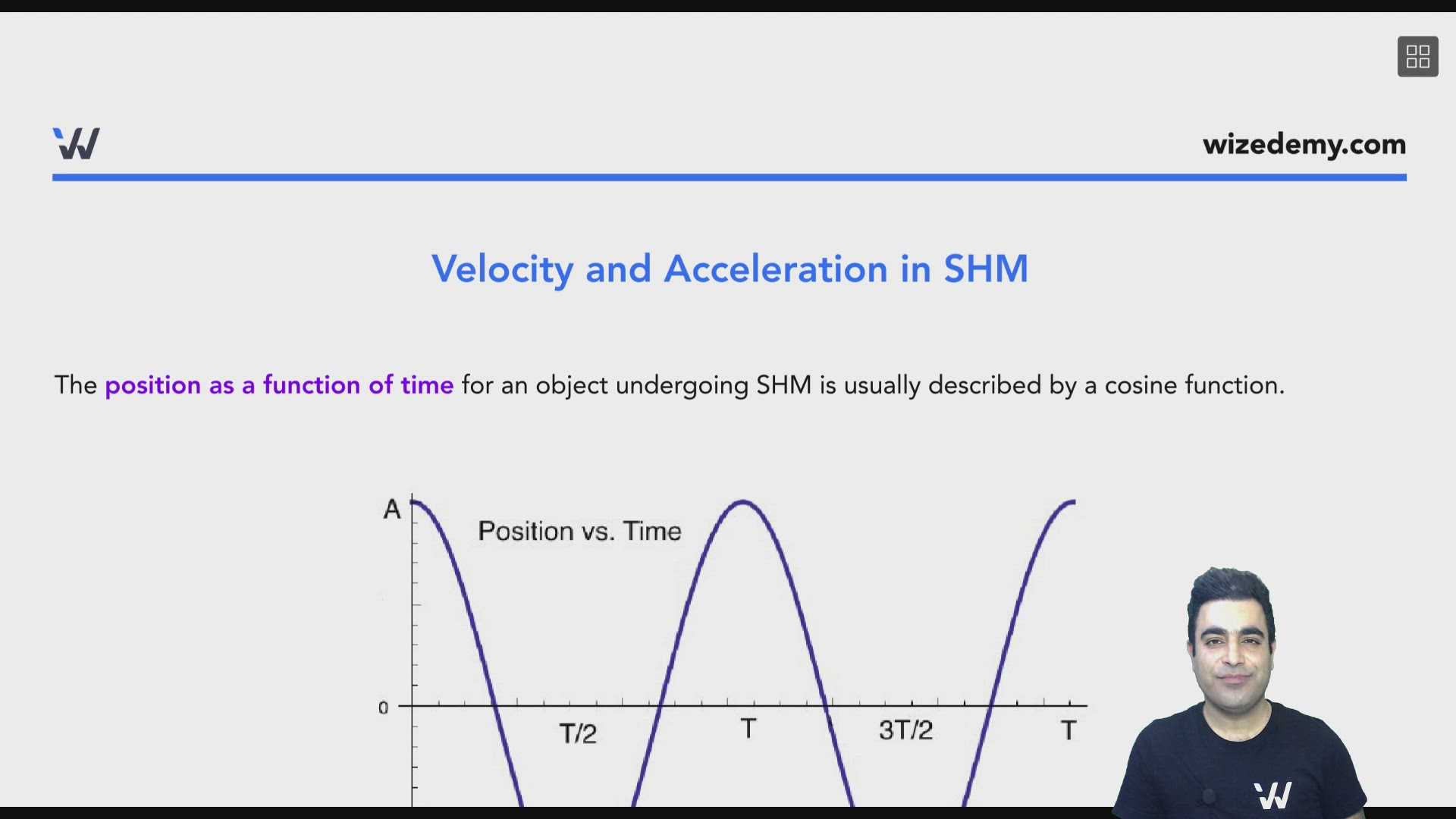
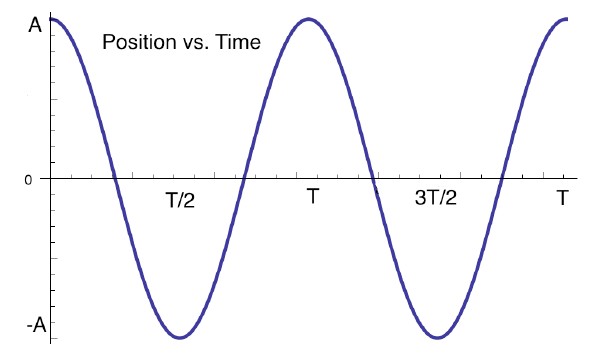
The position as a function of time for an object undergoing SHM is usually described by a cosine function.
Velocity
We can find the velocity of an oscillator by taking derivate of displacement respect to time:
Wize Concept
- Velocity of an oscillator is an oscillating function with the same period as .
- Velocity is changing in the following range:
Watch Out!
Velocity is a vector and it could be both positive or negative but speed is the magnitude of velocity vector and it is always positive! Hence:
Acceleration
We can find the acceleration of an oscillator by taking derivate of velocity respect to time:
Wize Concept
- Acceleration of an oscillator is an oscillating function with the same period as and .
- Acceleration is changing in the following range:
Finding Acceleration by Knowing Displacement
Let's look at the equations for displacement and acceleration of an oscillator one more time:
By comparing displacement and acceleration functions we can find the following nice relationship between them:
Wize Tip
Note that based on the above equation, acceleration is maximum when displacement is minimum and vice versa.
Exam Tip
Above equation could be used to find acceleration of an oscillator at any moment if you know its position!
Relation Between and
We just learned that any physical system with a force in the form of undergoes a simple harmonic motion. Here is a constant which depends on the physical properties of the system.
We can fins find a relationship between this constant and the angular frequency of oscillation by looking at the second law of Newton:
0:00 / 0:00
Finding Acceleration by Knowing Displacement
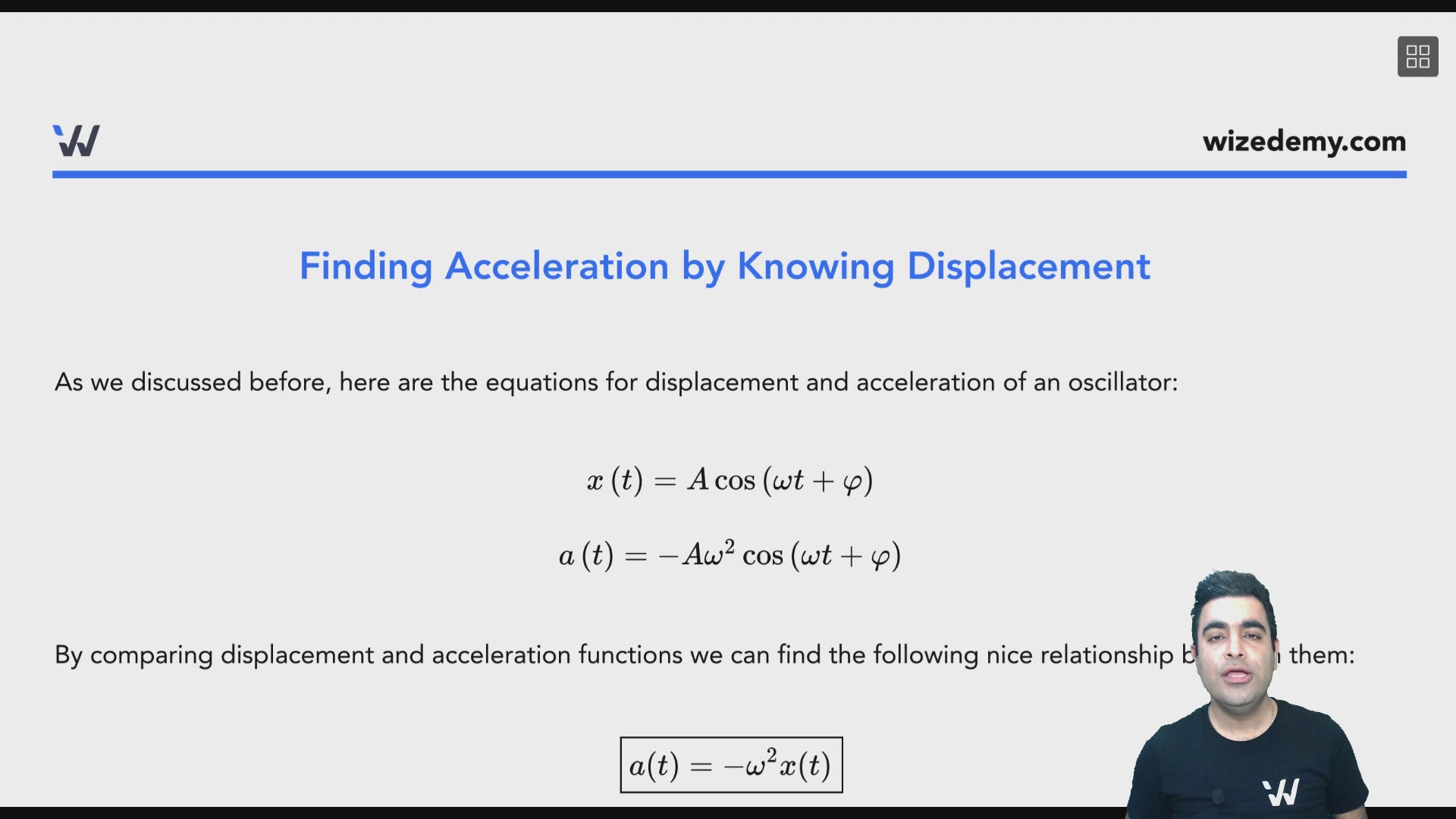
As we discussed before, here are the equations for displacement and acceleration of an oscillator:
By comparing displacement and acceleration functions we can find the following nice relationship between them:
Wize Tip
Note that based on the above equation, acceleration is maximum when displacement is minimum and vice versa.
Exam Tip
Above equation could be used to find acceleration of an oscillator at any moment if you know its position!
Relation Between and
We just learned that any physical system with a force in the form of undergoes a simple harmonic motion. Here is a constant which depends on the physical properties of the system.
We can fins find a relationship between this constant and the angular frequency of oscillation by looking at the second law of Newton:
A 12.5 kg mass is hung on a spring with spring constant 80 N/m. It stretches a distance of 2.1 m and released. Its phase shift is 1.57. What is the instantaneous velocity at 3 seconds?
m = 12.5 kg
A = 2.1 m
phi = 1.57
t = 3 s
find w:
w = sqrt (k/m) = sqrt (80/12.5) = 2.5 Hz.
v(t) = A w cos(wt + phi)
v(3) = 2.1(2.5)(cos((2.5)(3s)) + 1.57)
= 5.25 cos(9.07)
= -4.9 m/s.
The position of an oscillating mass in a simple pendulum is given as: .
What is the maximum velocity of the mass?
Practice: Getting Info About Acceleration by Looking at Displacement
A harmonic oscillator's motion is described by the following graph
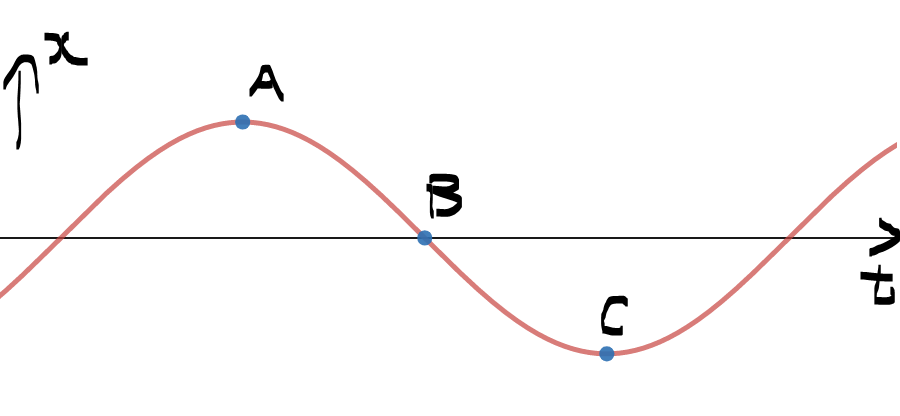
Which of the following statement is correct about the acceleration (NOT the magnitude) of the oscillator?