Wize University Physics Textbook (Master) > Periodic Motion: Oscillations
SHM as the Projection of a Uniform Circular Morion
Popular Courses
Intro to Physics
University Study Guides
Grade 12 Physics
Ontario High School
PHYSICS 1D03
McMaster University
AP Physics C: Mechanics Exam Prep Course
AP Exam Prep
Physics
General Course
PHYS 157
University of British Columbia
Grade 12 Physics
Canada High School
PHYS 101
McGill University
PHYS 131
University of British Columbia
PHYS*1300
University of Guelph
Intro to Physics
University Study Guides
PHYS 131
McGill University
APSC 112
Queen's University
PHYSICS 1402A/B
Western University
LE/PHYS 1800 3.00
York University
PHYS-1400
University of Windsor
PHY131H1
University of Toronto
PHYS 142
McGill University
PHYS 117
University of British Columbia
ENGG 212
University of Calgary
0:00 / 0:00
SHM as the Projection of a Uniform Circular Motion
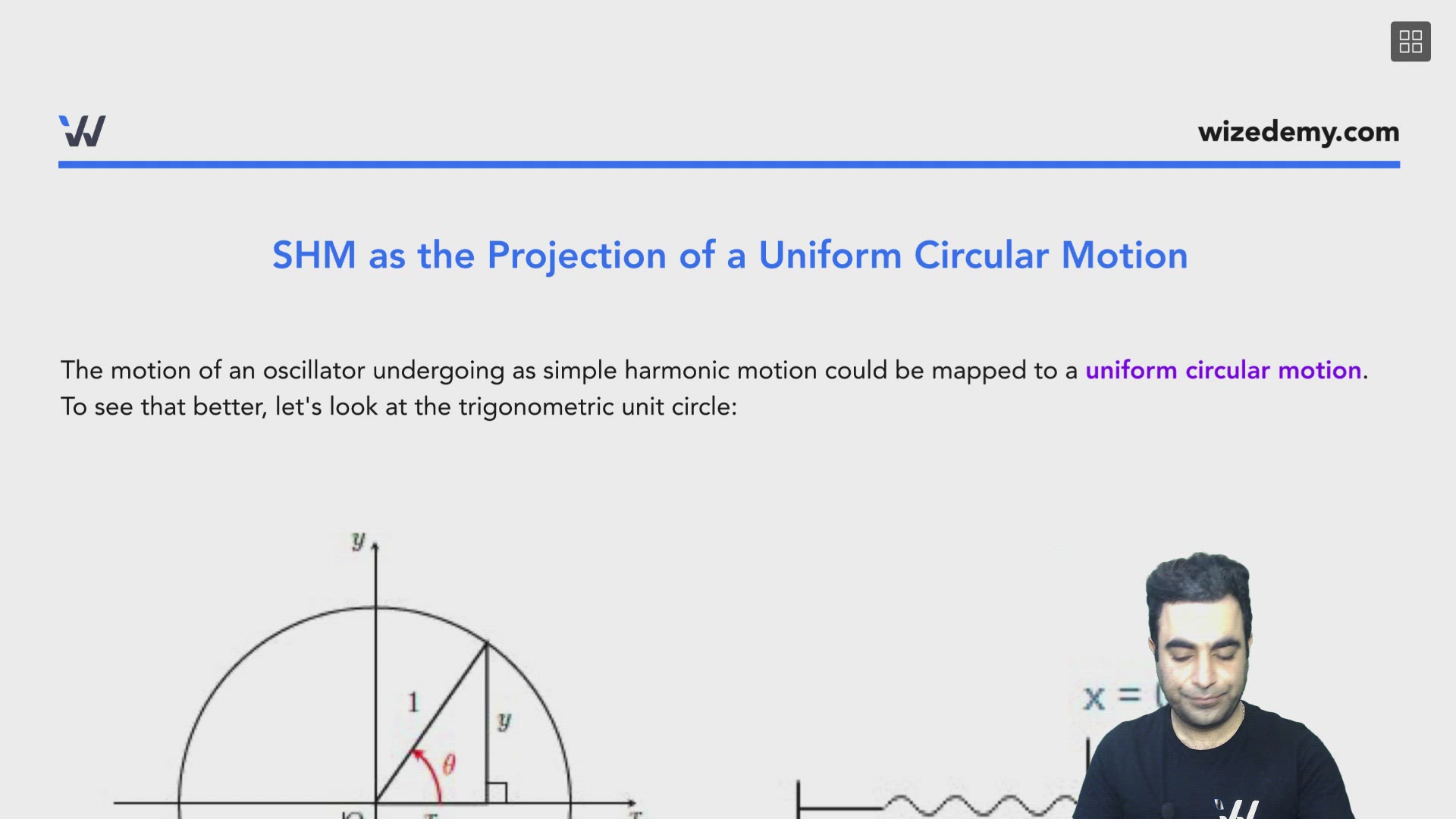
The motion of an oscillator undergoing as simple harmonic motion could be mapped to a uniform circular motion. To see that better, let's look at the trigonometric unit circle:

Let's choose angle to be equal to where is the angular frequency of SHM.
Wize Concept
When time passes, is getting larger, so the point on the circle corresponding to this angle rotates in a counter-clockwise direction.
From the picture, using trigonometric relations for the triangle shown at any moment:
Above equations are similar to the functions which describe the position of an oscillator in a SHM.
Wize Concept
Since both SHM and uniform circular motion over the above circle are described by the same equation, we can describe SHM as a projection of circular motion over x or y axis.
Wize Tip
As we know, the phase constant indicated the starting point of the oscillation. For example, if the circular motion starts from the positive x-axis or if it starts from the highest point on the positive y-axis.
Example: SHM from Circular Motion
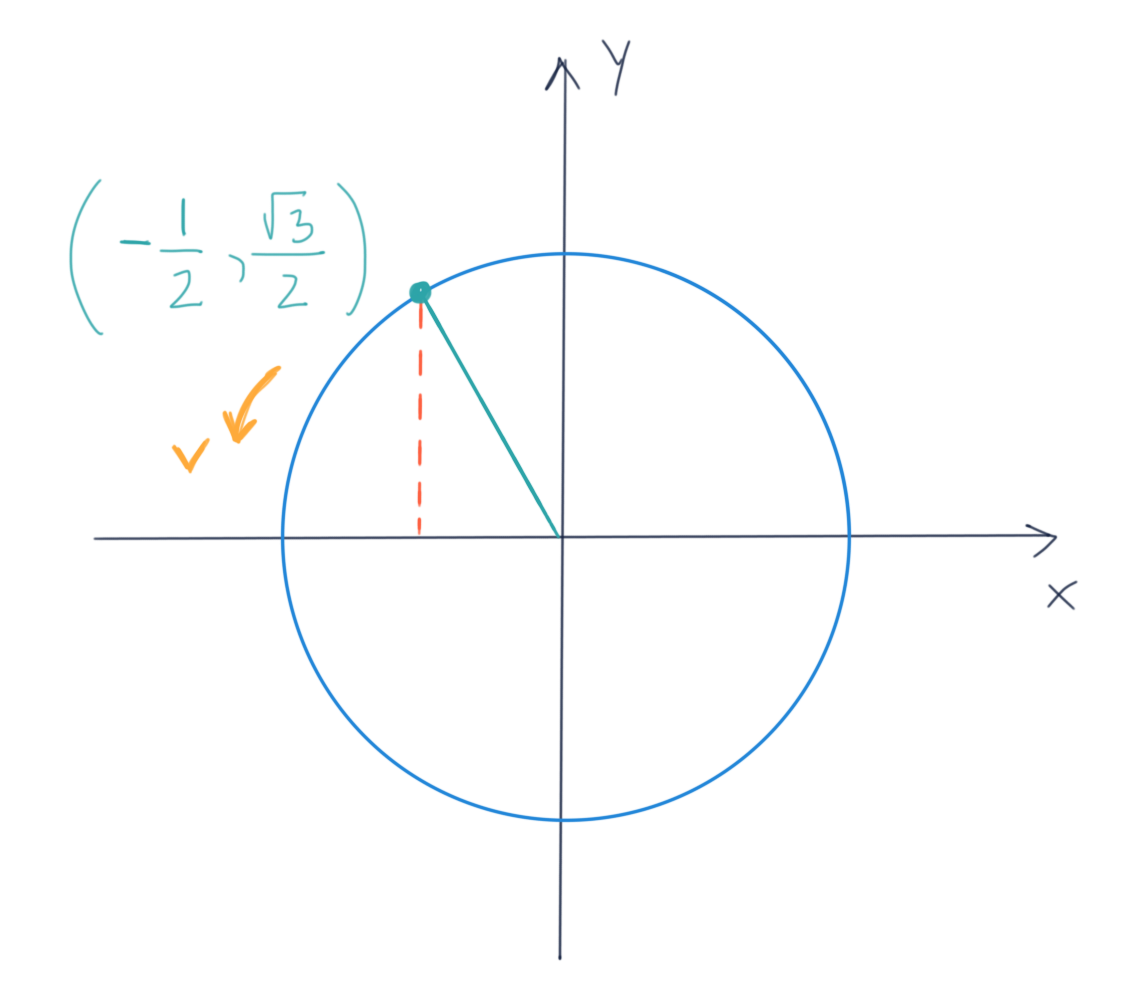
The image below shows the coordinates of a particle moving around a circle at , as well as the direction of motion. Find the equation of its position as a function. Then find the velocity and acceleration equations as well.
Begin with the position equation for SHM:
We see that the circular motion has a radius because the coordinates of the point are on the unit circle, so the amplitude is . (Alternately, find the radius = hypothenuse of the triangle using the Pythagorean Theorem.)
When , the position is . Put these into the equation to find the phase shift:
Ignoring the negative sign, we get a reference angle of . But since is negative, the angle could be in Quadrants II or III.
To figure out which one it is, we have to look at the velocity. From the diagram, the particle is moving in the negative direction (clockwise), so the velocity should be negative.
The velocity is given by:
At time we have:
and since the velocity is negative and positive, should be positive, so the angle could be in Quadrants I or II.
Therefore to satisfy both conditions, the angle has to be in Quadrant II and our phase shift is:
Now we have the position equation:
The velocity equation is:
The acceleration is:

Mark Yourself Question
- Grab a piece of paper and try this problem yourself.
- When you're done, check the "I have answered this question" box below.
- View the solution and report whether you got it right or wrong.
Practice: SHM from Circular Motion
The image below shows the coordinates of a particle moving around a circle at , as well as the direction of motion. Find the equation of its position as a function. Then find the velocity and acceleration equations as well.
