Wize University Physics Textbook (Master) > Periodic Motion: Oscillations
Energy Conservation
Popular Courses
MCAT
General Course
PHYSICS 1201A/B
Western University
Intro to Physics
University Study Guides
Grade 12 Physics
Ontario High School
PHYSICS 1D03
McMaster University
AP Physics C: Mechanics Exam Prep Course
AP Exam Prep
Physics
General Course
PHYS 157
University of British Columbia
Grade 12 Physics
Canada High School
PHYSICS 1401A/B
Western University
PHYS 101
McGill University
PHYS 101
McGill University
PHYS 131
University of British Columbia
PHYS 204
Concordia University
Intro to Physics
University Study Guides
PHYS*1300
University of Guelph
PHYS 131
McGill University
APSC 112
Queen's University
APSC 111
Queen's University
PHYSICS 1402A/B
Western University

0:00 / 0:00
Energy of An Oscillator
There are two different type of energies related to an oscillation: Kinetic energy and potential energy
- The kinetic energy is the energy of a moving object:
- The potential energy is the energy stored in the oscillation. For mass and spring oscillation, it is a potential energy stored inside of the spring due to stretch or compression in the length of the spring:
Watch Out!
Kinetic energy is also shown by , or . Similarly, potential energy is also shown by , or .
- The total energy of the system at any time during SHM is the sum of kinetic energy and potential energy and is constant because of the conservation of energy:
Watch Out!
Note that we have a seesaw behaviour between kinetic energy and potential energy. They can each change but sum of them should remain conserved!
Exam Tip
Since energy is conserved in a simple harmonic motion, if we know the total energy at a moment, we know it at any other moment as well!
How to Find Total Energy of an Oscillator
We can find total energy of an oscillator using the three following methods:
- We can find it directly from its definition if we know position and velocity of the oscillator at any moment.
- We can find it by looking at the equilibrium point.
At equilibrium: x = 0, and V = Vmax
- We can find it by looking at turning points.
At turning points: and V=0
Exam Tip
Above equations are helpful in solving problems using conservation of energy:
Note: It is usually easier to solve problems using conservation of energy if the oscillator starts with a non-zero initial velocity.
0:00 / 0:00
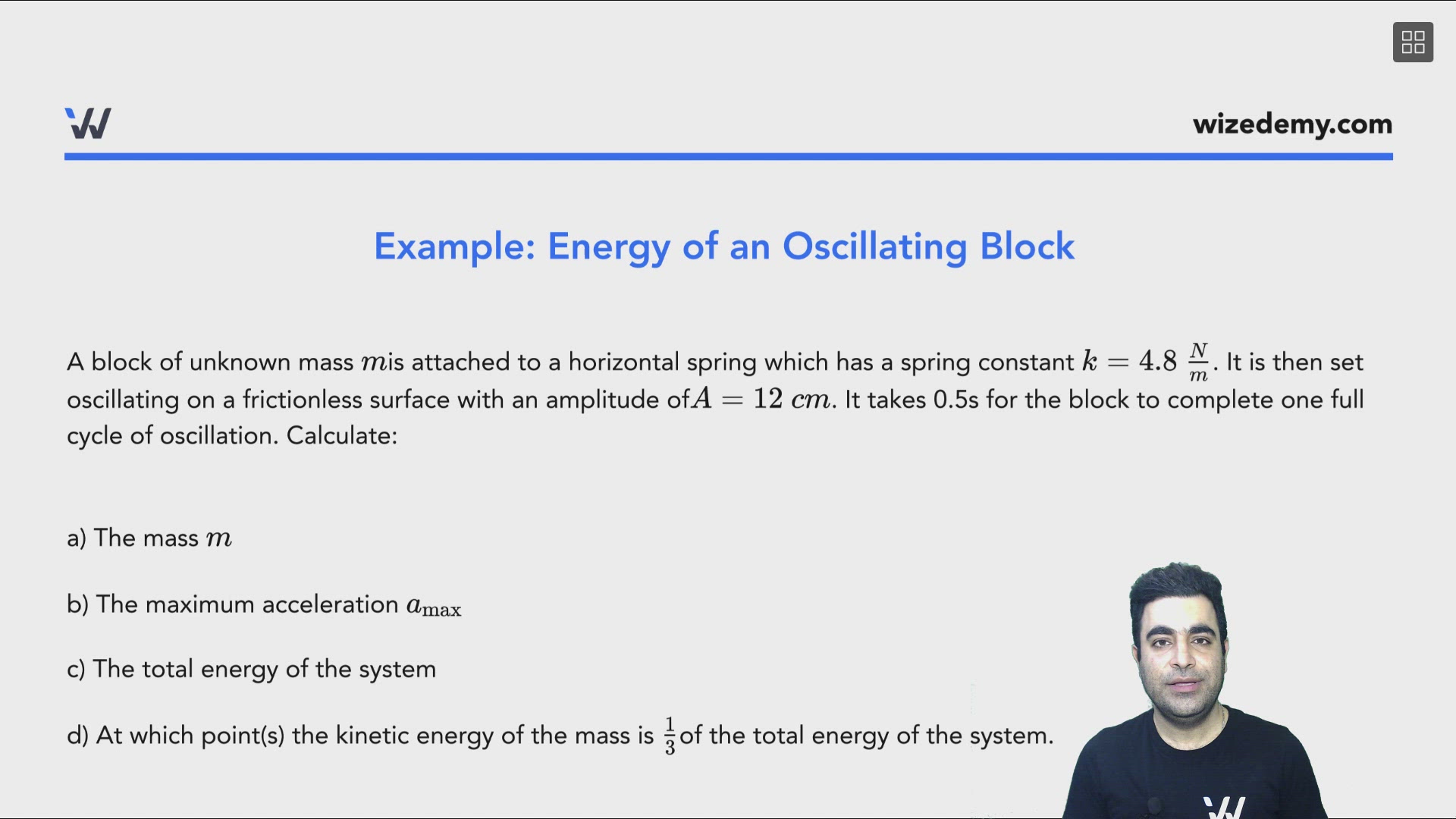
Example: Energy of an Oscillating Block
A block of unknown mass is attached to a horizontal spring which has a spring constant . It is then set oscillating on a frictionless surface with an amplitude of. It takes 0.5s for the block to complete one full cycle of oscillation. Calculate:
a) The mass
b) The maximum acceleration
c) The total energy of the system
d) At which point(s) the kinetic energy of the mass is of the total energy of the system.
Solution:
Part a)
Part b)
Part c)
Part d)
A simple mass on a spring with spring constant oscillates about its equilibrium with amplitude . If the energy of the system suddenly decreases to half of the initial value, what will be the mass' new maximum speed?