Popular Courses
MCAT
General Course
PHYSICS 1201A/B
Western University
Intro to Physics
University Study Guides
Grade 12 Physics
Ontario High School
PHYSICS 1D03
McMaster University
AP Physics C: Mechanics Exam Prep Course
AP Exam Prep
Physics
General Course
PHYS 157
University of British Columbia
Grade 12 Physics
Canada High School
PHYSICS 1401A/B
Western University
PHYS 101
McGill University
PHYS 131
University of British Columbia
PHYS 204
Concordia University
PHYS*1300
University of Guelph
Intro to Physics
University Study Guides
PHYS 131
McGill University
APSC 112
Queen's University
APSC 111
Queen's University
PHYSICS 1402A/B
Western University
LE/PHYS 1800 3.00
York University
0:00 / 0:00
Vertical Springs
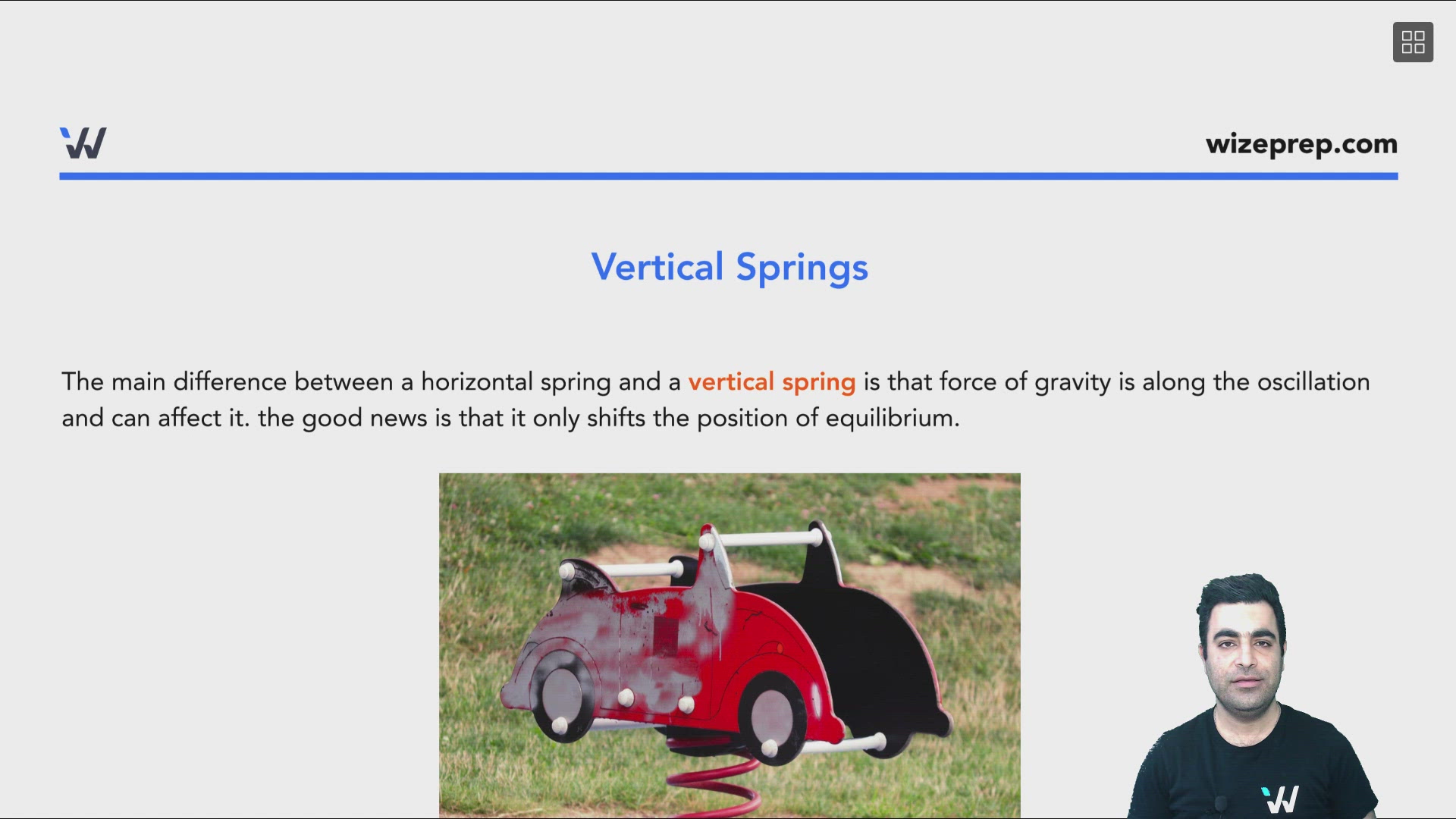
The main difference between a horizontal spring and a vertical spring is that force of gravity is along the oscillation and can affect it. the good news is that it only shifts the position of equilibrium.
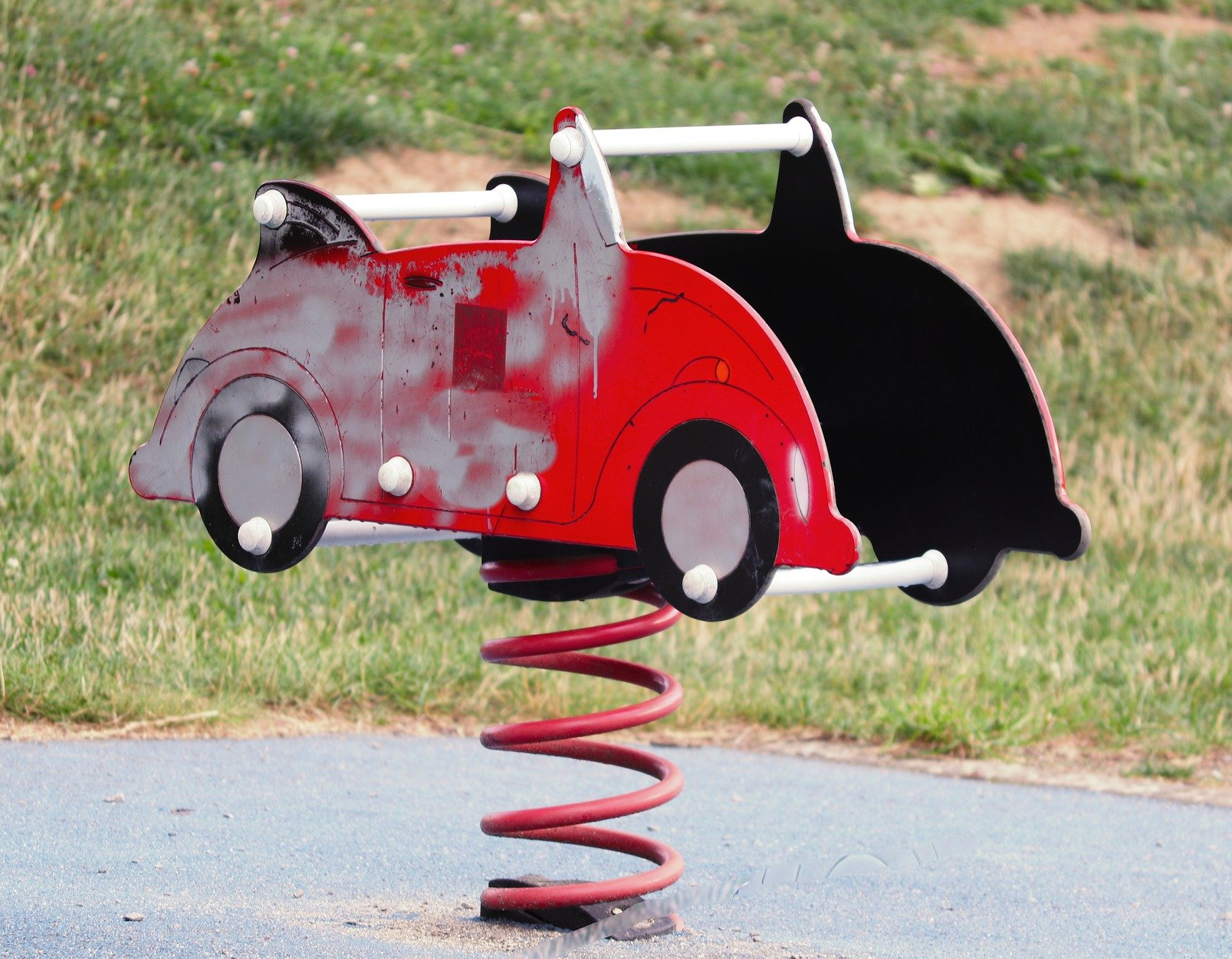
If a mass is attached to a vertical spring and then is slowly lowered to stop in a lower position, the spring is stretched by
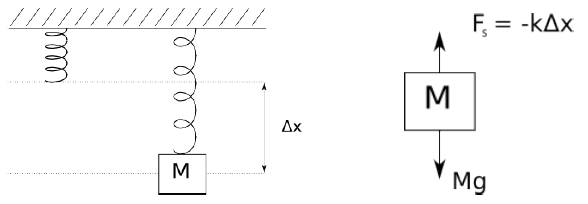
Basically, would be at equilibrium in the new position. So, the equation could be derived by noting that the net force on is zero.
Watch Out!
Changing the mass attached to a vertical spring (adding or removing a mass) shifts the position of equilibrium . Any oscillation (SHM) now would be around the new equilibrium position. Note that change in the length of the spring is the same as the shift in the equilibrium position.
Exam Tip
As long as we describe the oscillations about the new equilibrium point, we can completely forget about gravity and treat vertical spring oscillation as a horizontal spring oscillation.
Common Vertical Springs Scenarios
There are two common scenarios for problems about vertical springs:
- Mass is already attached to the spring and is at rest in the new equilibrium position. It is pulled down and then released to oscillate.

Wize Tip
As shown in the above picture, in this case you set the amplitude of the oscillation by how much you pull the mass down.
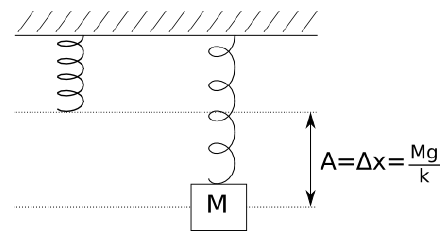
- Here, we start with a free spring. Now, the mass is added to the spring and then released to fall down.
Watch Out!
Here we change the mass attached to the spring . As a result, we shift the equilibrium position.
Wize Tip
As shown in the picture, here the amplitude is set by mass of the object and spring constant. The amplitude is basically the shift in the equilibrium position:
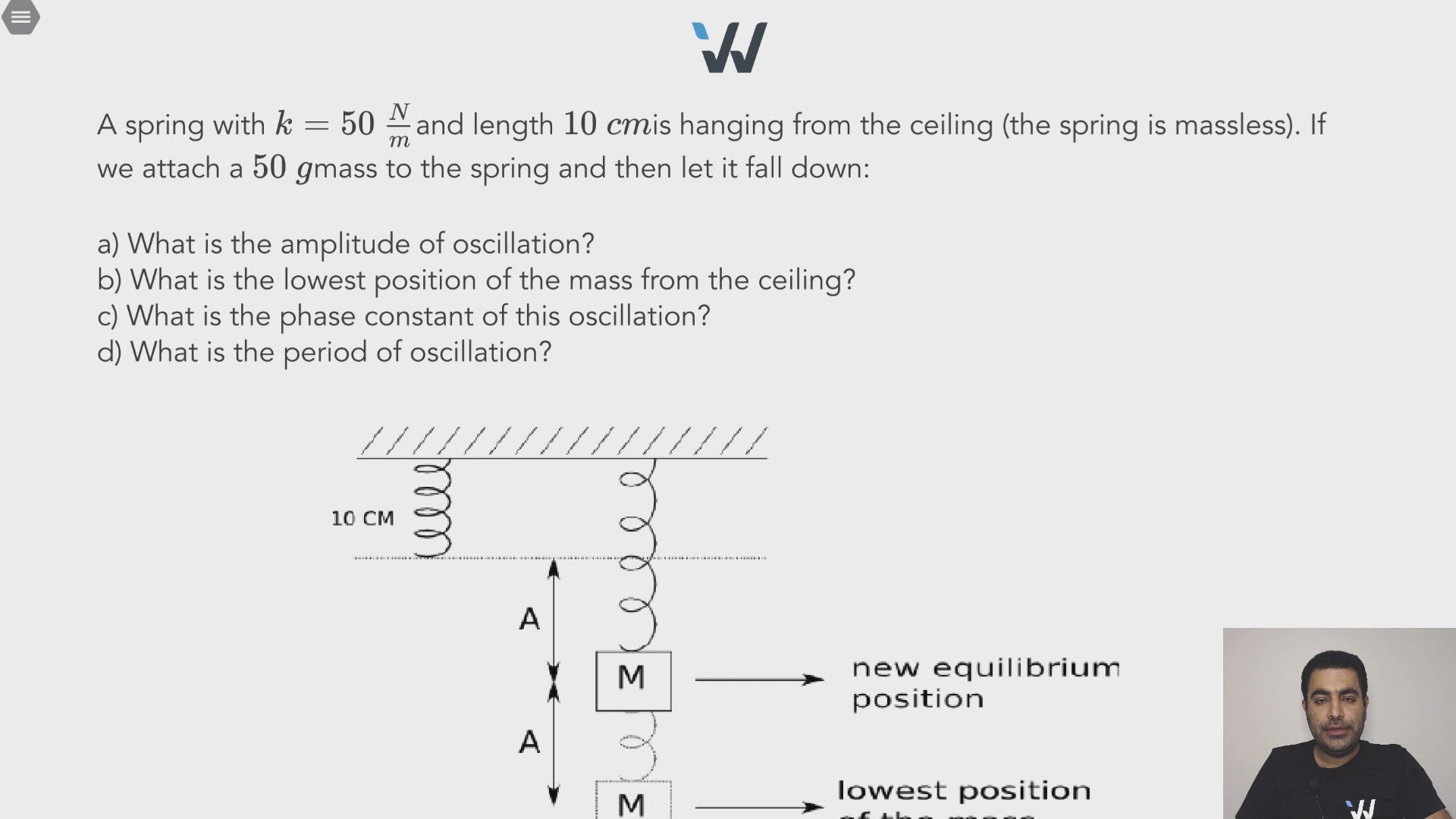
0:00 / 0:00
Example: Oscillating Vertical Spring
A spring with and length ofis hanging from the ceiling (the spring is massless). If we attach a mass to the spring and then let it fall down:
a) What is the amplitude of oscillation?
b) What is the lowest position of the mass from the ceiling?
c) What is the phase constant of this oscillation?
d) What is the period of oscillation?
Solution:

Part a)
As shown in the picture, since the mass is released when it is attached, the initial position is the highest position of oscillation. So, mass starts at the amplitude respect to the new equilibrium position which is found by:
Part b)
Lowest position of the mass from the ceiling is equal to natural length of the spring plus twice the amplitude of oscillation:
Part c)
Let's focus on the initial condition and consider upward direction to be positive.
at :
Part d)
The springs , and have the same initial length. If .Different masses are added to them and they have extended to their new equilibrium position.
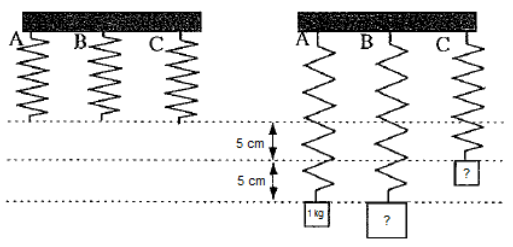
Find the values of , respectively. (Use .The answers are in kg)
A mass of 200gr is attached to a free vertical spring with k=5 N/m and natural length of 20cm and is set to oscillate with an initial downward velocity of 2m/s at the moment of attachment. Find the amplitude of this oscillation.