Popular Courses
MCAT
General Course
Intro to Physics
University Study Guides
PHYSICS 1D03
McMaster University
AP Physics C: Mechanics Exam Prep Course
AP Exam Prep
Physics
General Course
PHYS 157
University of British Columbia
PHYS 101
McGill University
PHYS 131
University of British Columbia
PHYS 204
Concordia University
PHYS*1300
University of Guelph
Intro to Physics
University Study Guides
PHYS*1080
University of Guelph
PHYS 131
McGill University
APSC 112
Queen's University
PHYSICS 1402A/B
Western University
LE/PHYS 1800 3.00
York University
PHYS-1400
University of Windsor
PHY131H1
University of Toronto
PHYS 142
McGill University
PHYS 117
University of British Columbia

0:00 / 0:00
Simple Pendulums
Simple pendulums are pendulums for which the mass attached to the string is considered as a point. The motion of these pendulums could be described as a simple harmonic motion. We usually focus on the condition in which the angle pendulum makes respect to the vertical line is very small.

Let's look at a schematic diagram of a pendulum to understand it better:

Wize Tip
Note that the mass moves on part of a circular path when pendulum is oscillating. The only force along this motion is the component of gravitational force.
The driving force acting on the mass is and since it is restoring (Always pushes the mass toward equilibrium which is the lowest point), we have:
For small: . So:
The distance travelled by the mass is the arc length corresponding to angle :
where in the length of pendulum.
By comparing with the general form of SHM forces () :
This is called the “effective spring constant” of a simple pendulum.
So, it is a Simple Harmonic Motion and its angular frequency is:
Watch Out!
Note that the equations found above for sprig constant and angular frequency are only valid when angleis very small!
0:00 / 0:00
Example: Simple Pendulum Length
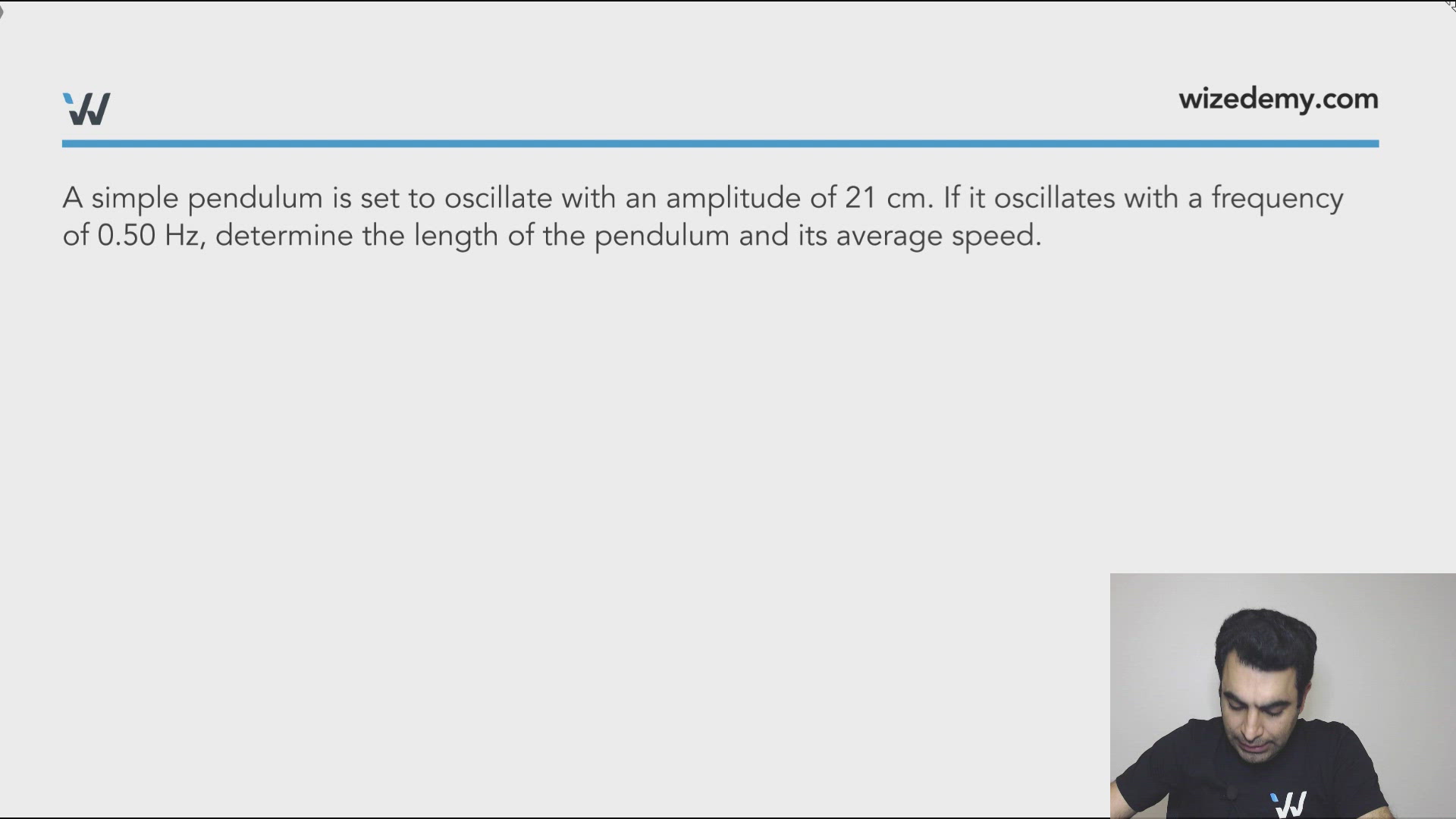
A simple pendulum is set to oscillate with an amplitude of 21 cm. If it oscillates with a frequency of 0.50 Hz, determine the length of the pendulum and its average speed.
Solution:
We can find the length of the pendulum by remembering the equation for the angular frequency of a simple pendulum:
To find the average speed, we need to find the distance travelled in one cycle of oscillation and divide it by the time of one cycle of oscillation which is basically the period:
You pull a simple pendulum to the side and release the mass at an angle of .
If the length of the pendulum is 25 cm, how much time does it take the mass to reach its highest speed? (in s)