Popular Courses
COMM 214
Concordia University
COMM 214
Concordia University
STAT 151
University of Alberta
AP Statistics Exam Prep Course
AP Exam Prep
Statistics
General Course
Intro to Statistics
University Study Guides
COMM 215
Concordia University
STAT 213
University of Calgary
COMM 191
University of British Columbia
DATASCI 1000A/B
Western University
STA 100
University of California - Davis
Grade 12 Data Management
Ontario High School
High School Statistics
US High School
STATS 2244A/B
Western University
STAT 200
University of British Columbia
Intro to Statistics
University Study Guides
STATS 2035
Western University
STATS 2035
Western University
STAT 161
University of Alberta
QMS 210
Toronto Metropolitan University
0:00 / 0:00
Scatterplots

A scatterplot is a mathematical diagram that illustrates any relationship between two quantitative variables, and , for a set of data, where the plots are a bunch of coordinates.
- The quantitative variable that we are predicting is called the response variable, referred to as Y.
- Y is also known as the dependent variable.
- The quantitative variable that we are basing our predictions on is called the explanatory variable or predictor variable, referred to as X.
- X is also known as the independent variable.
Examples
- The number of transaction made at a store (X) explains the revenue generated (Y).
- The depth of a bathtub (X) determines how much water it could contain (Y).
- The number of hours spent at swim practice (X) predicts the time it takes to finish a lap (Y).
A scatterplot can show:
- A positive (+) association,
- A negative (−) association, or
- No association
Example
Suppose we want to see if there is a relationship between how many hours a student studies the day before the exam and their exam grade. We randomly sampled 8 students:
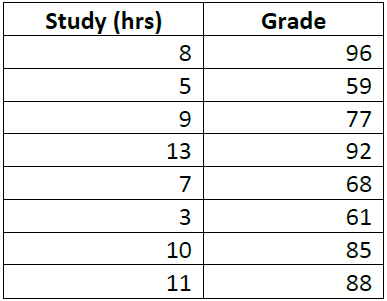
- Hours studied is the explanatory variable (X)
- Grade is the response variable (Y)
Given the bunch of data (X,Y) above, we can generate a scatterplot:
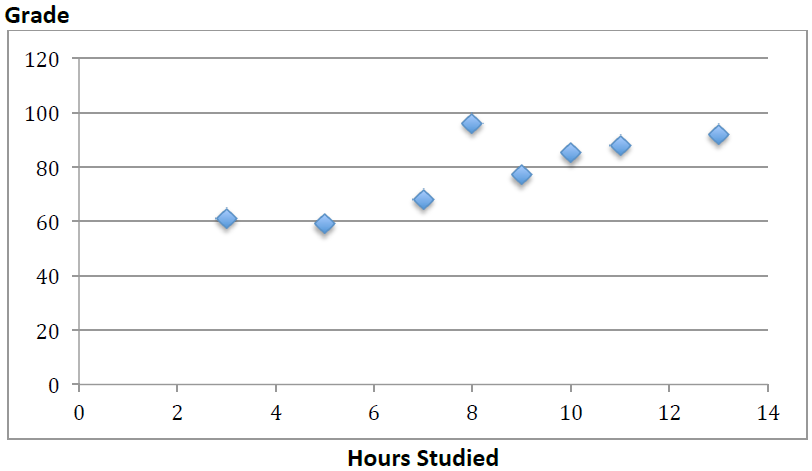
Important observations
- The response variable (Y) is on the Y-axis; the explanatory (X) is on the X-axis.
- This is always the case, unless it is not obviously apparent (e.g. # incoming calls vs. # outgoing calls) in which case they can go in any axis.
- The variables must be quantitative; we cannot make scatterplots based on categorical variables.
- Each person is represented by a single data point in the scatterplot with an coordinate.
- The mean-mean point is always in the center of the cloud of data points.
- In this example,
Practice: Scatterplots
This question has two parts.
(i) Which of the following may be shown as a scatterplot?