Wize University Statistics Textbook > Collecting Data & Sampling
Statistical Sampling
Popular Courses
COMM 214
Concordia University
STAT 151
University of Alberta
AP Statistics Exam Prep Course
AP Exam Prep
Statistics
General Course
Intro to Statistics
University Study Guides
COMM 215
Concordia University
STAT 213
University of Calgary
COMM 191
University of British Columbia
DATASCI 1000A/B
Western University
STA 100
University of California - Davis
Grade 12 Data Management
Ontario High School
High School Statistics
US High School
STATS 2244A/B
Western University
STAT 200
University of British Columbia
Intro to Statistics
University Study Guides
STATS 2035
Western University
STAT 161
University of Alberta
QMS 210
Toronto Metropolitan University
STAT 263
Queen's University
STAT*2040
University of Guelph

0:00 / 0:00
Statistical Sampling
Statistical sampling involves drawing members from a population to form a sample. Depending on how you draw your members, benefits and drawback may apply.
There are several methods of sampling:
- Convenience sampling
- Simple random sampling
- Systematic sampling
- Stratified sampling
- Cluster sampling
- Multi-stage cluster sampling

0:00 / 0:00
Convenience Sampling
Convenience sampling entails selecting easy-to-obtain members from the population.
Example
I choose my friends to sample because they are conveniently accessible and happen to be where I am. I do not consider selecting members in other areas.
Benefits
- Easy, fast, inexpensive, and members are readily available
Drawbacks
- Convenience samples are basically useless in statistics as they may not be representative of the population that it was drawn from--there is bias.
0:00 / 0:00
Simple Random Sampling

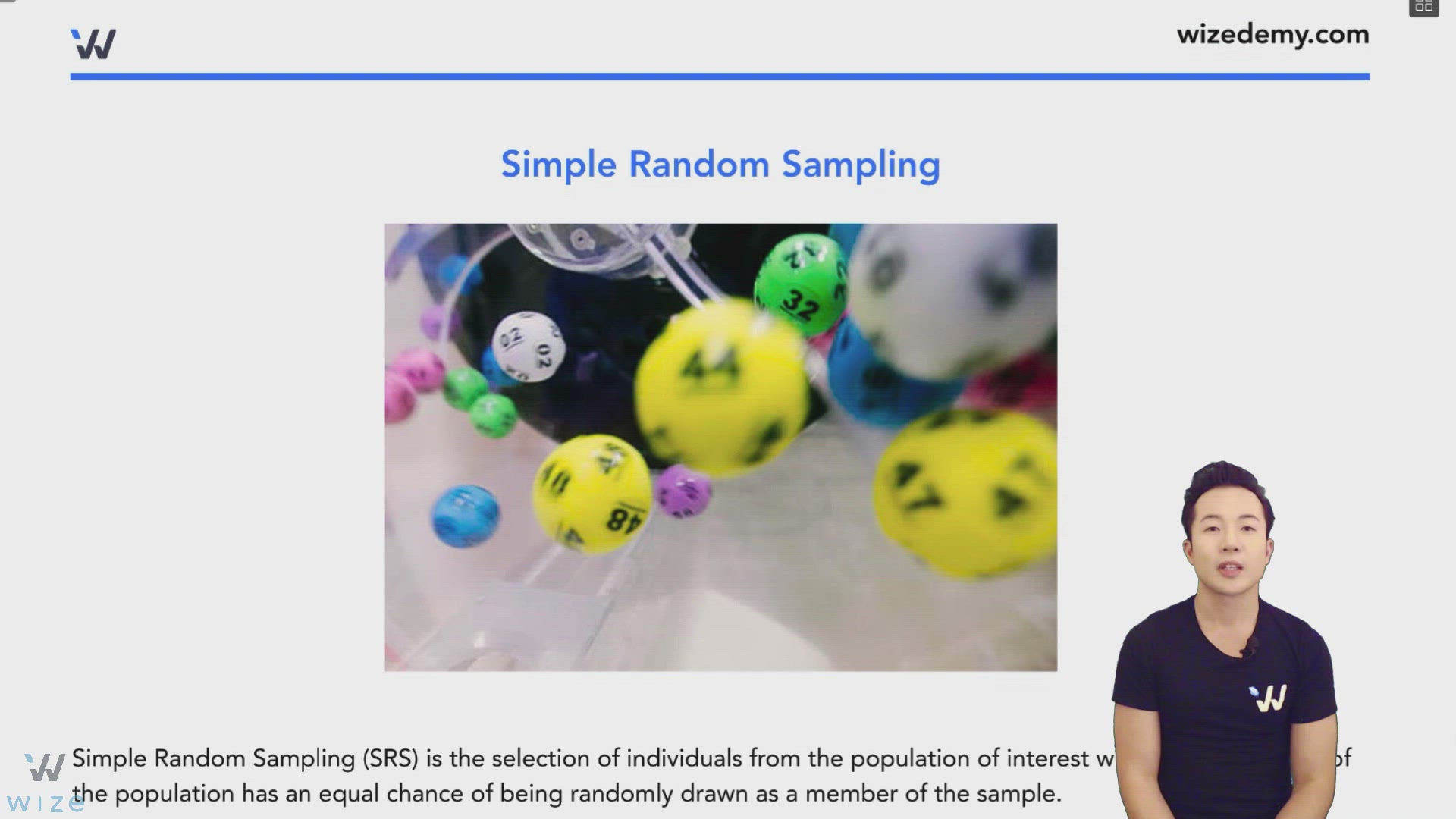
Simple Random Sampling (SRS) is the selection of individuals from the population of interest where each member of the population has an equal chance of being randomly drawn as a member of the sample.
Benefits
- Less complicated than other good sampling methods.
- In most cases, sampling bias is avoided if sample is drawn properly.
Drawback
- The sample may not be good if you don't have full access to a large population to draw from (i.e. limited sampling frame)
0:00 / 0:00
Systematic Sampling
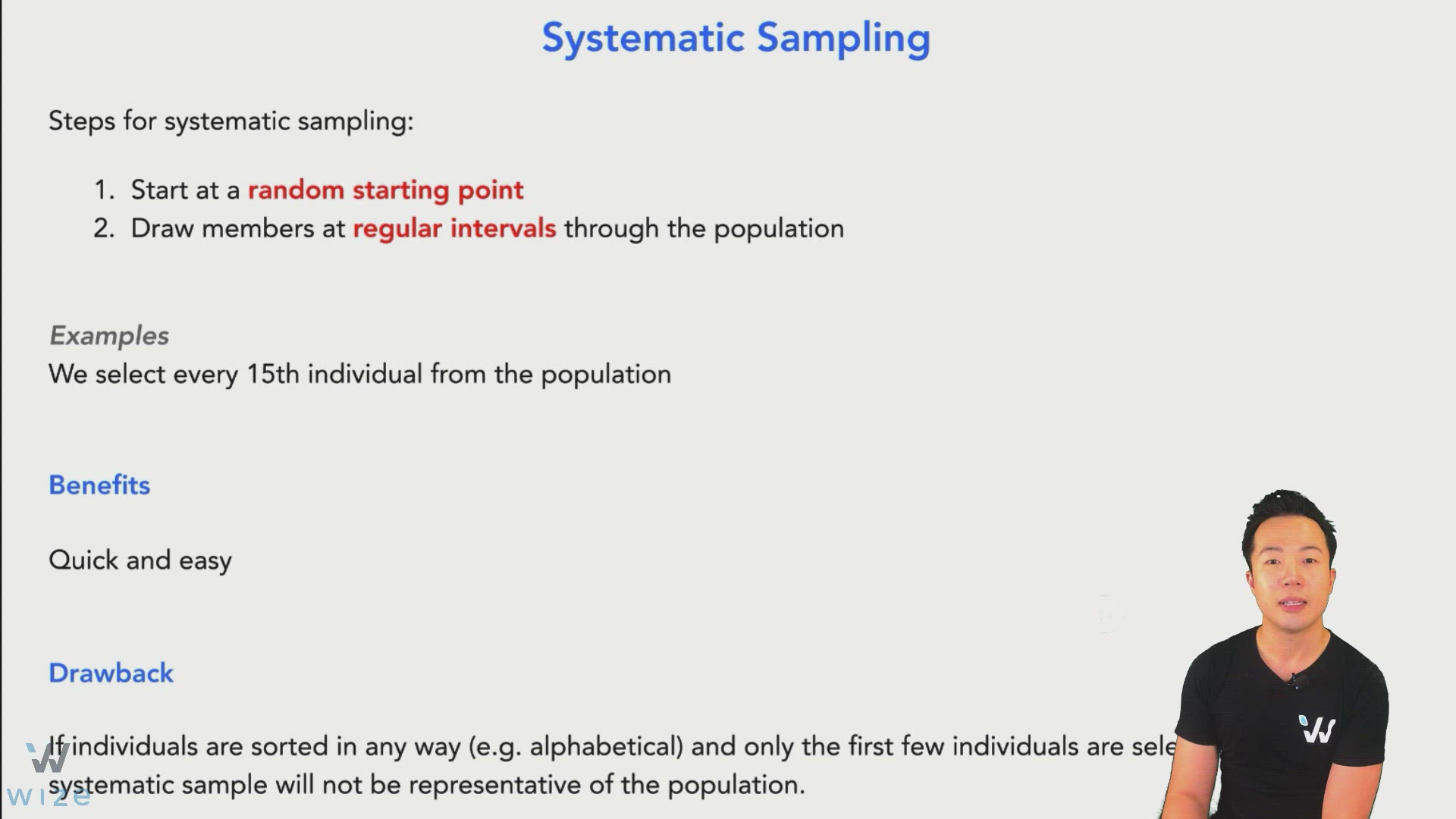
Steps for systematic sampling:
- Start at a random starting point
- Draw members at regular intervals through the population
Examples
We select every 15th individual from the population
Benefits
- Quick and easy
Drawback
- If individuals are sorted in any way (e.g. alphabetical) and only the first few individuals are selected, then this systematic sample will not be representative of the population.

0:00 / 0:00
Stratified Sampling vs. Cluster Sampling
Stratified Sampling

Steps for stratified sampling:
- Divide the population into homogenous, non-overlapping subgroups (i.e. strata) based on their characteristics
- Randomly select members from each stratum.
Example
The student population at UBC are stratified by their year of study (i.e. first-year, second-year, etc.)
Benefits
- This reduces sampling variability and provides a better picture of the population.
- We have control of ratios of strata. This is called proportional allocation.
Drawback
- Could be expensive and time-consuming
Cluster Sampling

Steps for cluster sampling:
- Divide the population into clusters of evident subgroups (e.g. geographical locations) that the population contains
- Randomly select a few clusters.
All members of the selected clusters are surveyed!
Benefits
- Usually cheap, quick, and easy.
- You can also get a larger sample size than if you do a SRS.
Drawbacks
- Not very representative of the population since you are drawing from clusters where members in them have similar characteristics.
- Also, there can be a high sampling error, especially when some clusters are not accessible, leaving a large proportion of the population unrepresented.
- The sample will only be unbiased if each cluster is rather representative.
0:00 / 0:00
Two-Stage Cluster Sampling

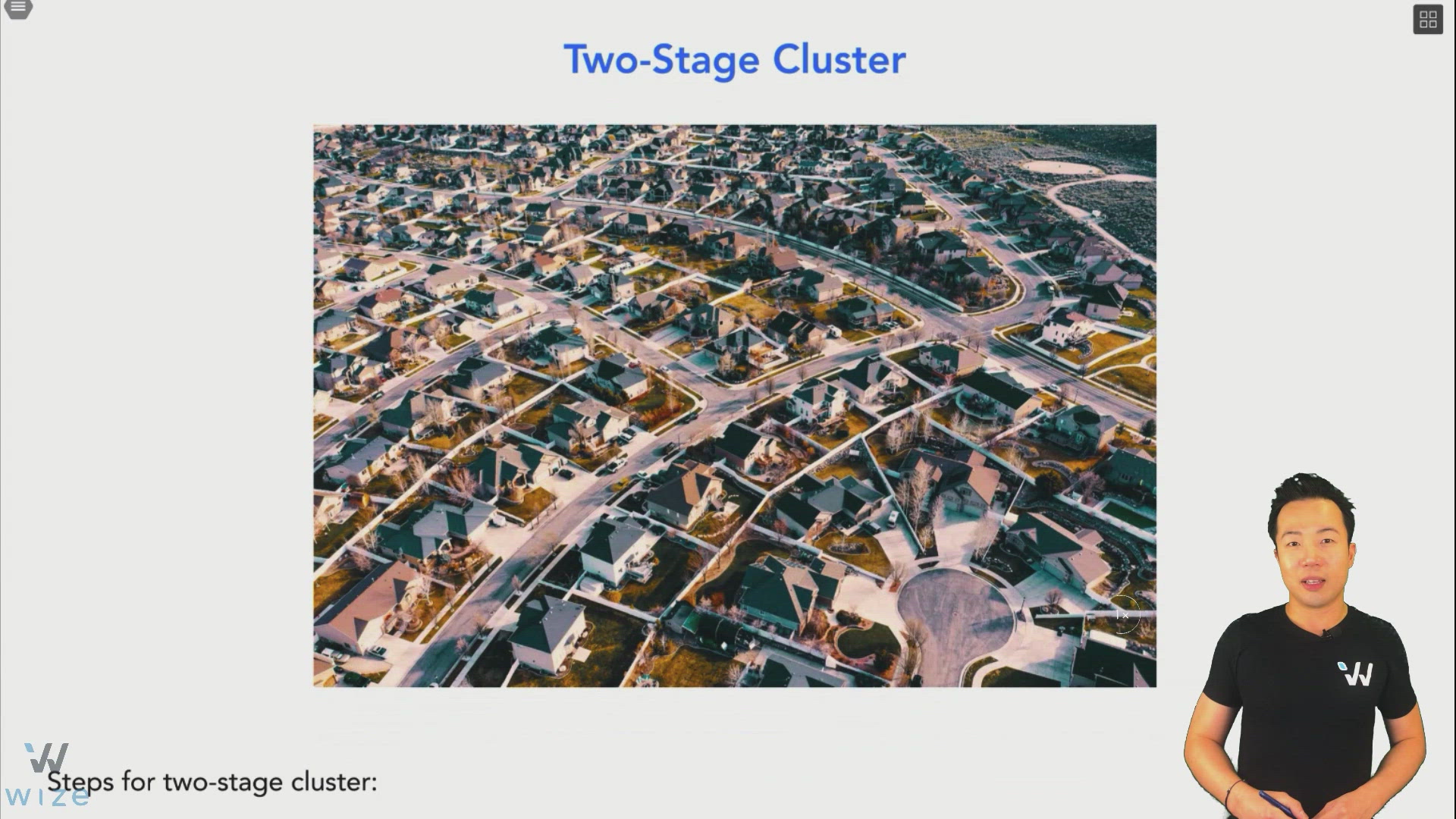
Steps for two-stage cluster
- Divide the population into clusters of evident groups that the population contains
- Randomly select a few of those clusters.
- Instead of including all members from each cluster in the sample, you perform SRS (or Systemic Sampling) on each of the selected clusters to draw members, and only those members get surveyed.
Benefits
- More accurate and more random than cluster sampling with the same sample size.
Drawback
- Difficult or tedious to do.
Practice: Stratified vs. Cluster
When compared to stratified random sampling, cluster sampling is
Practice: Sampling
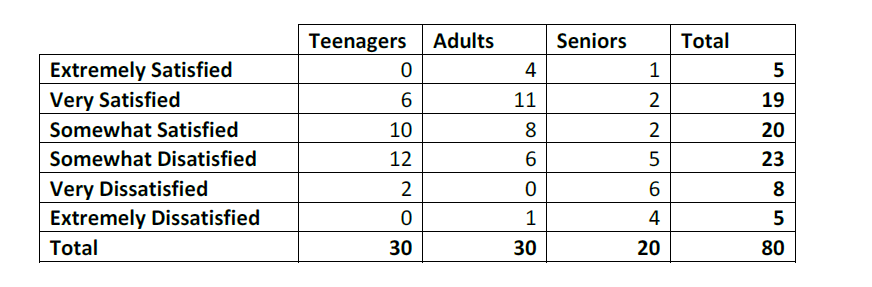
A survey was conducted with random samples in three groups in Portland: 30 teenagers, 30 adults, and 20 seniors. We asked them how satisfied they are with their qualify of life. What type of sampling was done?
Practice: Two-Stage Cluster
The population of interest is "all cars on campus". Which of the following is an example of a two-stage cluster sampling?