Wize University Statistics Textbook > Collecting Data & Sampling
Introduction to Statistics
Popular Courses
COMM 214
Concordia University
STAT 151
University of Alberta
AP Statistics Exam Prep Course
AP Exam Prep
Statistics
General Course
Intro to Statistics
University Study Guides
COMM 215
Concordia University
STAT 213
University of Calgary
COMM 191
University of British Columbia
DATASCI 1000A/B
Western University
STA 100
University of California - Davis
Grade 12 Data Management
Ontario High School
High School Statistics
US High School
STATS 2244A/B
Western University
STAT 200
University of British Columbia
Intro to Statistics
University Study Guides
STATS 2035
Western University
STAT 161
University of Alberta
QMS 210
Toronto Metropolitan University
STAT 263
Queen's University
STAT*2040
University of Guelph

0:00 / 0:00
Introduction to Statistics

Statistics is the science of collecting, presenting, analyzing, and interpreting data.

A sample is a portion of the population that it is drawn from. The data in a sample is used to describe or infer about a population.
Two Branches of Statistics
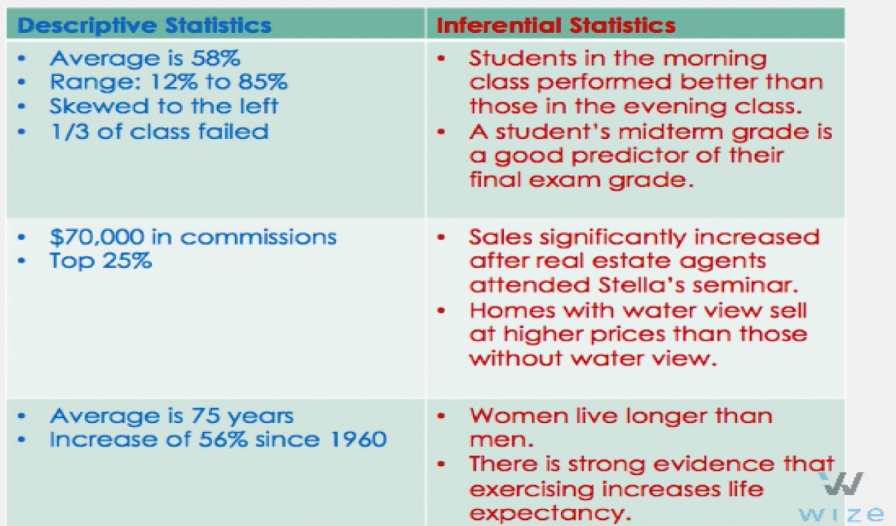
- Descriptive Statistics
- A summary of your data.
- Refers to describing numbers in the data you collected in various ways such as displaying data using charts and graphs.
- Merely describing.
- Examples
- The midterm grade average is 58%, ranging from 12% to 85%.
- The distribution of grades is skewed to the left, and one-third of the class failed.
- Seth made $70,000 in commissions selling condos, putting him in the top 25% percentile amongst his colleagues.
- The average life expectancy is 75 years, an increase of more than 56% since 1960.
- Inferential Statistics
- Making estimations and drawing conclusions after analyzing your data.
- Refers to using the data in the sample to make general conclusions about the population.
- More interesting but more challenging than describing data.
- Examples
- Students in the morning class performed better than those in the evening class.
- A student's midterm grade is a good predictor of their final exam grade.
- Sales significantly increased after real estate agents attended Stella's seminar.
- Homes with waterview sell at higher prices than homes without waterview.
- Women live longer than men, on average.
- There is strong evidence that exercise increases life expectancy.
0:00 / 0:00
Sample vs. Population
What is the Point of Statistics?
- To try to describe the real world.
- This may not be easy to do when the population of interest is large.
- We draw conclusions about the population using statistics.
In most cases, we do not need to survey every single individual in the population.
- Usually impossible
- Costly
- Time-consuming
- Overkill and unnecessary
Drawing a Sample From the Population
- Drawing a large enough sample that is representative of the population is usually sufficient.
- The statistics in a sample is used to describe or infer about the parameter of a population.
A population is defined as all people or items with a certain characteristic that one wishes to understand.
- Measurable characteristics of a population are called parameters
A sample consists only of observations drawn directly from the population.
- Measurable characteristics of a sample are called statistics
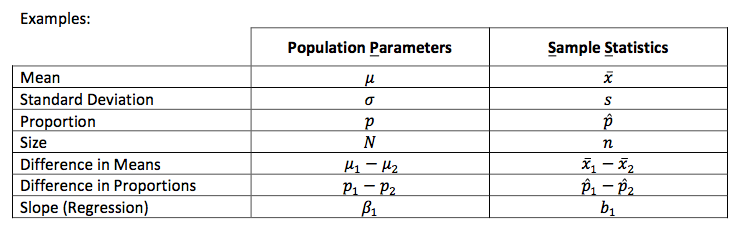
Wize Tip
Population parameters usually Greek letters (i.e. )
Sample statistics usually lowercase English letters (i.e. )
Sampling Frame
A sampling frame is the available or accessible source of data from which the sample is drawn from.
Examples
Census, human resources database, street map, telephone directory, etc.
A census is data collected about every individual in the entire population of interest.
Practice: Sample vs. Population
We want to determine the average salary of assistant professors at UCLA. Based on a random sample of 100 from the HRMS database of all assistant professors, the mean salary is $100,000.
(i) What is the population?
0:00 / 0:00
Measurement Scales
Measurement scales are used to quantify or categorize variables.
- Quantitative variables can take on different numerical values.
- Categorical variables can take on different qualities or characteristics.
Wize Tip
What types of charts and graphs to use depends on whether your are displaying quantitative variables or categorical variables.
There are four common levels of data measurement:
Nominal
- Categorical or numerical values
- Simply used to classify or identify
- You can’t rank or put them in any order.
- You can’t do any math (+,−,×,÷) with it!
- Examples
- religion, occupation, ethnicity, brand, dog breed
More Examples
- Binary data
- Unit can only take on only two possible states
- Examples
- 0/1, yes/no, pass/fail, win/lose
- Identifier (or String)
- unique string of numbers and/or letters representing that name of the variable
- Examples
- zip code, jersey number, student number
Ordinal
- Categorical or numerical values
- Simply used to classify or identify
- You can rank or put them in order.
- You can’t do math (+,−,×,÷) with it!
- Examples
- level of education (BA < MA < PhD)
- level of pain (mild < moderate < severe)
- Olympic medals (bronze < silver < gold)
- dress size (S < M < L < XL)
Interval
- Always quantitative
- You can rank or put them in order.
- Distances between consecutive intervals are equal.
- You can do some math (+,−) with it! Can’t (×,÷).
- The value “0” has little meaning.
- Examples
- temperature (), IQ
Ratio
- Always quantitative
- Numbers go from lowest to highest.
- Distances between consecutive intervals are equal.
- You can do all math (+,−,×,÷) with it!
- The value “0” has significant meaning (i.e. absolute zero)
- Examples
- age, height, weight, income
Summary
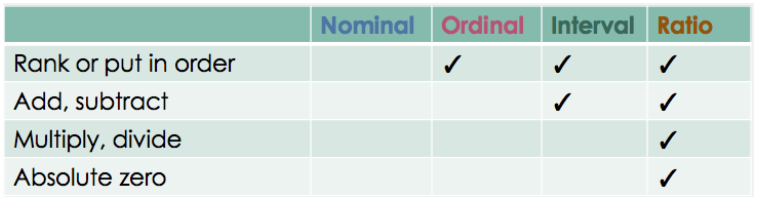
Practice: Types of Variables
Classify each of the following variables as nominal, ordinal, interval, or ratio.
1) Height of a student