Wize University Statistics Textbook > Experiments and Observational Studies
Experimental and Observational Studies
Popular Courses
STAT 151
University of Alberta
AP Statistics Exam Prep Course
AP Exam Prep
Statistics
General Course
Intro to Statistics
University Study Guides
DATASCI 1000A/B
Western University
STA 100
University of California - Davis
Grade 12 Data Management
Ontario High School
High School Statistics
US High School
STATS 2244A/B
Western University
STAT 200
University of British Columbia
Intro to Statistics
University Study Guides
STAT 161
University of Alberta
STAT 263
Queen's University
STAT*2040
University of Guelph
MGCR 271
McGill University
STAT 251
University of British Columbia
STATS 2B03
McMaster University
MGTSC 212
University of Alberta
STAT 1060
Dalhousie University
Grade 12 Statistics
Canada High School

0:00 / 0:00
Observational Studies
An observational study is a study where researchers collect data based on what is seen/heard and conclusions are made based on the data collected. The researchers do not attempt to influence the responses.
Lurking and Confounding Variables
- A lurking variable is a variable not included in the study, but affects the relationship between those studies
- A confounding variable is a variable included in the study, but we just cannot distinguish its effects on the response variable from either variables.
- i.e. the effect of a factor of interest is mingled with that of another factor.
Example
People on high fat diet don't exercise and have excess weight.
- "High fat diet" and "no exercise" are confounded. We don't know which one causes excess weight
- A lurking variable here could be lack of education. People not well educated might not know how to take care of their weight and hence eat wrong foods and not exercise, leading to excess weight.
Watch Out!
Observational studies fail when the explanatory variable is confounded with lurking variables.
Experiments that are properly designed and conducted take step to prevent confounding.

0:00 / 0:00
Experimental Studies
An experiment is a method of applying treatments to a certain group and recording the effects. A treatment a specific experimental condition that is applied to the subjects.
Notes
- The individuals being studied in an experiment are called subjects.
- The explanatory variables in an experiment are known as factors.
- The values taken on by the factors are called levels.
- When an experiment has more than one factor, a treatment is a combination of specific values of each factor.
- The measured response to the treatment is the response variable.
Wize Tip
If there are multiple factors, then the treatment will be a combination of levels.
If there is only one factor, then the levels become the treatments.
Wize Tip
There's only one response variable that's measured at a time but there could be multiple factors.
0:00 / 0:00
Example: Experiments
An experiment is conducted on see how consumers rate spot prawns based on its freshness and how it is prepared. The spot prawns could be fresh, kept on ice, or have been previously frozen. They could be prepared raw or cooked. There are 120 consumers in the experiment. They rate the spot prawn from 0 (yuck) to 10 (yum).
What/who are the Subjects?
120 consumers
What are the Factors?
There are 2 factors:
- Factor A: Level of freshness (3 levels)
- Level 1: Fresh
- Level 2: Kept on ice
- Level 3: Previously frozen
- Factor B: How spot prawns are prepared (2 levels)
- Level 1: Raw
- Level 2: Cooked
What is the Response variable?
Consumer rating (0 to 10)
How many treatments are there?
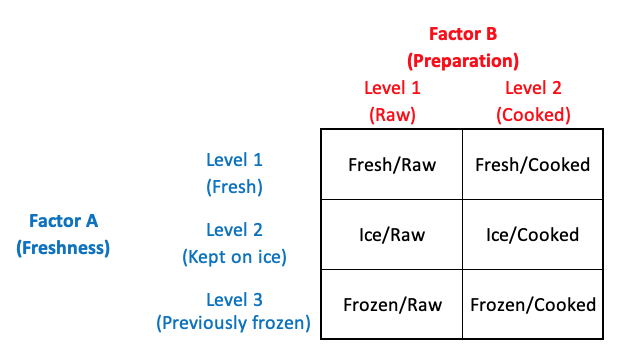
- This experiment has 2 factors; one with 2 levels and the other with 3 levels.
- Thus, there are 6 combination and therefore 6 treatments.
In this experiment, we can assess the effect of multiple factors on the response variable.
Wize Tip
If there are multiple factors, then the treatment will be a combination of levels.
If there is only one factor, then the levels become the treatments.
If there is only one factor, then the levels become the treatments.
Example
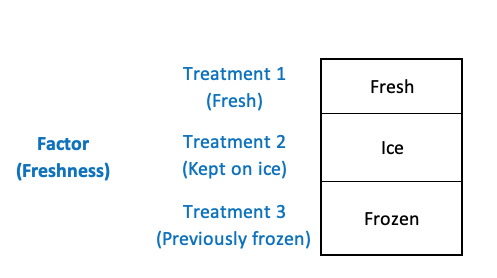
Suppose there is only one way to prepare the spot prawns.
- Only one factor: freshness. Its levels are simply the treatments now.
- There are no combinations so there are simply 3 treatments.
Practice: Experiment
A farmer wants to see the effect on the size of tomatoes based on the type of fertilization (natural and synthetic) and amount of fertilization (low, medium, and high). Three hundred tomato seeds were randomly assigned to different types of fertilization and amounts.
How many types of factors are there in this experiment?