Wize University Statistics Textbook > Experiments and Observational Studies
Types of Experimental Designs
Popular Courses
STAT 151
University of Alberta
AP Statistics Exam Prep Course
AP Exam Prep
Statistics
General Course
Intro to Statistics
University Study Guides
DATASCI 1000A/B
Western University
STA 100
University of California - Davis
High School Statistics
US High School
STATS 2244A/B
Western University
STAT 200
University of British Columbia
Intro to Statistics
University Study Guides
STATS 2035
Western University
STAT 161
University of Alberta
STAT*2040
University of Guelph
MGCR 271
McGill University
STAT 251
University of British Columbia
STATS 2B03
McMaster University
MGTSC 212
University of Alberta
STAT 1060
Dalhousie University
STA220H1
University of Toronto
MATH 203
McGill University

0:00 / 0:00
Types of Experimental Designs
Randomized Comparative Experiment
A randomized comparative experiment is where the subjects are randomly assigned to two or more treatment groups.
The response to a treatment is composed to that of
- another treatment or
- no treatment (a control) or
- a placebo (a dummy or fake treatment such as a sugar pill) or
- a combination of all of the above
Method for experiments
- The experimental units are divided into different groups according to the treatments that are to be tested
- Some groups receive the treatment and some do not
- The units are measured to see if there are differences between the treatments
Example
Students learn how to drive, either taught by a driving instructor (treatment 1) or being self-taught by watching YouTube videos (treatment 2).

Notes
- A response (to a treatment) so large that it would rarely occur by chance is called statistical significance.
- An experiment is single-blind when either the subjects or the researcher knows which treatment each subject gets.
- An experiment is double-blind when neither the subjects nor the researcher know which treatment each subject gets.
0:00 / 0:00
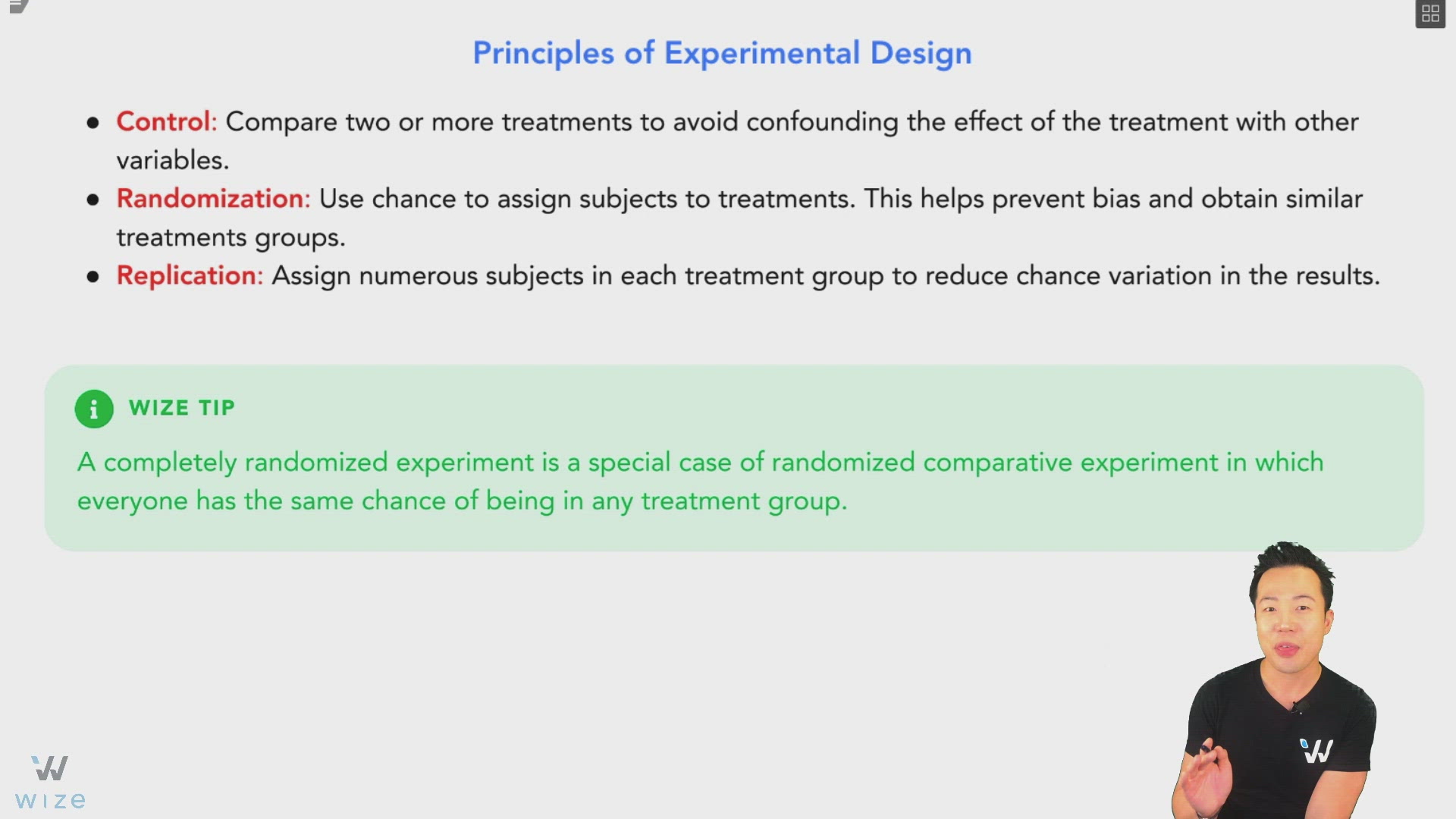
Principles of Experimental Design
Here are three principles of experimental design:
- Control: Compare two or more treatments to avoid confounding the effect of the treatment with other variables.
- Randomization: Use chance to assign subjects to treatments. This helps prevent bias and obtain similar treatments groups.
- Replication: Assign numerous subjects in each treatment group to reduce chance variation in the results.
Wize Tip
A completely randomized experiment is a special case of randomized comparative experiment in which everyone has the same chance of being in any treatment group.
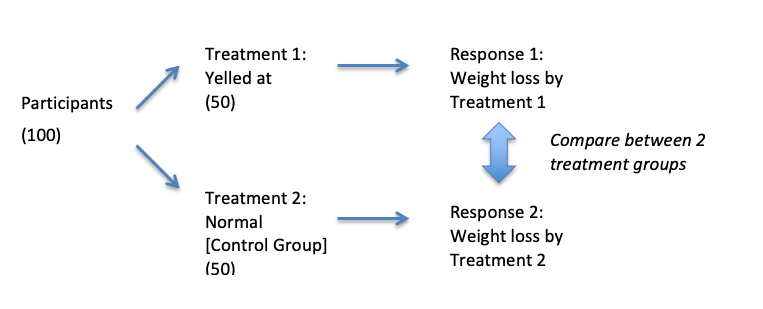
Completely Randomized Design
The experimental units are randomly assigned to groups, which are then randomly assigned to the treatments.
Example
Participants in spin classes either get an instructor that yells at them (treatment group) or an instructor that talks normally "standard" or "basic" treatment (control group).
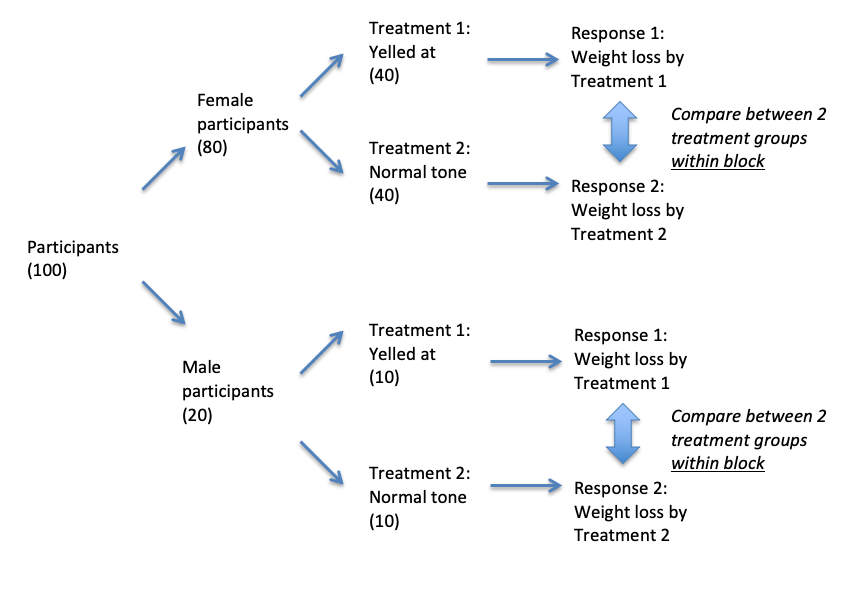
Randomized Block Design
- The experimental units are divided into blocks (groups of individuals that are similar in some way that the researcher believes may affect the outcome of the experiment).
- Examples:
- Male and females may respond differently to a treatment
- Near-sighted people may react differently to a treatment than far-sighted people.
- People prone to addiction should probably be in a separated group
- Then within each block the experimental units are randomly assigned to one of the treatments
Example
Blocking by gender:
Example: Types of Experimental Design
A lab wants to test out a new drug called EYE-C for improving eyesight. They randomly sampled 100 subjects with poor eyesight and randomly assigned them to two even groups. Each subject in Group 1 took the drug and each subject in Group 2 took a placebo. The subjects do not know which one they took; neither do the lab technicians.
(i) What type of experiment is this?
☐ Observational study
☐ Completely randomized design
☐ Randomized block design
Completely randomized design - subjects are randomly assigned to each group
(ii) What is true about this experiment? [Check all that applies]
☐ The control group is Group 1.
☐ This is a single-blind experiment.
☐ This is a double-blind experiment.
☐ The response variable is eyesight improvement.
This is a double-blind experiment - neither the subjects nor the researchers know who took the drug or placebo
The response variable is eyesight improvement. At the end of the experiment, the results are compared between the two groups
(iii) The technicians believe that younger people respond better to the drug. If this is true or highly plausible, how should we modify the experiment?
Make this a blocked experiment. Block by age group (e.g. young and old), then randomly assign to treatment groups within each age group.
Practice: Types of Experimental Designs
We randomly select 50 teenagers and split them according to their age (14, 15, 16, or 17) and their gender. We assign half of each of the subgroups to play hockey and the other half to not play any sports.
What type of study is this?
Example: Experimental Design
Dr. Friskas want to determine if cats that are fed a grain-free, organic diet are healthier than cats that are not. She acquired 50 newborn kittens and randomly separated them into two groups. One group of kittens is fed a grain-free, organic diet; the other group is not. She monitored the cats’ health over time and noticed a sufficiently large difference in overall health between the two groups. She concluded that a cat’s diet significantly impact its overall health.
Which of the following is most appropriate?